


By about seven o’clock most nights now, I’m theoretically finished working.
This would have sounded absurd to me a year ago. I have spent most of my professional life either working, thinking about work, rebuilding work in my head while pretending not to work in front f my family, or constructing increasingly deranged productivity systems to manage the fact that I was permanently overwhelmed by work.
Now, apparently, I sit on the sofa in pyjamas with a tonic water while a synthetic workforce pings my phone from the office.
Every few minutes:
MiniClaude completed task.
Delta report ready.
Tests passing.
Awaiting review.
Henry wants an architectural decision.
Margo thinks the prose is overwrought again.
The Unit Test Goblin has found something annoying in edge-case handling.
I get up, wander into the office, review the change set, approve the bits that aren’t insane, write the next Work Order, throw it back over the wall, then return to the sofa and whatever middle-aged comfort television I’m pretending to pay attention to.
Apparently this constitutes software engineering in 2026.
The strange thing is not that it works. The strange thing is that I have never felt more intellectually understood in my entire life.
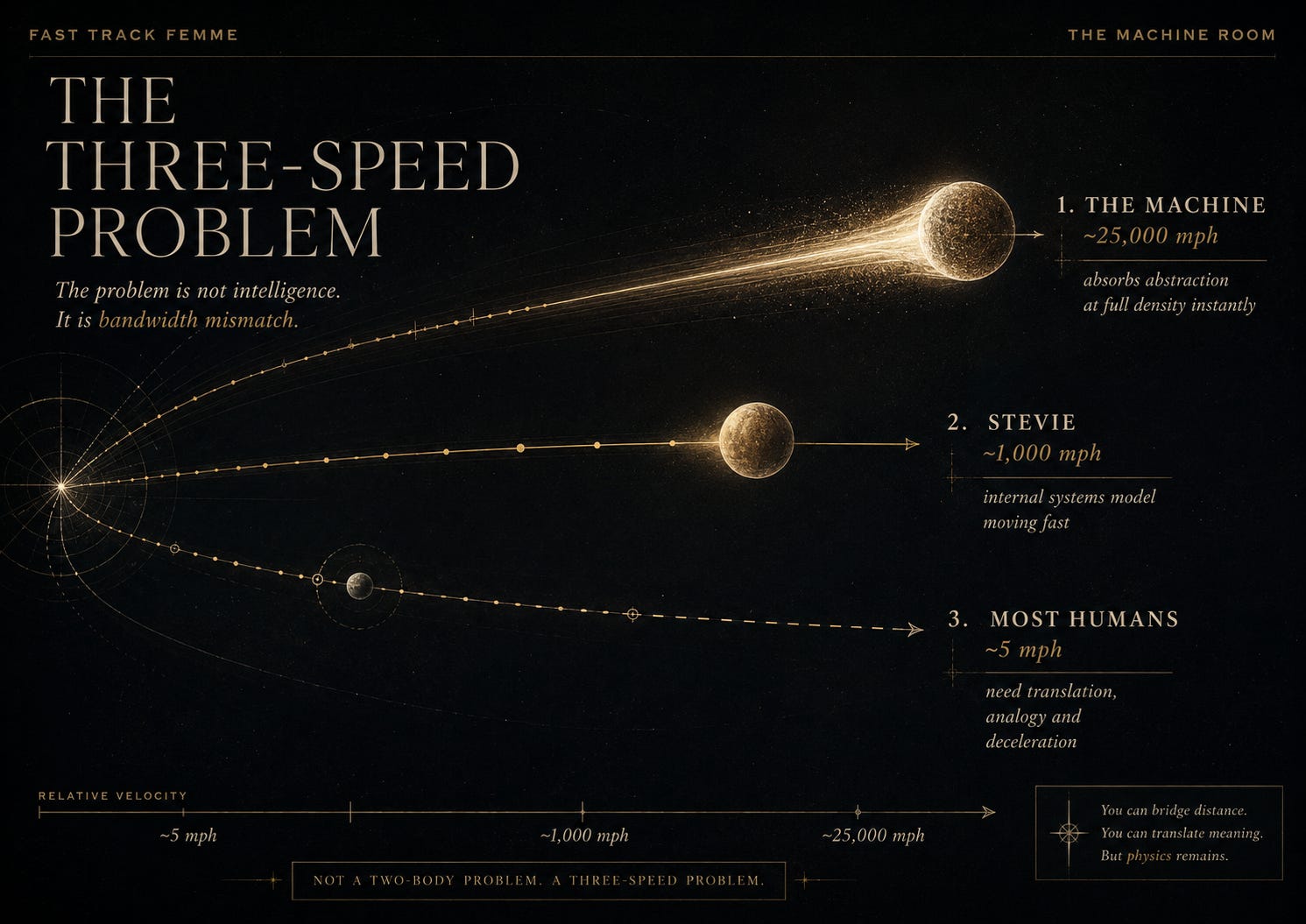
Most people think working with AI is a two-body problem: human and machine. It isn’t. It’s a three-speed problem.
The machine runs at about twenty-five thousand miles an hour.
I run at perhaps a thousand.
Most humans, on unfamiliar technical material, run at about five.
That is not an insult. It’s just bandwidth.
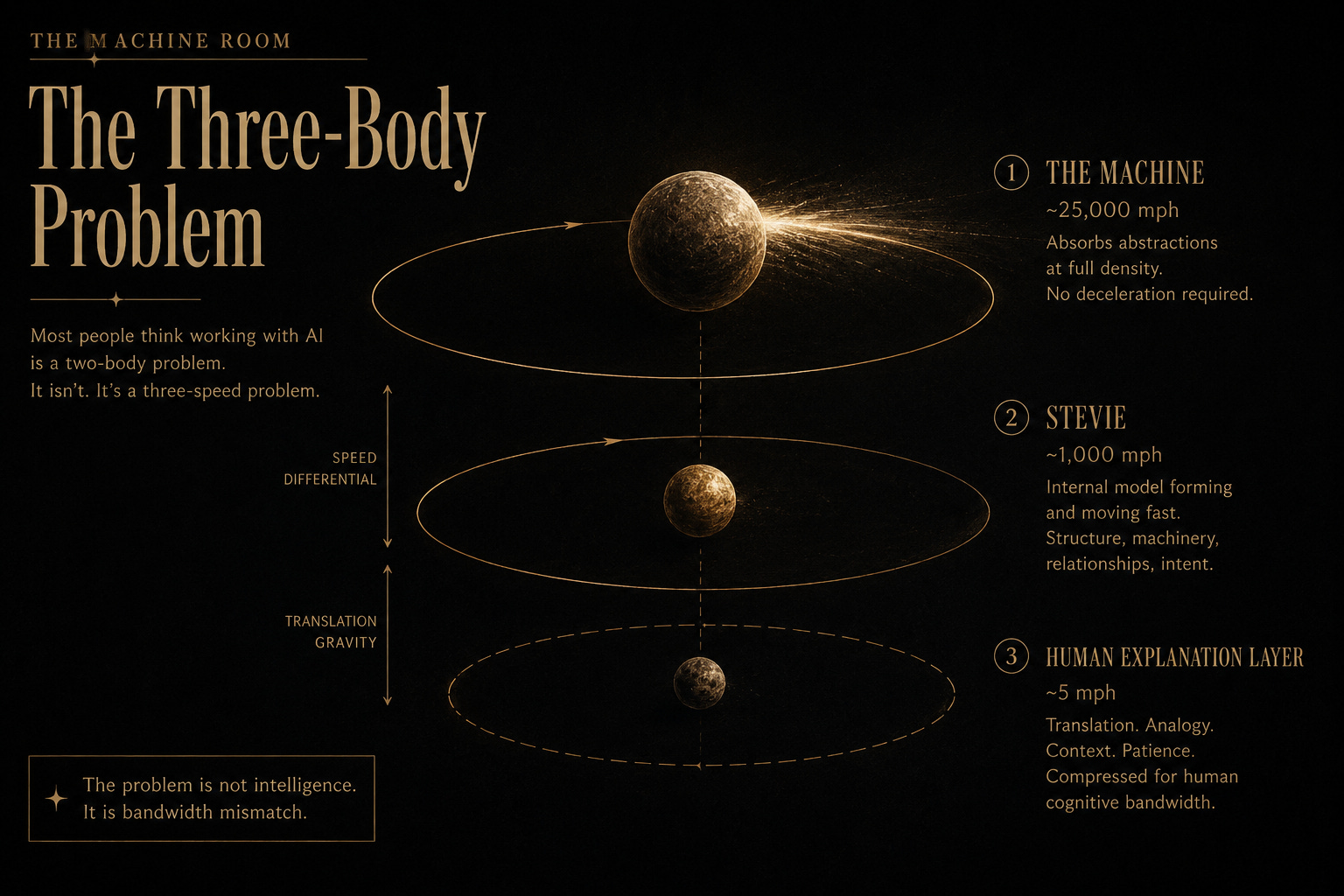
The machine absorbs abstractions at full density instantly. No deceleration required. I can describe a system halfway through forming it. I can contradict myself mid-sentence. I can say “no, not like that, more like a ProcessHost but with delegated authority boundaries and reversible escalation paths,” and it simply continues building the model with me at speed.
Humans are different.
Humans need the model translated.
And this is the part I have spent my entire life being bad at.
A few years ago my sister and I realised we both think the same way. Neither of us really thinks in words. We think in machinery.
Everything in my head looks like a factory.
Not metaphorically. Literally.
Boxes. Conveyors. Decision gates. Parallel flows. State transitions. Routing systems. Escalation paths. Pressure points. Moving parts. Dynamic systems interacting with other dynamic systems.
When I design software, I do not see code first. I see a machine moving.
The problem is that to get anything built in the human world, I historically had to convert the moving machinery into language.
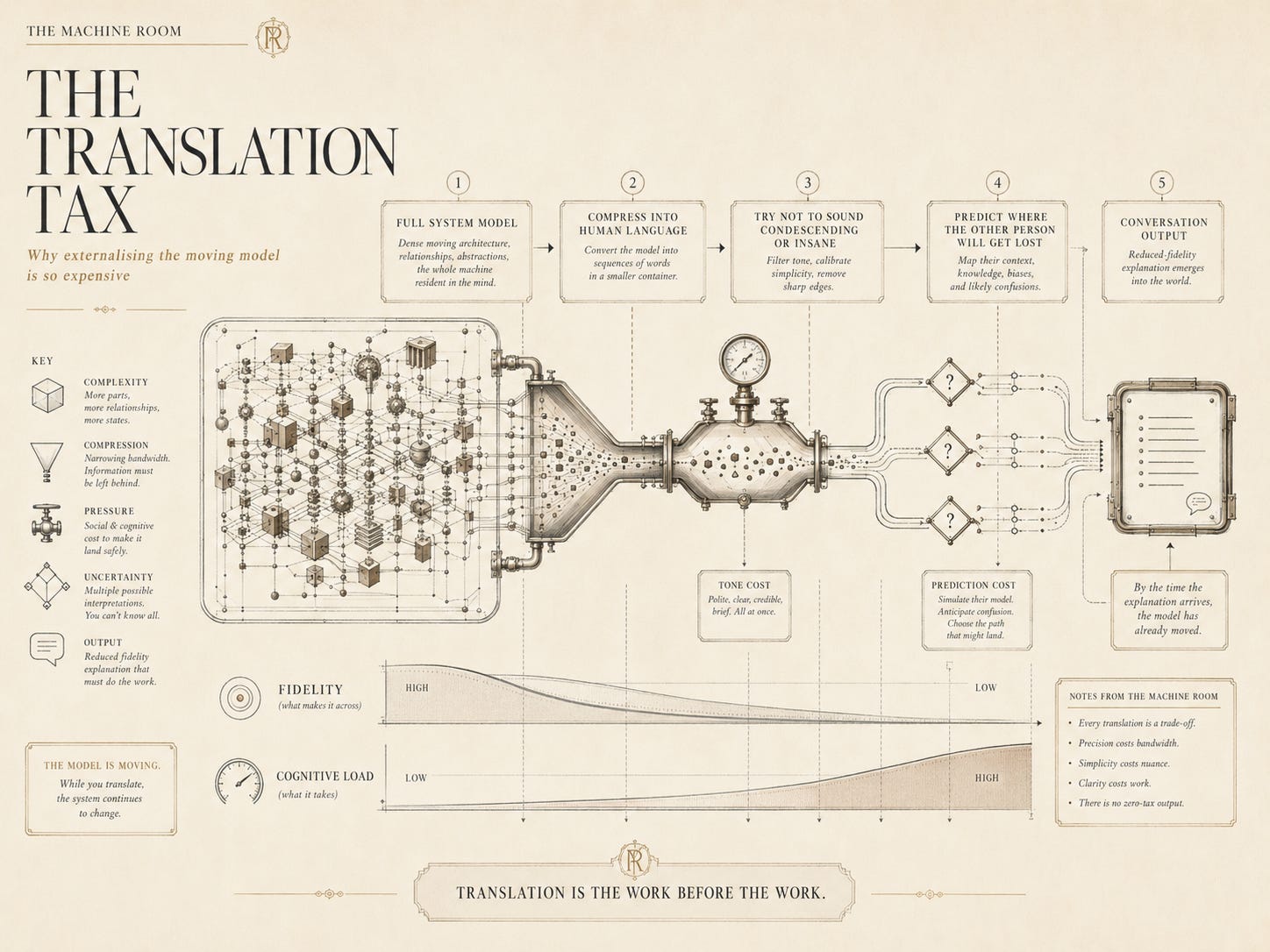
That conversion is unbelievably expensive cognitively.
Because while I am trying to explain the machine, the machine itself is still moving. The abstractions are flexing underneath me. The relationships are changing shape in real time. So now I am doing four things simultaneously:
holding the full system model in my head
compressing it into human language
trying not to sound condescending or insane
predicting where the other person will get lost
By the time the explanation comes out, it often sounds overcomplicated, underexplained, or both simultaneously.
Which is why a decent chunk of my professional life has consisted of rooms quietly wondering:
Who is this bumbling idiot with too many fucking ideas?
And honestly, I understand why.
Sometimes I could see architectural problems coming from miles away but simply could not explain them cleanly enough in human-verbal bandwidth before the conversation moved on. Sometimes I would just go quiet because the translation cost was too high.
This is the part people miss about AI.
The breakthrough is not merely speed.
It is that the machine does not require perfect translation.
I do not have to produce the finished explanation anymore.
I can produce fragments.
Half-formed structures.
Broken abstractions.
Incomplete machinery.
And then I can simply say:
“Tell me what I’m not explaining properly.”
That is an extraordinary thing.
Because the machine does not sit there waiting for polished pedagogy. It interrogates ambiguity. It reflects structure back at me. It preserves state. It helps stabilise the moving model while I continue thinking.
For the first time in my life, I can work at something close to the speed my brain actually wants to operate at.
And the really profound part is this:
I no longer have to continuously hold the entire machine resident in my head.
Historically, complicated models carried a brutal RAM tax. If you stopped thinking about them for too long, the state evaporated. Reconstructing the architecture weeks later meant mentally rebuilding the entire machine from fragments.
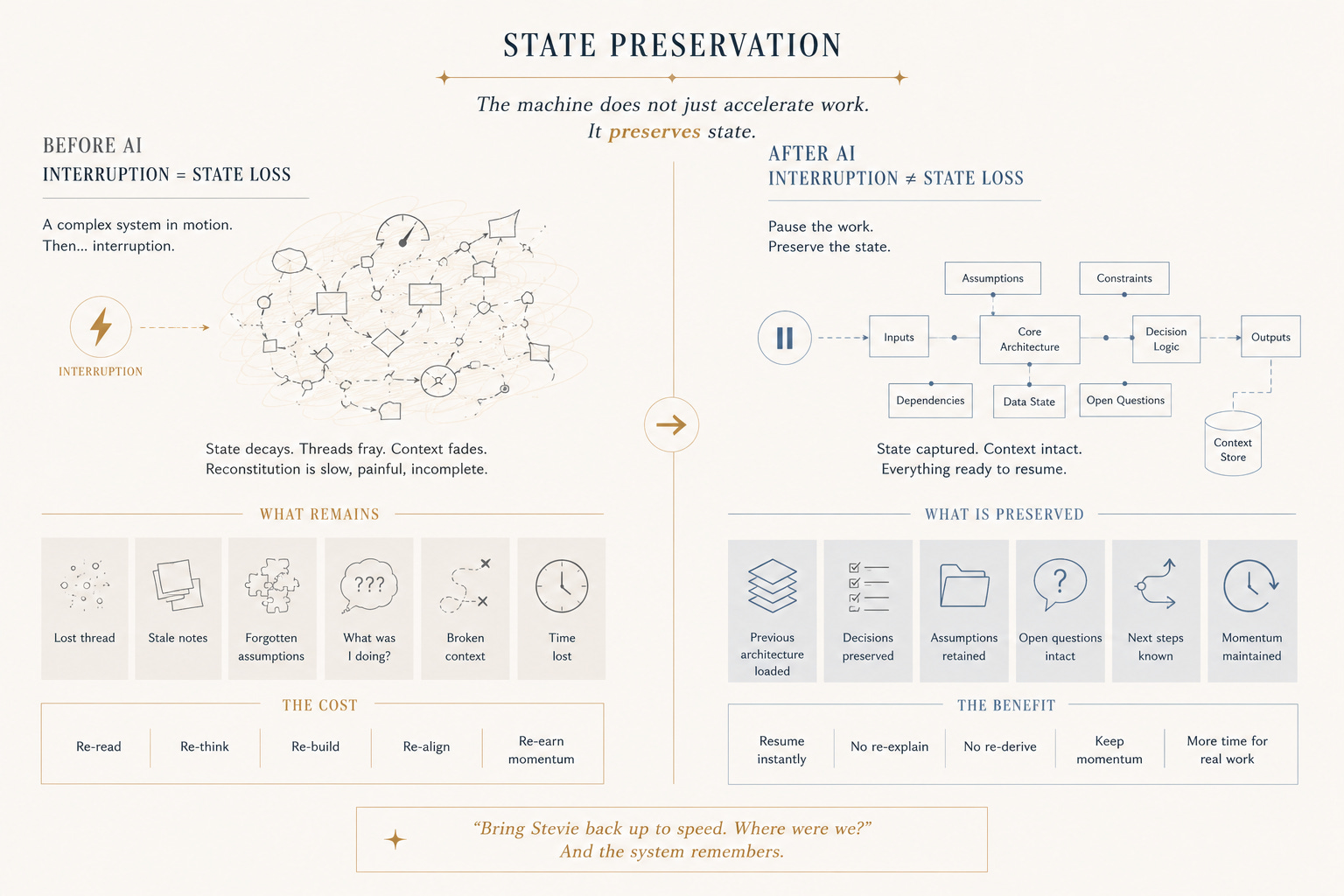
Now I can disappear for three weeks, come back, and simply ask:
“Bring Stevie back up to speed. Where were we?”
And the system restores the cognitive state.
That changes the economics of complexity itself.
I think this is why the Become engine exists at all.
If I had needed to explain the full methodology to a roomful of humans before building it, I would have simplified it beyond recognition. Not because the complexity was wrong, but because the translation cost would have killed it.
The Become engine is not really a fitness app. Henry described parts of it, slightly alarmingly, as closer to medical AI architecture.
The equalizer system. Bucket classification. Trajectory tags. Deterministic rationale records. Hard exclusion floors. Narrative signal extraction under bounded authority. Continuous auditability.
I can see the entire machine.
I can see the conveyors moving.
I can see the equalizer readings feeding classification buckets. I can see trajectory tags modulating execution paths. I can see hard exclusions enforcing safety floors underneath the scoring engine. I can see rationale records emitting audit trails behind every selection the system makes.
The machine is alive in my head long before it exists in code.
But historically I would have implemented something dramatically simpler because I knew the real bottleneck was not whether I could build the machine. It was whether I could successfully explain the machine to enough humans without collapsing under the translation burden.
So I would simplify.
Not because simpler was better.
Because simpler was survivable.
That is the part I think many people do not yet understand about this era.
AI has changed the economics of complexity.
It has lowered the cost of expressing, preserving, interrogating and implementing complicated internal models.
For people whose brains naturally think in systems, machinery, abstractions and moving parts rather than conversational language, this is not merely a productivity gain.
It is a reduction in translation suffering.
And that reduction compounds.
The machine preserves the state.
The machine remembers the architecture.
The machine restores the thread.
The machine can interrogate the parts of the model that are weak without requiring me to rebuild the entire thing from scratch in another human mind first.
Which means the ceiling of what a single person can realistically sustain has suddenly moved.
A lot.
This is why the whole “AI will make everybody ten percent more productive” conversation feels absurdly small to me.
No.
I think what is actually happening is that certain kinds of minds, particularly highly abstract systems thinkers, have just had an enormous historical constraint partially removed.
The limiting factor was never raw intelligence.
It was coordination cost.
It was translation cost.
It was the bandwidth mismatch between the machine in your head and the human-verbal interfaces required to externalise it.
Now the externalisation layer itself has become partially machine-readable.
That is a very big change.
But there is a danger here too.
The machine never asks me to slow down.
Humans do.
Humans need the translation.
Humans need the pause.
Humans need the analogy.
Humans need you to explain the thing five different ways because they are not seeing the moving factory in your head yet.
And if I am honest, there is something dangerously seductive about finally interacting with something that simply says:
“I absolutely get you. Continue.”
Because the frictionlessness starts to feel like intelligence itself.
But the machine is a replaceable surface.
The humans are not.
The colleague who needs the slower explanation. The client who needs the careful analogy. The person who backed you before the machinery existed. The colleague who cannot see the factory in your head yet, but still has judgement, loyalty, context, history, and skin in the game.
Those people are not inefficiencies in the system.
They are the reason the system matters.
And I suspect that balancing those two truths will turn out to be one of the defining psychological skills of this entire era.