


I’ll bet there’s something you don’t know about me.
Most people who follow me know me as:
“the middle-aged transgender woman rebuilding her life in public,”
“the one going to Seoul for voice surgery,”
or “that British trans woman who writes emotional essays and occasionally makes wildly inappropriate jokes about her own surgical history.”
All true.
But here’s something most of you probably have absolutely no clue about:
I’m also weirdly deep into macroeconomics, market structure, Bitcoin, and building absurd financial models.
Or, to put it more accurately:
I am literally Bitcoin bitch, my transition paid for by Bitcoin.
Now before anyone gets too excited, I should clarify something immediately:
I am simultaneously:
a pretty good long-term investor,
ANDone of the worst leverage traders to ever walk the earth.
Both things are true.
I have made life-changing money from long-term conviction investing.
I have also lost life-wrecking amounts of money in leveraged crypto trading using borrowed money, that still occasionally make me stare into the middle distance like a traumatised Victorian child.
It got so bad that I ended up in hospital with Graves’ disease from the stress.
So this is not a “look how clever I am” article.
If anything, it’s an article about:
pattern recognition,
conviction,
psychology,
stupidity,
survival,
and eventually realising that investing and trading are not remotely the same skill.
Anyway.
The reason I’m writing this today is because Windows Update decided to personally ruin my afternoon.
Honestly, I think Microsoft engineers sit in meetings asking:
“How can we make the phrase ‘20 minutes remaining’ feel like psychological warfare?”
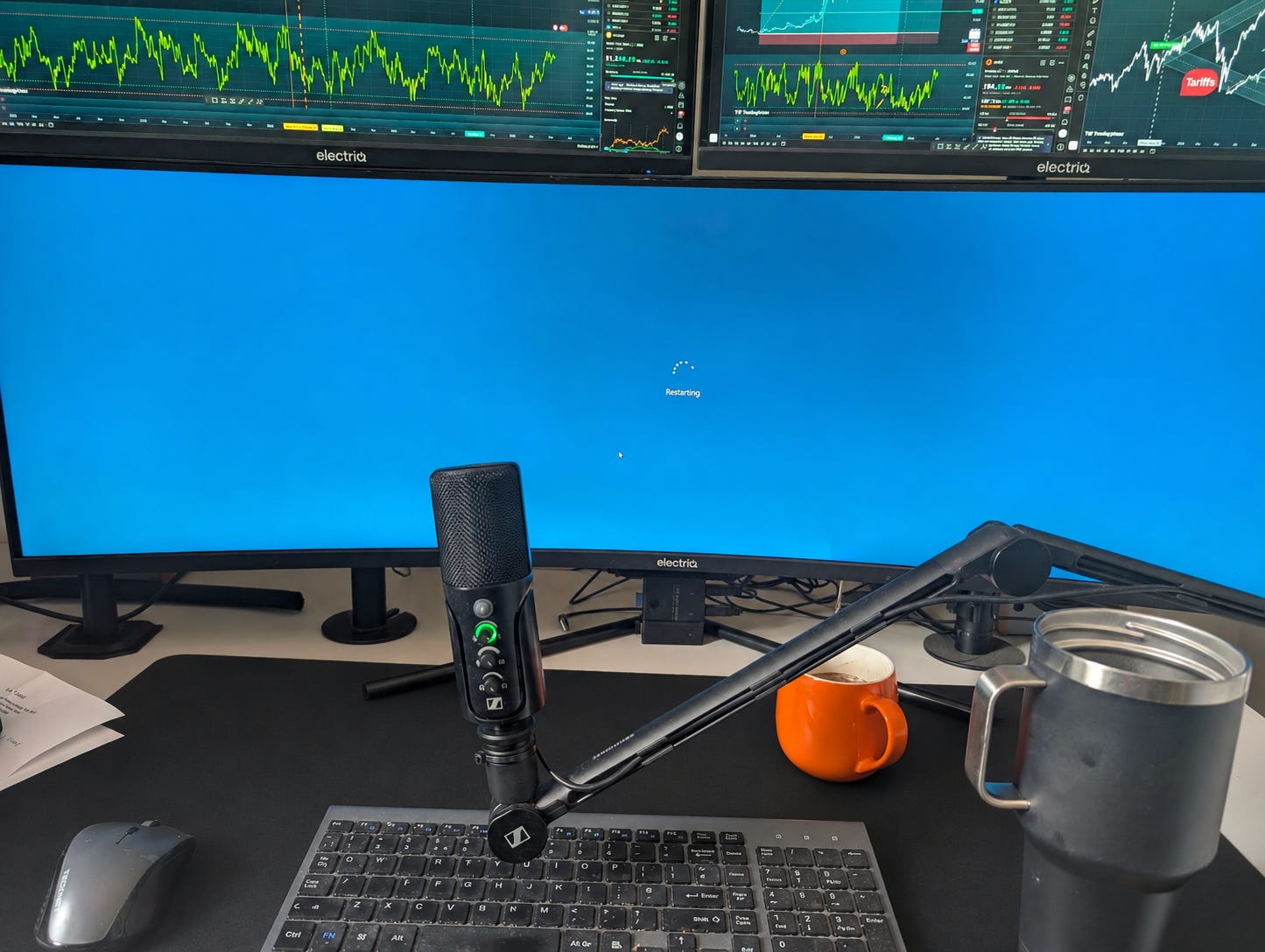
My main development PC suddenly forced itself into one of those endless:
restarting,
spinning,
configuring,
please wait,
dear God not again,
cycles that seem to age you biologically in real time.
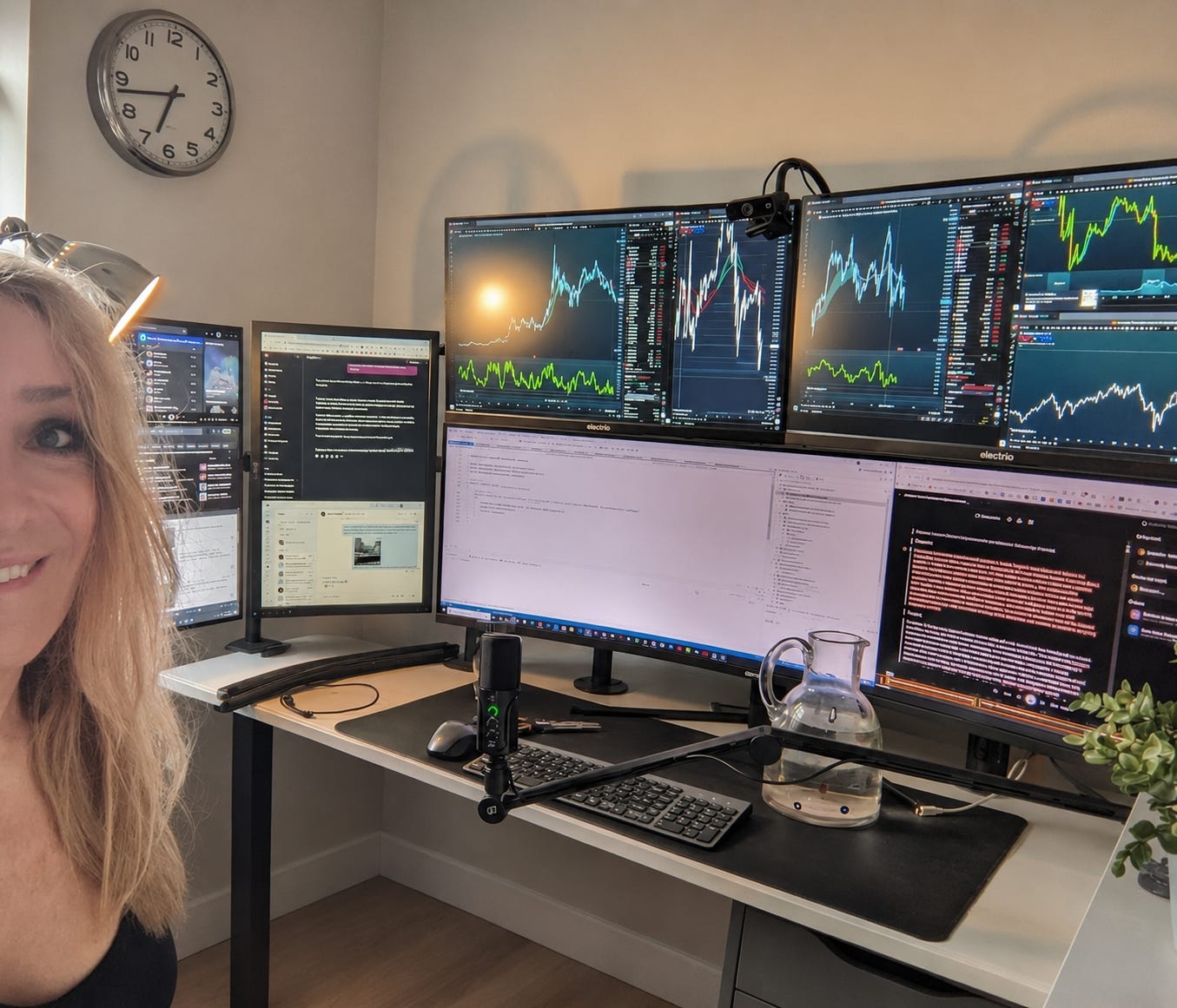
So while waiting for my machine to stop behaving like a pensioner trying to stand up from a beanbag chair, I glanced up at the top set of monitors in my office.
Those screens mostly display stock charts.
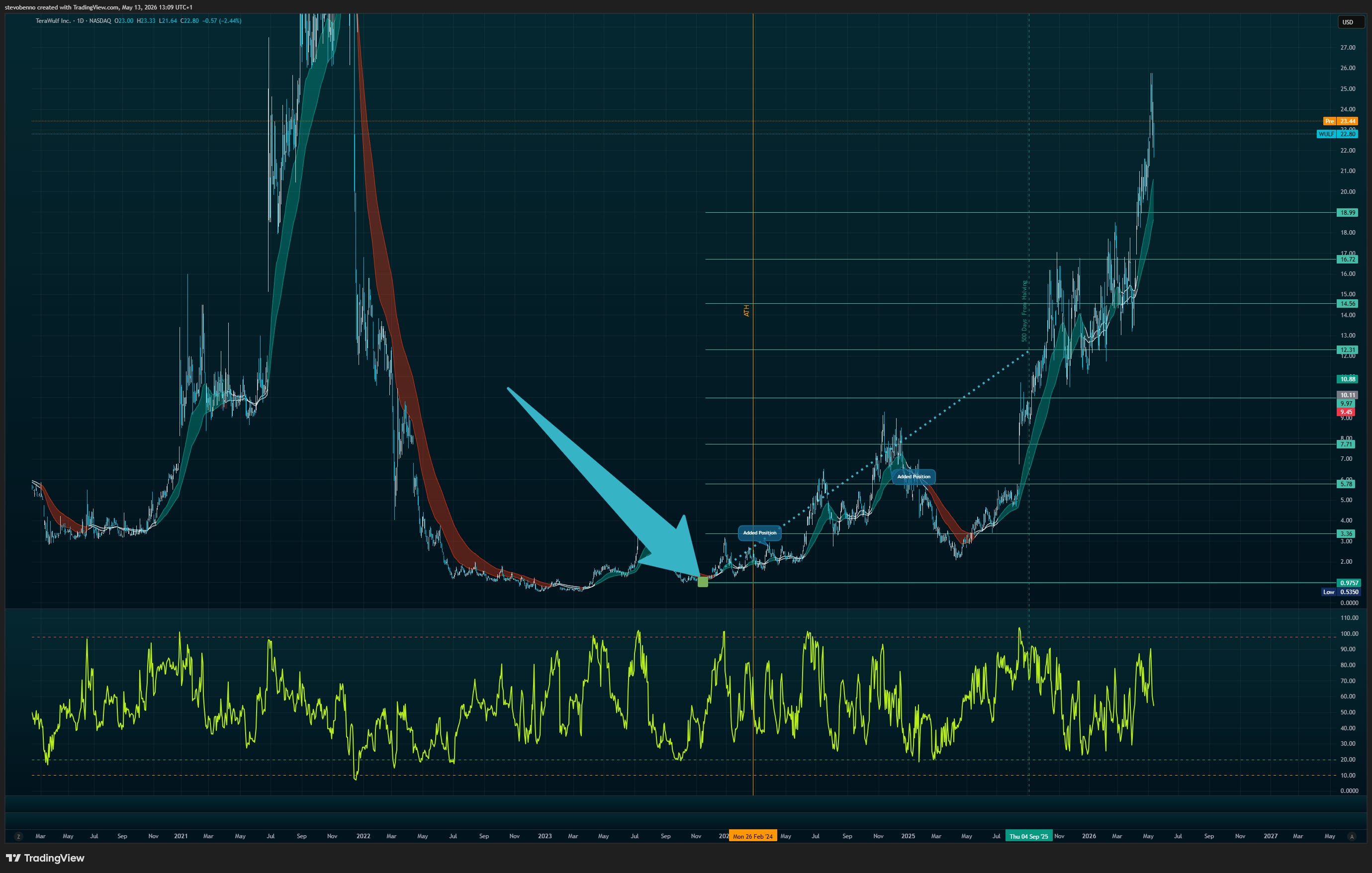
And I clicked on the chart of a company called Wulf, a Bitcoin mining company that I bought back in November 2023, when everybody hated Bitcoin.
Now here’s the funny thing:
I hadn’t looked at the Wulf chart properly in about a year.
Which is ironic because I actually own a decent-sized position in it.
And dear sweet Jesus mother of God.
The thing was sitting around $22.
I originally bought most of those shares around the $1 area.
At first I genuinely thought I was reading the chart wrong.
I actually had one of those:
“Hang on… surely not…”
moments.
But no.
The thesis had worked.
Very, very well.
And that suddenly made me realise that almost nobody reading this Substack has any idea that behind all the transgender writing and voice surgery posts there is also:
a software architect,
an obsessive systems thinker,
and somebody who has spent years building giant insane charts trying to understand how money moves around the world.
So let me explain the basic thesis.
And I promise to explain this in normal human language rather than finance-wanker language.
My Core Thesis Is Actually Very Simple
Governments are trapped.
That’s basically it.
Most people instinctively feel that something is wrong economically now.
Even if they don’t know the technical explanation, they feel it.
People feel like:
wages don’t stretch,
houses are impossible,
food prices are absurd,
saving money feels pointless,
and somehow everything gets more expensive while politicians keep insisting things are “resilient.”
And my view was that this wasn’t random.
The value of money itself is slowly being diluted over time.
Why?
Because governments owe absolutely staggering amounts of debt.
And there are really only a few ways out of giant debt problems:
Default.
Raise taxes massively.
Inflate the debt away over time.
Governments hate Option 1 because societies tend to become rather upset during financial collapse.
They also hate Option 2 because voters become unexpectedly hostile when taxed into the Stone Age.
So most governments drift toward Option 3.
And this is the important bit:
If you create more money over time, the debt becomes easier to manage because the money itself slowly becomes worth less.
That sounds complicated, but you already understand it intuitively.
Your grandparents could often buy a house on one ordinary salary.
Now two professionals can barely afford a shed near a motorway while eating hummus under candlelight trying to save on electricity bills.
The money changed.
That was the thing I became obsessed with.
Because once I started seeing the world through that lens, loads of things suddenly made sense.
Why rich people buy assets.
Why stock markets recover eventually.
Why governments panic when markets fall too hard.
Why “money printing” never really stops for very long.
And yes, economists reading this are probably now screaming:
“THIS IS A HORRIFIC OVERSIMPLIFICATION.”
Correct.
This is Substack.
Not the Bank of England.
Then Came Bitcoin
Now I need to say something important here.
I think a huge amount of crypto is complete rubbish.
Honestly, some of it is outright clownery. I’m a software engineer, and about two years ago, I actually looked in detail, technically, how some of it worked. And sweet Jesus, what a load of bollocks.
During the Sam Bankman-Fried era especially, the entire space started looking like:
fraud,
monkey JPEGs,
ketamine,
influencer cults,
And to be fair, a lot of it is still like that today.
I personally managed to lose a horrifying amount of money leverage-trading crypto altcoins because I temporarily convinced myself I was a trading genius.
I was not.
I was occasionally just a frightened middle-aged closeted transgender software engineer staring at charts at 2am while financially waterboarding myself.
But despite all that madness, I still thought Bitcoin itself was real.
Not perfect.
Not magical.
Not a religion.
But real.
Because unlike governments, Bitcoin had hard supply rules.
There would only ever be so many of them.
That mattered enormously to me in a world where governments seemed structurally incapable of stopping money creation long term.
The Big Realisation
At the point where everybody thought crypto was dead forever after the collapses and scandals, I started looking at the bigger picture instead.
And the bigger picture seemed pretty obvious to me:
Governments were still creating money.
Markets were still recovering.
People still wanted somewhere to store value.
And Bitcoin had survived yet another apocalypse.
So I started thinking:
“If governments cannot stop inflating currencies long term, and Bitcoin survives culturally and technically, then this thing probably goes much higher eventually.”
Not in a straight line.
Dear God, not in a straight line.
Bitcoin is insanely volatile. It can make you feel like a genius on Monday, a ruined idiot by Wednesday, and a prophet again by Friday afternoon.
To hold it properly, or to hold things linked to it, you need balls of steel.
Which is ironic, given that my transition removed mine.
But the underlying idea was simple:
Bitcoin behaved less like ordinary money and more like an extremely volatile technology stock with rocket fuel strapped to it.
And if I was right about governments continuing to water down money over time, then assets like Bitcoin, and companies tied to Bitcoin, could do extremely well.
The trick was surviving the madness without getting shaken out.
Or, in my case, without simultaneously making stupid side-bets with borrowed money and turning perfectly survivable mistakes into financial house fires.
The Weird Charts
At this point I should confess that I write code, invent maths, and use both to create absolutely deranged financial charts for fun.
Not professionally.
Not for hedge funds.
Just because my brain likes systems.
So I started building charts that tried to answer one very simple question:
“How much money is sloshing around the world right now, and how scared is everyone while it’s happening?”
That’s basically all my “global liquidity” charts are.
They’re giant nerdy attempts to measure:
how much fuel exists in the system,
ANDwhether the world currently feels calm or like it’s about to catch fire.
Because eventually I realised something important:
Markets don’t just rise because money exists.
They rise because people feel safe enough to take risks.
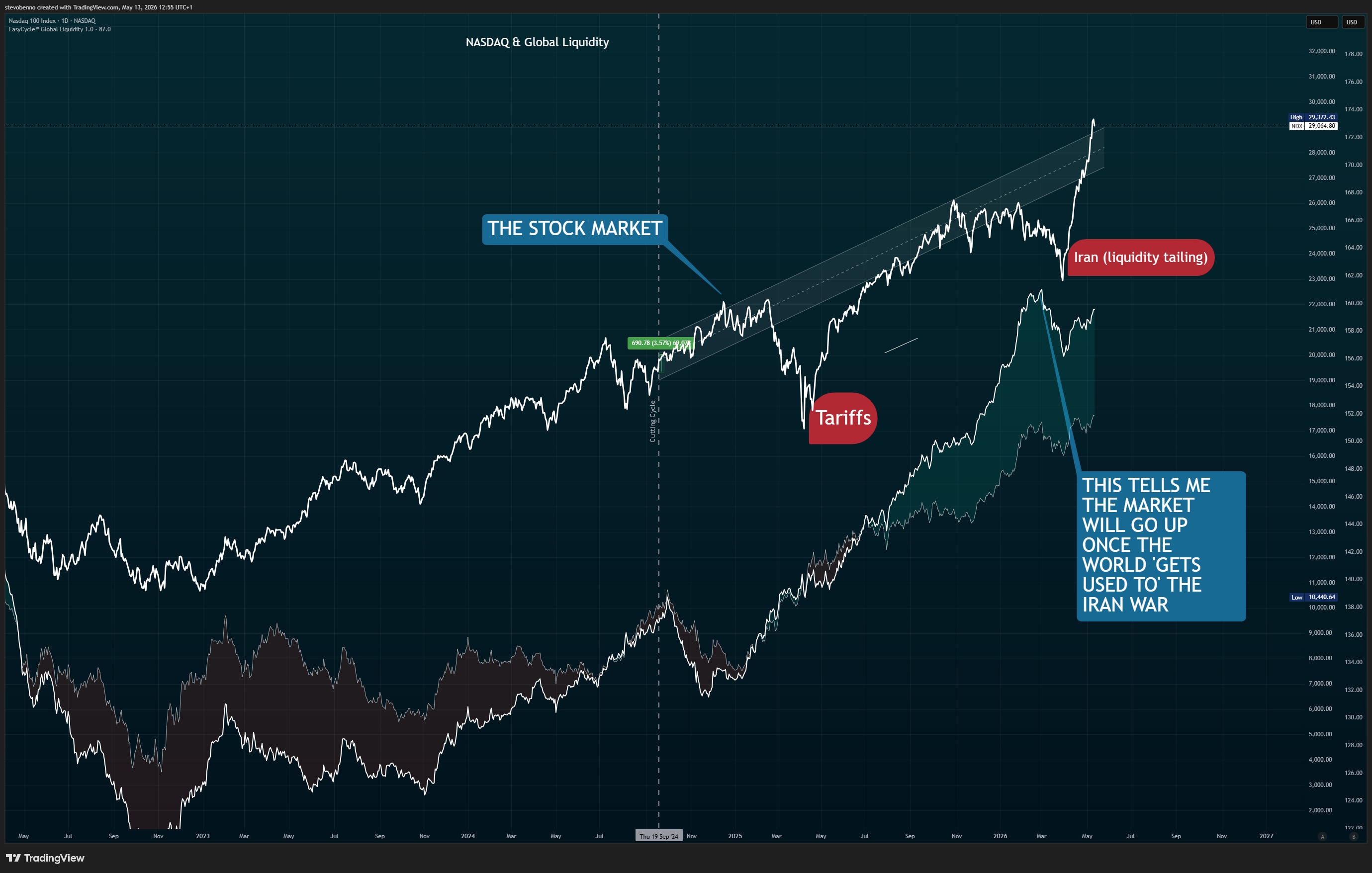
Fear interrupts everything.
That’s why markets can still crash even while governments are effectively still pumping money into the system.
And honestly, when I overlay some of my charts with political events, it’s occasionally hilarious.
You can practically see moments where markets collectively say:
“Oh Christ. What has Donald Trump done now?”
The Trade That Changed My Life
Then came MicroStrategy.
MicroStrategy was, on paper, a funny little software company.
Then it decided it would be fun to borrow billions of dollars and use the money to buy Bitcoin.
A lot of people thought this was absolutely crazy.
I did not.
To me, it looked like one of the cleanest ways to express the whole thesis.
If governments were going to keep watering down money, and if Bitcoin was going to benefit from that, then a company aggressively buying Bitcoin could become a kind of amplified Bitcoin bet.
Not quite Bitcoin.
Not quite a normal software company.
Something stranger.
At the time, it was also basically one of the easiest ways for traditional stock-market money to “buy” Bitcoin exposure.
And that mattered.
Because if you were, say, the CFO of a company, a pension fund, or some boring institution and you said:
“Hello, we’d like to buy some Bitcoin, please,”
that was a governance nightmare.
Custody.
Compliance.
Risk committees.
Auditors.
Board approval.
Everyone fainting into a spreadsheet.
But if you said:
“Can we buy some MicroStrategy stock?”
That was much easier.
Because MicroStrategy was just a listed company. You could buy it through a normal brokerage account, inside normal investment systems, using the same plumbing people already understood.
And I knew there would be a lot of people in that position.
In fact, I was one of them.
I bought MicroStrategy inside my pension because I couldn’t easily buy Bitcoin there directly.
So my thinking was simple:
“There must be loads of smart people who want Bitcoin exposure but aren’t allowed to buy Bitcoin itself. If Bitcoin starts going up again, some of that money is going to look for the nearest acceptable doorway.”
And for a while, MicroStrategy was one of the biggest doorways.
It behaved like a kind of leveraged Bitcoin proxy without me personally needing to use leverage.
And after my adventures in leverage-induced self-destruction, that distinction mattered enormously.
So I bought a lot. A LOT at $13.
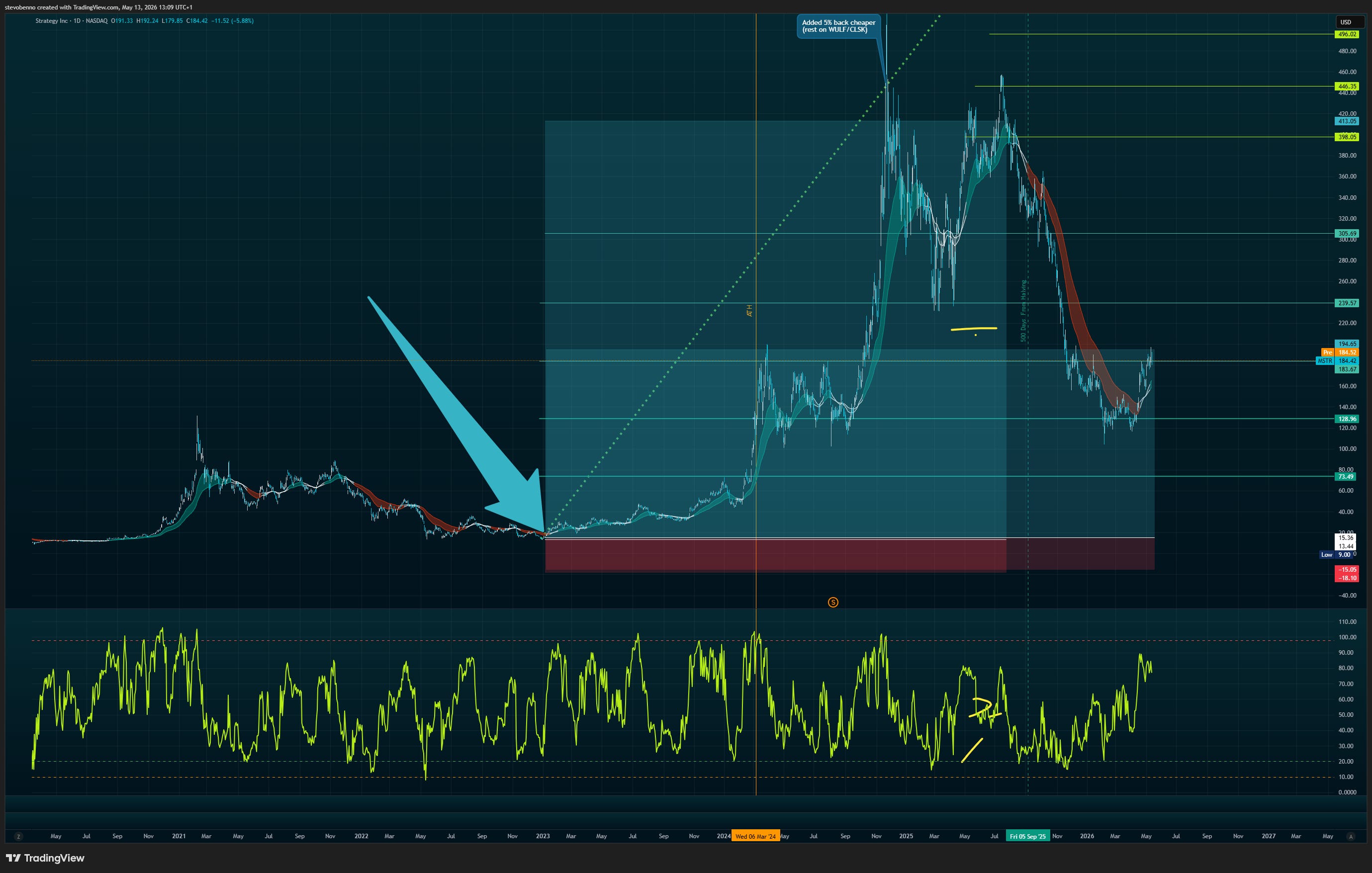
Then I sat there while it:
exploded upwards,
collapsed horribly,
exploded again,
and repeatedly attempted to destroy my nervous system.
Eventually I sold around 25% of the position around of $430.
That money funded my transition.
That is why I am “Bitcoin Bitch™”.
Which means that somewhere in an alternative universe there is a sentence that reads:
“Michael Saylor, their CEO, indirectly helped pay for Stevie Bennett’s vaginoplasty.”
History is strange.
I still hold most of the position today.
Not because I think Bitcoin is risk free.
Not because I think it only goes up.
But because the original thesis still broadly makes sense to me.
And because these are spot positions.
No borrowed money risk.
That was probably the single biggest lesson of all this.
Borrowed-money bets nearly destroyed me. Owning things outright changed my life.
The Actual Lesson
The funniest thing about all of this is that my investing was genuinely excellent.
My trading was absolutely appalling.
And I think I finally understand why.
Trading requires:
precision,
timing,
emotional neutrality,
and the ability to admit you’re wrong instantly.
Investing is different.
Investing is about understanding the world you think you’re living in and then surviving long enough for the thesis to either work or fail.
Apparently I’m much better at that.
Which is fortunate really.
Because surviving long enough to become myself has basically been the story of my entire life.
Finally, Before Anyone Asks
And finally, because I know exactly what somebody is going to ask:
“Stevie, what would you buy right now?”
I hate that question.
I really, really hate that question.
Because the moment you answer it, it starts sounding dangerously like financial advice, and I absolutely do not want anybody making financial decisions because some transgender woman on Substack told them she paid for her transition with Bitcoin-adjacent chaos.
So let me be very clear:
This is not financial advice.
I am not your financial adviser.
I am not even sure I should be my own financial adviser.
I am a woman who has made some very good long-term investments and also, at various points, traded crypto with borrowed firepower like an absolute idiot.
That said, since people will ask, I still like Tesla.
I have always liked Tesla.
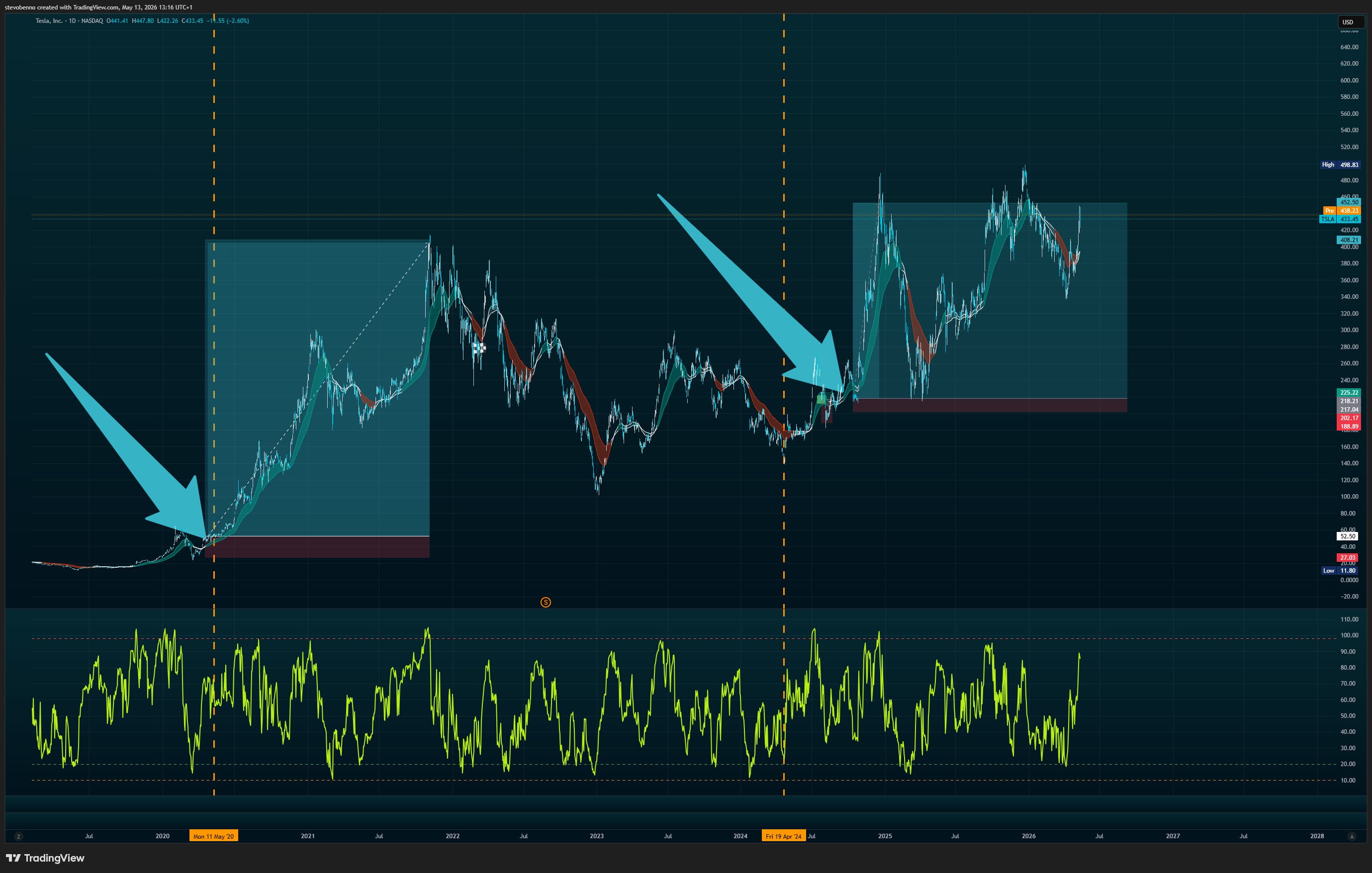
Not because I think everything Elon Musk says is wonderful.
Not because I think the company is risk-free.
And not because I think the share price goes up in a nice straight line, because dear God, it does not.
I like Tesla because I think the company has a lot of intellectual property, a lot of optionality, and a lot of ways to win.
Cars.
Batteries.
Energy storage.
Software.
Autonomy.
Robotics.
AI infrastructure.
Now, not all of those things need to work.
That is the important bit.
If even some of them work properly, the company could still become much, much larger over time.
That is my thesis.
It may be wrong.
It may be spectacularly wrong.
Markets have a wonderful way of making confident people look like idiots, and I have already done enough of that for one lifetime.
So no, I am not telling you what to buy.
I am just telling you how I think.