

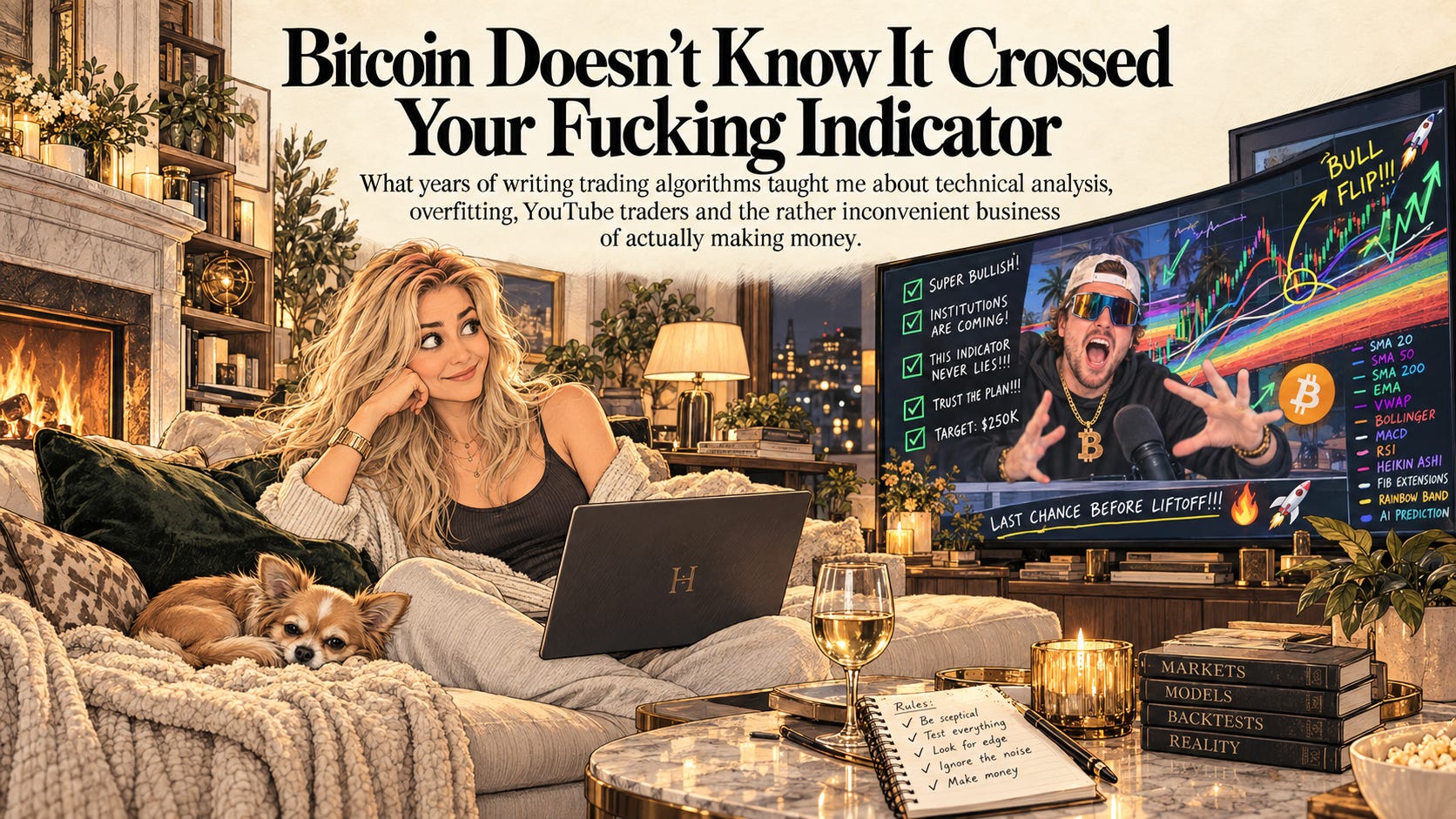
My evenings tend to start the same way.
Eventually I drag myself away from the screens in my office and start doing all the boring little things that make tomorrow morning slightly less irritating. I prepare my breakfast, put the dishwasher on, make sure the bedroom is tidy and wander around doing jobs I should probably have done earlier.
And then Chester notices the logs.
This is the important bit. The moment I start putting logs on the fire, he knows exactly what is supposed to happen next.
She's going to lie down on the sofa. Excellent. Please lie down on the sofa. Now.
If I make the mistake of wandering back into the kitchen afterwards because I've forgotten something, I can actually see the irritation on his little face. His head starts wobbling from side to side as he watches me.
What are you doing? We had an agreement.
Fire. Sofa. Chihuahua.
Tonight I eventually complied. I lit the fire, lay down and watched the final episode of The Gentlemen on Netflix. Incidentally, was Ray Winstone contractually prohibited from being filmed anywhere other than a sauna for the entire series? Every time he appeared I expected somebody to throw another ladle of water over the rocks.
Anyway.
After that I opened YouTube.
YouTube has become particularly irritating recently because it keeps offering me approximately the same twelve things forever, so for reasons I cannot quite explain, I clicked on my old subscriptions instead.
I haven't looked through them properly in years.
Oh dear God.
I genuinely think I may have one of the most eclectic YouTube subscription lists in existence. Algorithmic crypto traders sitting beside James Charles, programming channels, makeup tutorials, finance and, I'm sorry, Jordan Peterson.
All sitting happily beside each other like the world's most dysfunctional dinner party.
Then I started seeing names from another life. Crypto, Bitcoin, trading, technical analysis. People I used to watch years ago when I spent an unhealthy proportion of my life sitting in front of huge banks of monitors writing trading algorithms.
I wondered how many of them were still going.
So I clicked on Ivan on Tech.
I mainly wanted to hear the introduction because I always found it funny. He used to launch into his videos with this enormous, enthusiastic Eastern European accent and an intensity suggesting Bitcoin had approximately thirty seconds left to live.
I intended to watch for thirty seconds. Two minutes later, I was still there.
And then I started getting annoyed.
Because there it was again. The thing that eventually drove me absolutely insane about retail technical analysis.
Some indicator had changed state. Bitcoin had crossed something called a Bull Flip. A bullish zone. A line had changed colour. And it was being discussed with the solemnity of Moses receiving the tablets.
Apparently this mattered. Apparently Bitcoin had done a Thing.
And I found myself sitting on the sofa thinking something I remember thinking many years ago:
Bitcoin does not know it has crossed your fucking indicator.
It doesn't.
Bitcoin isn't sitting there watching twenty-five TradingView indicators. It hasn't noticed the golden cross. It isn't worried about Ivan's Bull Flip. It doesn't know your RSI has crossed 50.
And unless enough actual market participants are watching exactly the same thing and acting on it, the market doesn't particularly care either.
There are exceptions, obviously. Widely watched levels can become reflexive. If a sufficiently large proportion of participants care about the 200-day moving average, then the 200-day moving average can matter precisely because everybody cares about it.
But some proprietary rainbow-coloured indicator using seventeen transformations of exactly the same price data?
Come on.
I used to call it chart pornography.
And I say that as somebody who spent years producing a considerable amount of chart pornography myself.
My journey into algorithmic trading
I started out like most technically minded people probably do. I discovered Pine Script, looked at other people's scripts, played with strategies, changed parameters and combined indicators.
This one looks good. What happens if I add this? What happens if I change that period from 20 to 25?
Oh, look at that.
Christ, I've cracked it.
Then you get more sophisticated. You stop downloading somebody else's RSI strategy and start building your own things. More complicated mathematics, more data, machine learning, optimisation and different market regimes.
More screens. More code. More cleverness.
And something very peculiar happens. The more you actually build these things, the less impressed you become with them.
Because an indicator can look like absolute voodoo on a chart. Green there, buy. Red there, sell. Green again, buy. Jesus Christ, look at that. It caught the whole move.
Now turn it into an actual automated strategy.
That's where the fun starts.
No repainting. No magically deciding after the candle has closed that you would obviously have entered halfway through it. Trade using the information that genuinely existed when the decision had to be made. Execute on the close, add fees, slippage, the difference between the price TradingView thinks existed and the price your exchange actually offered you, and then add latency.
Add the real world.
And suddenly Mystic Meg has lost quite a lot of her mysticism.
This is why those YouTube videos where somebody puts TradingView into replay mode and manually draws profit boxes on the screen used to drive me demented.
Yep, winner there. Green rectangle. Winner there. Another green rectangle. Tiny little loss. Massive winner. Look how easy this is.
No.
You are manually backtesting your own hindsight.
Of course it looks wonderful. You already know what happened.
And even when you're genuinely automating things, the next monster arrives.
Overfitting.
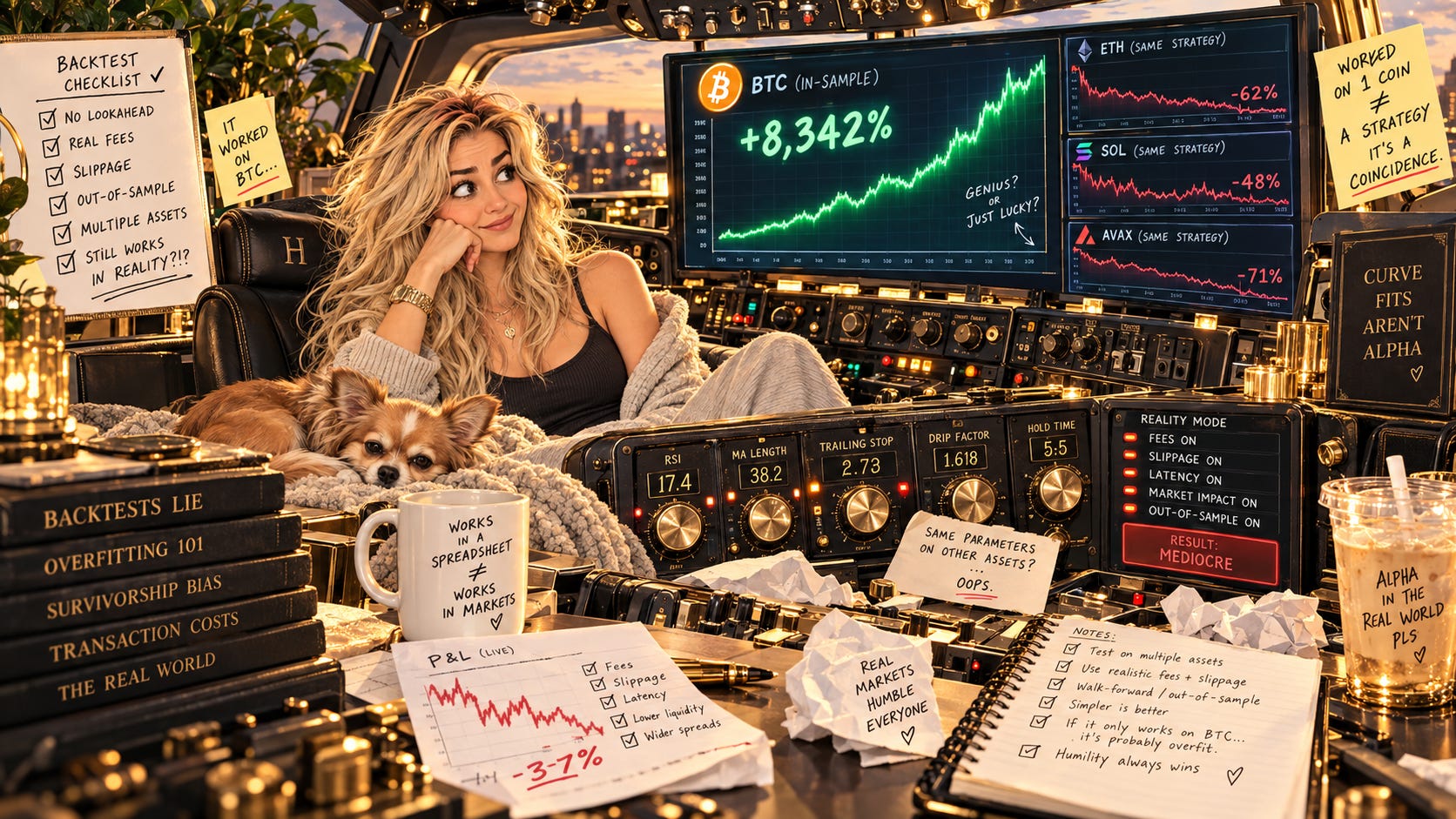
You produce something that looks spectacular on Bitcoin. Absolutely beautiful equity curve. Sharpe ratio to make your mother proud.
Then you try it on Ethereum and it loses money. Solana loses money. AVAX makes a tiny profit. Change one parameter slightly and the whole thing falls apart. Move the test window six months and suddenly your beautiful strategy looks considerably less beautiful.
Then you optimise it.
Now it works again.
Brilliant.
Except you've potentially just found the exact collection of numbers that most elegantly explains the past. That isn't necessarily prediction. Sometimes it's just curve fitting wearing expensive glasses.
Eventually I became much more interested in robustness than optimisation.
I didn't particularly want something that made 80% on Bitcoin using parameters 17.4, 38.2 and 2.73 but collapsed everywhere else. I'd rather have something that made 10 or 20% reasonably consistently across a basket of assets.
Something that was directionally right. Something where I could jiggle the parameters around and it didn't immediately fall apart.
Because that at least suggested I might have found something resembling a real phenomenon rather than a particularly attractive historical accident.
And writing that kind of algorithm is incredibly fucking difficult.
My algorithms, in the end, were average. Some were decent, some made money and some didn't. None of them contained the secret mathematical key to the markets.
And there is a dangerous temptation when you've built an average strategy. An average strategy doesn't make enough money, so you introduce leverage. Now your average strategy makes exciting money.
Until it doesn't.
I learned that lesson extremely expensively.
The market doesn't care about your lines
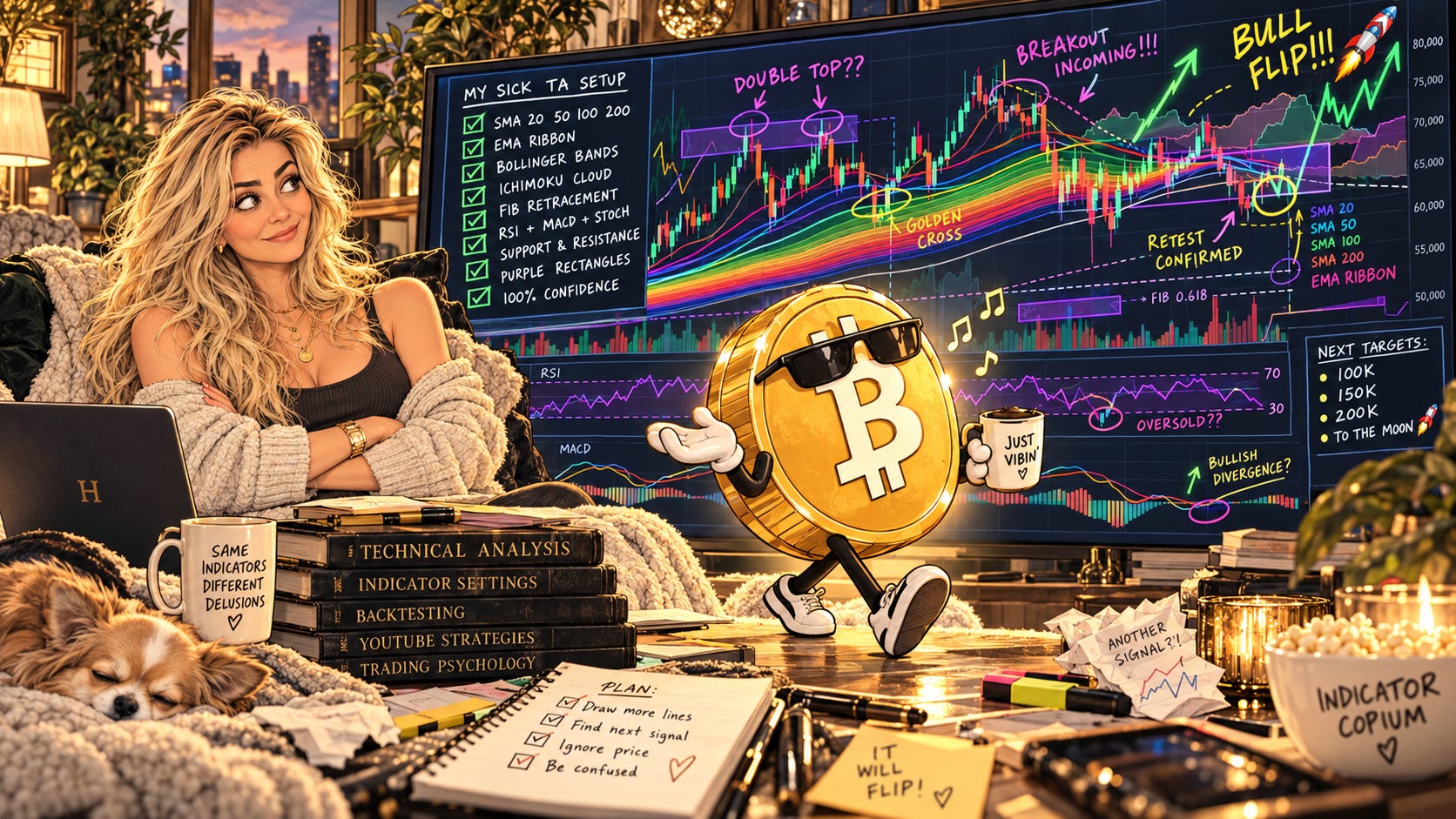
Around the same time, my thinking about markets started changing. I became less interested in transformations of price and more interested in information about the system producing the price.
What was global liquidity doing? What was happening in bonds? What was volatility doing, and how did bond volatility affect the transmission of liquidity into risk assets?
I started looking at derivatives markets, CME expiry dates and the pricing of subsequent contracts. I was interested in what changes in the futures curve might tell me about confidence further out, how expectations were evolving and what participants were collectively willing to pay for future exposure.
I was increasingly interested in what I would describe as the wisdom of the crowd.
Not because markets possess some mystical perfect wisdom. They don't. Crowds are frequently idiots. But markets aggregate enormous quantities of information, expectations, incentives and positioning.
And that interested me far more than whether two moving averages had kissed.
I still used moving averages, of course. I used plenty of conventional technical signals, but they increasingly became third-level confirmation. They weren't the thesis.
The thesis came first.
And that distinction eventually became the most important thing I learned.
You have a thesis, and then you collect evidence. Some evidence strengthens it, some weakens it and some changes it entirely. An indicator is one possible piece of that evidence.
It is not divine revelation.
The other problem I hit was the limitation of the tools themselves.
TradingView is fantastic for what it is, but I became increasingly frustrated that I couldn't simply consume whatever external data I wanted directly into my strategies.
I had endless ideas for services I could have written in C#. I wanted to pull data from multiple sources, normalise it, timestamp it properly, create historical series and build my own derived datasets.
I wanted to combine liquidity data with volatility measures and aggregate information that the normal TradingView user simply didn't have access to.
More importantly, I wanted to be able to backtest against those historical datasets properly, without introducing all the usual problems of look-ahead bias and information that wouldn't actually have been available at the time.
That interested me because at least then I was attempting to create an informational advantage.
If everybody has the same OHLCV data, everybody has the same RSI, everybody has the same MACD and everybody has access to the same library of community indicators, exactly where is your edge supposed to be coming from?
You can still create one. Execution can be an edge. Statistical modelling can be an edge. Market microstructure can be an edge.
But the bar is extremely high.
There are firms stuffed full of mathematicians, statisticians, physicists, alternative datasets and extremely expensive computers trying to extract fractions of a percentage point from markets.
And then there's Trevor on YouTube with a purple rectangle.
The retail trading circus

This is the part that actually makes me feel sorry for retail traders.
Because there's an entire industry built around selling certainty.
BUY NOW. BITCOIN ABOUT TO EXPLODE. THIS INDICATOR HAS NEVER BEEN WRONG. THE NEXT 48 HOURS WILL CHANGE EVERYTHING.
And some perfectly ordinary person with a few thousand pounds sees a man sitting in front of twelve monitors talking confidently about bull flips and liquidity zones and thinks:
He knows. He has figured it out.
No.
He may know something. He may even be a competent trader. But YouTube has its own incentives.
Excitement gets clicks. Certainty gets clicks. Fear gets clicks.
"This mildly increases the probability of a positive return over a particular horizon, although confidence intervals remain large" does not make a particularly compelling thumbnail.
And there is an obvious question I've always had about some of these people.
If you possess a repeatable trading system capable of making extraordinary risk-adjusted returns, why exactly are you spending Tuesday afternoon shouting at a webcam trying to get me to use your Binance referral code?
Maybe you're just very generous.
Maybe.
I'm not suggesting that every trading educator on YouTube is a charlatan. There are genuinely knowledgeable people out there, and some produce excellent educational material.
But the extraordinary confidence with which relatively trivial technical observations are presented to retail audiences makes me deeply uncomfortable.
Because there's real money involved.
Somebody is going to watch that video and believe that Bitcoin crossing Ivan's Bull Flip is a meaningful reason to put their savings at risk.
And when it goes wrong, the YouTuber has another video to make tomorrow.
The retail trader has a loss.
The greatest irony of my trading career
The greatest irony of my own trading period is that the serious money I made didn't come from algorithmic trading at all.
It came from investing.
Being directionally right.
I bought WULF, the Bitcoin miner, very early and watched the thesis change as the company moved towards AI infrastructure. I bought at around a dollar and sold roughly 70% of the position around $28. I still have the rest.
I also bought MicroStrategy at what would now be a roughly low-teens split-adjusted price and eventually sold part of that position at around $428.
Those positions made vastly more money for me than years spent trying to make algorithms clever enough to predict the next candle.
And that taught me something uncomfortable.
It is, in many ways, easier to find a strong investment thesis than a strong algorithmic trading thesis.
Not easy. Easier.
A good investment thesis allows you to think about the real world. Technology, capital, incentives, structural change and mispricing.
What happens if this company becomes something different? What happens if the market has misunderstood what this asset represents? What happens if everybody is looking at today while I'm looking at five years from now?
That doesn't mean you're necessarily right. A perfectly reasonable thesis can turn out to be completely wrong, and being right about a company's future doesn't automatically mean you've paid a sensible price for its shares.
But at least you're asking questions about the underlying asset and the world in which it exists.
Algorithmic trading is another beast entirely.
To do it properly, you need to be extremely good at mathematics, statistics and software, but even that isn't enough. You need original ideas, suitable data and relentless scepticism towards your own results.
You need a phenomenon that persists across market regimes, survives realistic transaction costs, works on unseen data and doesn't fall apart the moment you move one parameter slightly.
And you need the humility to realise that the beautiful thing you've just created may simply be an exquisitely engineered explanation of yesterday.
There are really two ends of this world that I respect.
Serious quantitative trading at one end and serious thesis-driven investing at the other.
Both require thought. Both require discipline. Both can still make you look like an idiot.
What increasingly irritates me is the enormous pseudo-quantitative swamp sitting between them.
Lots of lines, lots of colours, lots of complicated terminology and lots of confidence. Very little examination of whether any of it actually survives contact with reality.
And when the strategy stops working, rather than questioning the original thesis, somebody simply adds another indicator.
Another moving average. Another confirmation. Another filter.
Eventually the chart resembles the flight deck of a 747.
And what have you really learned?
Quite often, absolutely fuck all.
Back to the sofa

So tonight I watched Ivan for a little while longer than I intended, and then I switched him off.
Chester was asleep beside me. The fire was still going, and I found myself thinking about that enormous desk upstairs.
The same desk that now spends its days covered in AI agents writing software for me was once covered in trading algorithms, blinking charts and strategies trying desperately to predict markets.
I spent years trying to teach computers how to trade.
In the end, the computers taught me something much more useful.
If your idea isn't very good, automating it merely allows you to be wrong with extraordinary efficiency.