


Author’s Note on Privacy
I’ve thought carefully about this chapter, and about what I am and am not prepared to say regarding family members. I’ve decided that this chapter does not overly violate anyone’s right to privacy. Some future chapters do, and those will not be published. But this one, I’ve made the call, and I believe it is okay. I stand by that decision.


By the mid-2000s, I hadn’t seen Stevie in years. She felt like ancient history, sealed off, buried so deep I could almost believe she’d never existed.
I was still contracting in IT, making good money and bouncing from role to role, mainly London, brief stints abroad, a stretch in France renovating a house. When the money ran low, I took another contract. It was 2006 when two potential offers landed: Amsterdam or Dublin.
I took the Amsterdam one first, but something felt off. The manager on the phone sounded slightly condescending in a pre-onboarding call. So, I said, fine, I’ll do the Dublin interview too.
They offered me the job on the spot.
The role was rewriting a part of the Irish state pension system, and I was based just outside Dublin city centre. I booked into a B&B for a few weeks while I got settled. I’d deliberately avoided staying in the city centre because I knew if I did, I’d end up partying every night. Instead, I’d plan to walk along the South Circular Road each evening, Dublin’s rooftops rising ahead of me, tempting me to drift into town.
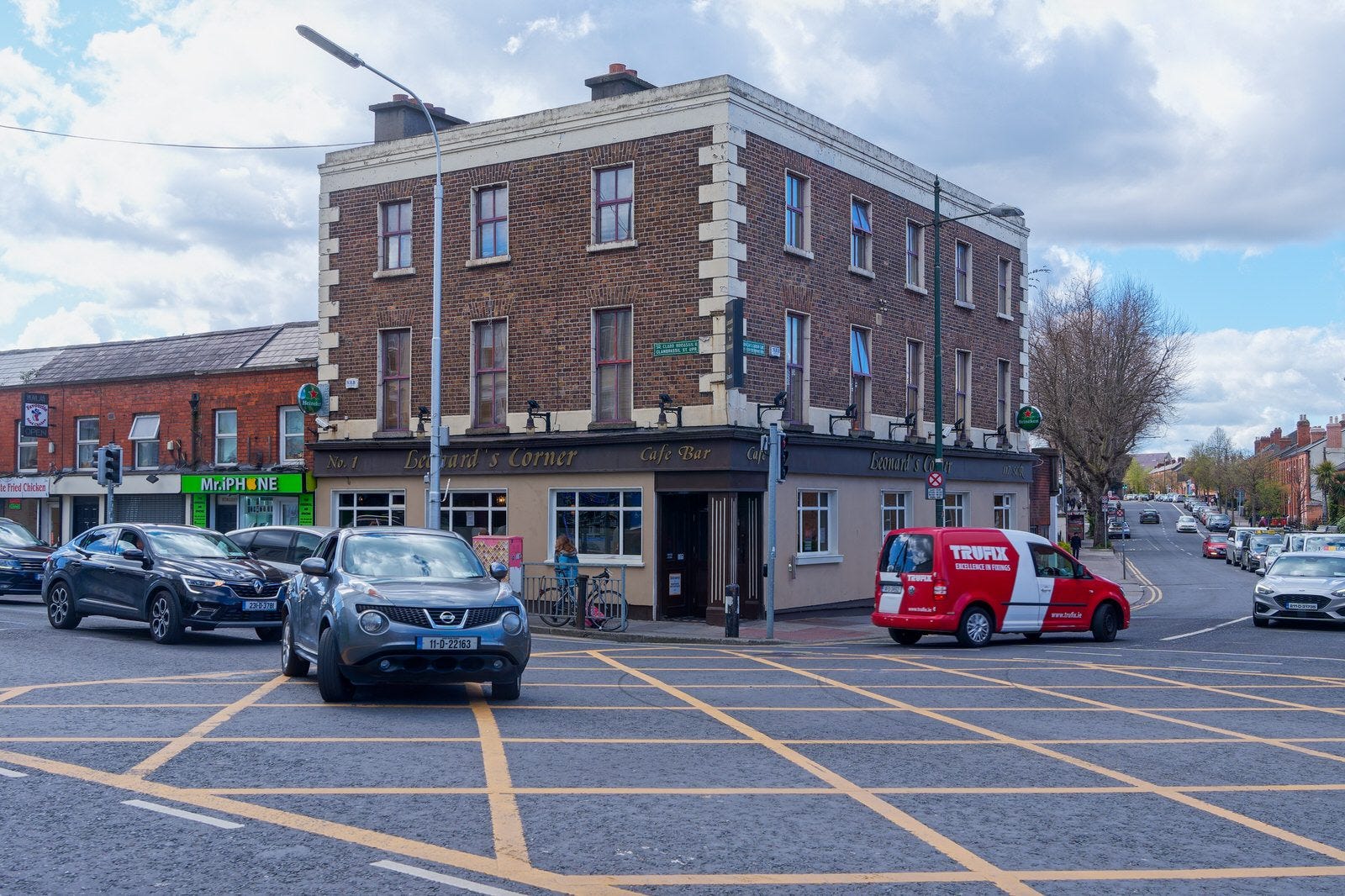
That first night is etched in my memory. I made a deal with myself: head to Leonard’s Corner, the pub on the corner next to the B&B, have one pint and some food, then straight to bed. No drama. No detours. Just one pint and bed.
But that’s not what happened.
I got chatting to a young guy at the bar who was studying bass guitar. I told him I played, too, and we talked music for an hour. Then he gestured over to a table in the corner, a group of his dad’s colleagues, teachers, all women in their early twenties, drinking gin like it was water. One of them was one year qualified, just turned 24. Her name was Sarah Jones.
I find this bit so hard to write. The tears are rolling down my cheeks right now.
You may suspect how it all ends. But that’s how it began.
We got on like a house on fire. We did first dates. I was horribly naff at one point, I even showed her a photo of my sports car. That’s how bad I was. But despite that, and much to her family’s confusion, she moved in almost straight away. I’d just rented a place in a nice, classy part of South Dublin, and before I knew it, she was there, toothbrush and all. There was something between us. It just worked. I fell so in love with her. I had immense respect for her intellect, her nuance, and her sharpness. Our conversations were witty, playful, clever in ways I’d almost forgotten were possible.
Three years later, after stints in Dublin, Tanzania, and London, we were married in a private ceremony at Belair House in Dulwich Village, London. It wasn’t smooth. Her family weren’t thrilled about the secular nature of the wedding. They weren’t exactly thrilled about me either. But we got through it.
We moved into a house with the absurd address of 4 Dog Kennel Hill, East Dulwich. Twelve years we lived there. Twelve years of friendship, laughter, arguments, furniture carefully chosen together. Every meal had a story. Sarah was one of the most astonishing cooks you’d ever meet. I mean, she was next-level. Every Christmas had its rituals, and boy could Sarah and I do Christmas. She cooked. And I fastidiously over-decorated the biggest tree you could possibly find.
I contracted in IT, rode out the financial crisis. Then the babies came.
In 2011, our son Ethan was born. Just less than a year later, Ava arrived. And nine months after that, Freya. Three children in under three years, all born in a birthing pool in our front room.
Dog Kennel Hill is stitched into my bones. There are ghosts of highchairs, Monty, our boxer dog and nappy bins. Sarah baking birthday cakes. Me endlessly prepping road bikes for races and training. By 2013 I was pretty slim and fit. Happy.
Evenings on the sofa, watching telly in shared happy silence. It was a life. A good life and I really really loved her.
And it contained no trace, none of Stevie. Not even a whisper.
The longer time passed, the bigger the gap. The more I thought I was ‘cured’. And the less guilt I felt about not telling Sarah. I convinced myself I was a good man who’d had a strange chapter in his life. Maybe I just needed the love of a good woman. Maybe that was the cure.
Eventually, we moved to rural Ireland. Sarah became a school principal, rising fast, and with total confidence, she was born to lead. I was juggling multiple IT projects while also quietly building crypto trading algorithms on the side, testing theories late into the night. The kids, somehow, relocated beautifully. They made friends. They adjusted. They thrived.
From the outside, we looked normal. Solid. Quietly successful. A family with a storybook arc: teacher, techie, three kids, a house in the countryside. Sarah, as ever, was thriving, building vast friendship groups like it was second nature. She was running local football teams, throwing herself into the fabric of the community, instantly popular wherever she went. And me? I sat in the shadows, glued to my screens, trading code for capital, quietly transforming electricity into money. While she was out there living, I was the machine in the corner blinking, calculating, always on.
For me, you’d have had to look very, very hard to see what came before. That other life.
Sometimes someone would mention trans people in passing. I’d shrug. Pretend I didn’t know much. Play dumb or be hostile.
But in truth, I knew everything.
I knew the protocols. The stages. The surgeons. The facial work. The limits of hormones. The nuance between autogynephilia and gender dysphoria. The costs. I think I even had sketched out in my mind a rough theoretical plan of how I would do it, if I was to theoretically do it, of course.
But I had to pretend not to know a thing.
Because if anyone asked too many questions, it might slip.
And sometimes, it nearly did.
I’d swing hard in the other direction, say something shitty about trans women, performatively dismissive. Sarah started to notice. She’d hear me talking about trans people a lot, even if it wasn’t positive. One day she looked at me, raised an eyebrow, and said, half-joking:
“You’re obsessed with trans people… are you secretly trans?”
I laughed it off, but I could feel my face changing colour.
It was a classic “the lady doth protest too much” moment.
There is one extra anecdote I would add during this period, a musing that stuck. I recall one time Sarah said to me, I can’t even remember the context, “Oh my god, if you were a woman, you would make a fucking ugly woman.”
I remember being really hurt by it. But at the same time, a strange consolation came with it: at least my cover was kept intact.
But in life, I cracked on during those years.
That’s what I did.
Got up. Went to work. Paid bills. Fixed bikes. Bought Christmas gifts. Lived a life so convincingly male it could pass as truth.
Because for a long time it was.