


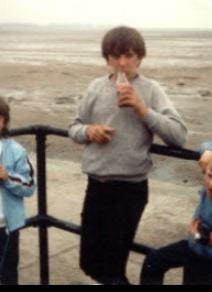
Skelmersdale was brand new. A postwar New Town with a shopping centre that gleamed and shimmered and echoed like the future.
It was the late ’70s, and everything seemed hotter, brighter, endless. That might just be memory, but those summers felt like they never ended.
The Concourse Shopping Centre had just opened. I went there almost every day, collecting helium balloons from whichever promotion or stall would give me one. My plan – and I was deadly serious about this – was to collect enough to tie together and float off the ground. I thought that was how hot-air balloons worked. This was going to be my grand escape.
I remember queues snaking around the cinema for Star Wars, then Superman, then Grease. The smell of popcorn. Plastic seats. Hot carpet.
Behind the school was a steep slope. In summer, the long grass would be flattened into shiny tracks as we slid down on pieces of cardboard. It was fast, it was rough, and it felt like flying.
I cycled for miles on my little red bike. By then, the stabilisers were off. I could go anywhere.
One of the few times my dad ever really did something for me, he took me to Wigan and bought me a Hornby train set. He even helped build the baseboard. I didn’t care much about the trains. What I loved was building the scenery – papier-mâché mountains, tiny buildings, painted roads and bridges. I think that’s where my love of architecture began. Not with grand ideas, but with tiny worlds I could control.
And of course, Blondie was in the charts. Some of the older girls dressed like Debbie Harry – short skirts, messy hair, confident eyes. That was the first time I ever felt real envy. Not attraction. Envy. Why couldn’t I dress like that? Why couldn’t I be like that?
Once we were settled in Skelmersdale, normal service was resumed.
If anything, I got better at it.
I knew what I wanted. I became more sophisticated in how I concealed things – more careful, more methodical. The cycle was already in place by then, and it always followed the same pattern.
A trigger. A spark. Something small – a pair of boots my mum brought home, a dress I couldn’t stop staring at, a model on the cover of Woman’s Weekly. Something that lit the fuse.
Then the pull.
It was never casual. Never playful. Once the urge hit, I went full tilt.
I’d start assembling the things I wanted to wear, always in two categories.
First, the safe stuff – the old ’70s pieces I knew she’d never wear again. I could steal those outright. Hide them. Make them mine.
Second, the riskier items – the ones she still wore. Those I had to borrow with military precision. I memorised how they were folded, noted which drawer they came from, tracked how often she used them. I’d take them, wear them, and put them back exactly as they were. No creases. No traces. No evidence.
It was a system. I was methodical.
I stored the permanent theft items – the ’70s things I knew she'd never wear again – in a giant jigsaw puzzle box. One of those big 3,000-piece ones my grandad used to give me. Nobody else touched them, so I thought it was safe. I also stashed a few pairs of tights in there. Ones I thought I might get away with – maybe they’d started to ladder slightly or looked like something she wouldn’t miss.
It was all calculated. Quiet. Controlled. Hidden in plain sight.
And for a while, it was.
Until it wasn’t.
One day after school, I opened the box and everything was gone. Whatever had been in there – old ’70s pieces, maybe some laddered tights, the odd skirt or slinky top I’d convinced myself she wouldn’t miss – it was all gone. Every last trace. No note. No comment. Just the echo of absence.
That was always the final stage of the cycle: discovery without confrontation. My mother never said a word. Not then. Not ever. But I knew. And she knew I knew.
The shame hit like a truck.
I’d swear it was over. I’d promise myself – no more sneaking, no more dressing, no more pretending. I meant it. Every time, I meant it.
And then, a few weeks later, I’d be back in the drawers. Back in the fabric. Back in the only place I ever felt like myself.
This was how it worked. Over and over. A private orbit of guilt and need. No exits. No language.
And underneath it all, something I couldn’t yet name: that strange, bittersweet ache when I looked at girls.
I knew I fancied them. That wasn’t in doubt. But it was different somehow. The boys at school talked about girls like they were targets – something to aim for, conquer, boast about. I just watched. In awe. They painted their faces. They walked like they meant it. They knew how to exist without apology.
I didn’t want to kiss them – well, maybe afterwards I realised I did, a little. But the truth is, the balance of those feelings was never even. It tipped heavily toward wanting to be them.
To have what they had. The licence. The softness. The shape.
That’s a strange thing to carry when you live in a place like Skelmersdale – a brutal, northern, working-class town where tenderness was in short supply, and difference even shorter. If anyone had caught so much as a whiff of what I was, my face would’ve been introduced to the pavement before I could say the word skirt.
Especially when your father’s already gone. My mum threw him out when I was nine. A couple of years later, he died in a fire.
I never saw him again.
By then, I’d already learned how to hide entire universes inside a jigsaw box.
But it wasn’t all cross-dressing and secrecy. I was still trying to be normal, whatever that meant. Still trying to figure out where I fit.
As the ’70s gave way to the ’80s, things changed. The music changed – Duran Duran, The Smiths, The Human League. I tried to grow my hair out like Phil Oakey. As long as I could get away with it, I let it grow.
I had little crushes, confusing ones.
In first year of secondary school, I liked a girl – can’t remember her name now – and at the end of the year we all went camping at Lake Coniston. School tents everywhere, rows of them pitched on the grass. Me and Paul Henshaw had our own fancy little tent, and we thought we were proper expedition leaders compared to everyone else. I remember buying a Curly Wurly and tossing it into the girl’s tent like it was a romantic gesture. She laughed. Told everyone. That echo came back all week. All term.
Then there was the girl I went on a date with in second year. I was maybe thirteen. We walked around town. I was too nervous to kiss her. I froze. And the next week at school, she told everyone I was pathetic. They all laughed. And laughed. And kept laughing, for what felt like months.
I knew I liked girls. That wasn’t the confusion. It was just never simple. Never straight. I didn’t want to be with them as much as I wanted to be like them. And somehow, both things were true. Always.
⚡ Lightning Rebirth — Read in order
Introduction | Chapter 1 | Chapter 2 | Chapter 3