


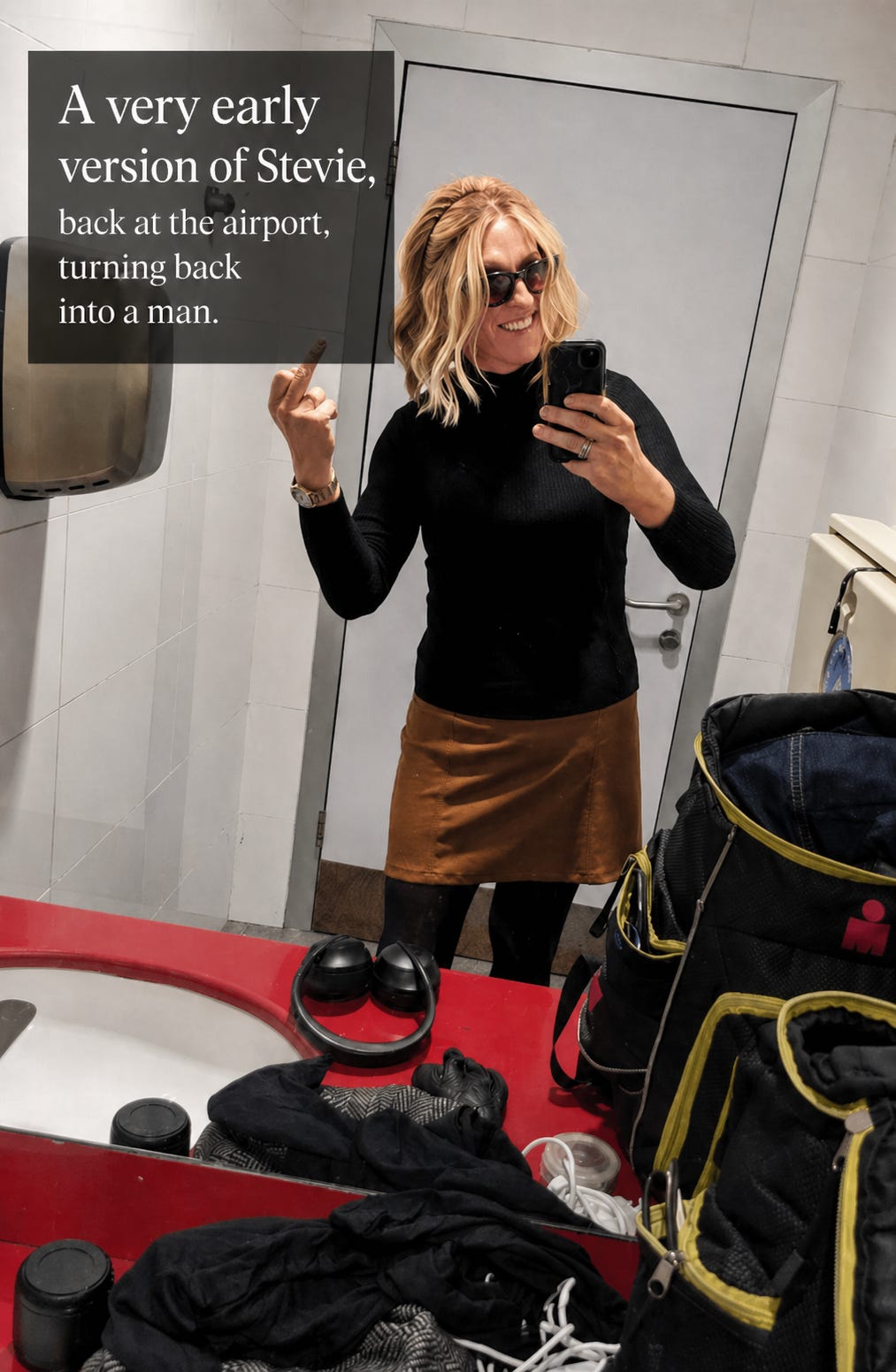
It’s been a long time since I released any of my autobiography, and the reason is something I made clear las year. The later chapters get into my family, my children, my marriage, the bitter pain of it all. And to be honest, I didn’t write those parts for public consumption. I wrote them for myself, and maybe one day, when I’m dead, my family might read it and see how it was from my side. If I never get to tell them in person, at least it’s there. That’s why I did it.
But before all that arrived, there was this. The point when I first decided I needed to go for a facial feminisation consultation. My plan was to go to Spain to see Facial Team, because they could produce virtual images of what a feminised face would actually look like on me. And that was pivotal. Make or break. Whether or not I thought I’d look okay after the work was done was, frankly, everything.
What follows used to be two chapters, Barcelona and The Consultation. I’ve amalgamated them into one here. It’s also one of the first times I ever went out the door as Stevie. I was absolutely terrified.
Chapter 27: Barcelona
The day before my flight to Barcelona, I was packing feverishly using, of all things, my Ironman finisher’s bag. The symbolism was not lost on me. That bag had once carried me through races, through triumphs built on sweat and sinew and discipline. Now, it carried a different kind of preparation. Not gels and bike gear, but lashes, heels, and hope. My body had trained for that other life. This one was new.
So I packed two parallel lives. A handful of male clothes for the hotel: jeans, hoodies, soft armour. The familiar uniform of the man I had been for fifty-five years. And then, carefully folded, sealed like contraband at the bottom of the bag, one full female outfit. Top, skirt, tights, shoes, the lot. Makeup. Jewellery. Everything I would need to become someone else, or rather, someone I had always been but had never let walk into a room. All of it crammed into the same bag that had once held my race-day kit.
I was absolutely shitting myself.
I had not left my house dressed as a woman in over twenty years. Not at night. Not in the dark. Not even once around the back garden. The closest I had come was the office, with the door locked, the curtains drawn, the camera angled just so. The idea that I would now fly to a foreign country, walk through an unfamiliar city, check into a hotel, and then appear the next morning as Stevie to a team of clinical professionals was borderline deranged.
But I had decided. If I was going to do this, I was going to do it properly. I wasn’t going to show them a miserable man and ask them to imagine. I was going to show them a hopeful woman and ask them to refine her.
I arrived at the hotel in Barcelona late afternoon. Dropped my bag on the bed. Stood at the window for a long minute looking at a city I had walked through several times before, but never as her. I knew I needed to do a test run. Not outside. I wasn’t ready for outside. Just a dry run, here in the room. Clothes laid out on the bed. Mirror lit. Lighting checked twice. Everything had to be right.
This had to be the best I had ever presented to the world, even though the world wasn’t watching. Because I was. Because this version of me would be immortalised in photographs the next morning. Fed into simulations. Studied on a surgeon’s tablet. This would become the blueprint for my face, and therefore for my future.
So with trembling hands and a jaw clenched so tight I could feel it the next day, I got to work.
I did my makeup better than I think I had ever done it. Too much concealer, yes. A wobble on the eyeliner that I caught and corrected and then noticed again half an hour later. The hair a fraction too overdone. But all of it forgivable. All of it real. I stood back from the mirror, tilted my chin the way I had practised in the office a hundred times, looked her in the eye, and whispered:
We can do this.
And we could.
The next morning I woke up wired. Heart already going. Mind already running multiple simulations. I had mapped out my timings in reverse like an airport logistics manager. I had a sequence for everything. Shower. Shave. Makeup. Outfit. Exit. Confidence.
But more importantly, I had choices. And each one said something about the woman I was becoming.
There were cowardly routes and brave routes.
Option one. Just turn up as a man. Smile politely. Let them guess. Tell them, use your imagination.
Option two. Pack the whole Stevie outfit into a bag, get a taxi to the clinic, find a gender-neutral bathroom, get changed, do the consultation, then reverse the process and disappear back into Steve before anyone outside the clinic ever saw her.
Option three. Get ready fully as Stevie in the hotel, take a pre-booked cab door to door to the clinic, do the consultation, change back into male clothes in the clinic bathroom before heading to the airport.
And then there was option four. The fuck it option. Walk out of the hotel through the streets of Barcelona as Stevie. Do the entire thing. Clinic, taxi, airport. As Stevie. And then, only at the very last moment, transform back into Steve at the departure gate like some weary, reluctant Superman.
That is exactly what I did.
It was the bravest, most exhilarating thing I have ever done in my life, and that is saying something for a woman who has finished an Ironman.
To get me through it I had built a playlist. It opened with New Jack Hustler by Ice-T. Angry, sharp, defiant. The kind of track that makes you walk like you own the pavement. That gave way to vintage Public Enemy. Fight the Power. These were my power tracks. My war drum. The music I had needed at twenty-five but only really earned the right to use at fifty-five.
I had rehearsed the walk. Seriously. From the hotel room to the lift, from the lift to the lobby, from the lobby to the street. I had it down to muscle memory. I knew where the mirrors were, don’t look. I knew where the awkward corners were, stride with intent. I knew when to hit play.
I dressed in a black polo-neck jumper, a black faux-leather biker jacket, a suede miniskirt, black opaque tights, Converse boots, massive sunglasses, and a pair of noise-cancelling headphones. Hair done. Makeup as good as I could manage. Heart absolutely pounding in my throat.
And then I opened the door.
Bang. Ice-T kicked in.
I strutted through the corridor like a woman on a mission. It felt like Baby Driver meets Run Lola Run, except the stakes weren’t a stolen car or a bomb. The stakes were me. My dignity. My right to walk through the world as Stevie and not explode from shame.
I kept going. Past the lift. Across the lobby. Past the concierge desk where I clocked the receptionist not even glancing up. Out the front door. Onto the street.
And the street did not collapse.
I walked across the city. Through crowds. Over crossings. I deliberately walked through groups of people instead of around them, just to see what would happen. Just to test the world.
And nothing happened. Nobody looked. Nobody stared. Nobody shouted. Nobody even cared. I was just a slightly eccentric middle-aged woman in too much black with possibly a suspect brow bone. That was it.
And I felt invincible.
By the time Sister Sledge came on, We Are Family blasting in my ears in a city full of strangers, I was flying. Shoulders back. Chin up. A little swing in the hips that I hadn’t given myself permission to have in decades. I had never felt like this. Not ever. It was not just that I was presenting as a woman. It was that I was doing it out loud. On purpose. On display. In motion. And the world had not ended. The world had, in fact, barely noticed.
I will never forget that walk for the rest of my life. Whatever else happens to me from here on in, I had that morning, in Barcelona, with Ice-T in my ears and the sun on my face and a miniskirt I had been too frightened to wear in my own house finally meeting daylight.
When I arrived at the clinic, I was euphoric. Properly euphoric. The kind of high that no drug has ever given me. I checked in at reception with hands that, for the first time that morning, were not shaking.
The clinic itself was beautiful. Spanish minimalist. Cool tiled floors, soft lighting, the smell of something faintly citrus. Trans women came and went through reception with the casual ease of people for whom this was all completely normal, because for them it was. There was a woman in her thirties on the sofa with a coffee, post-op, bandaged, scrolling her phone. There was a woman in her sixties at the desk speaking rapid Spanish to the receptionist about an appointment time. Nobody was hiding. Nobody was performing. It was just a clinic. It was just Tuesday.
I had walked into the first room of my life that was built for women like me, and I had walked in as one of them.
They took me through to consultation. CT scanner first. Lie still, breathe normally, hold your breath, and now we have a three-dimensional map of your skull. Then high-resolution photography from every angle. Front, three-quarter, profile, the lot. I had practised the angles in my office mirror so many times that the photographer’s instructions felt almost redundant. Chin down a touch. Eyes to camera. Hold.
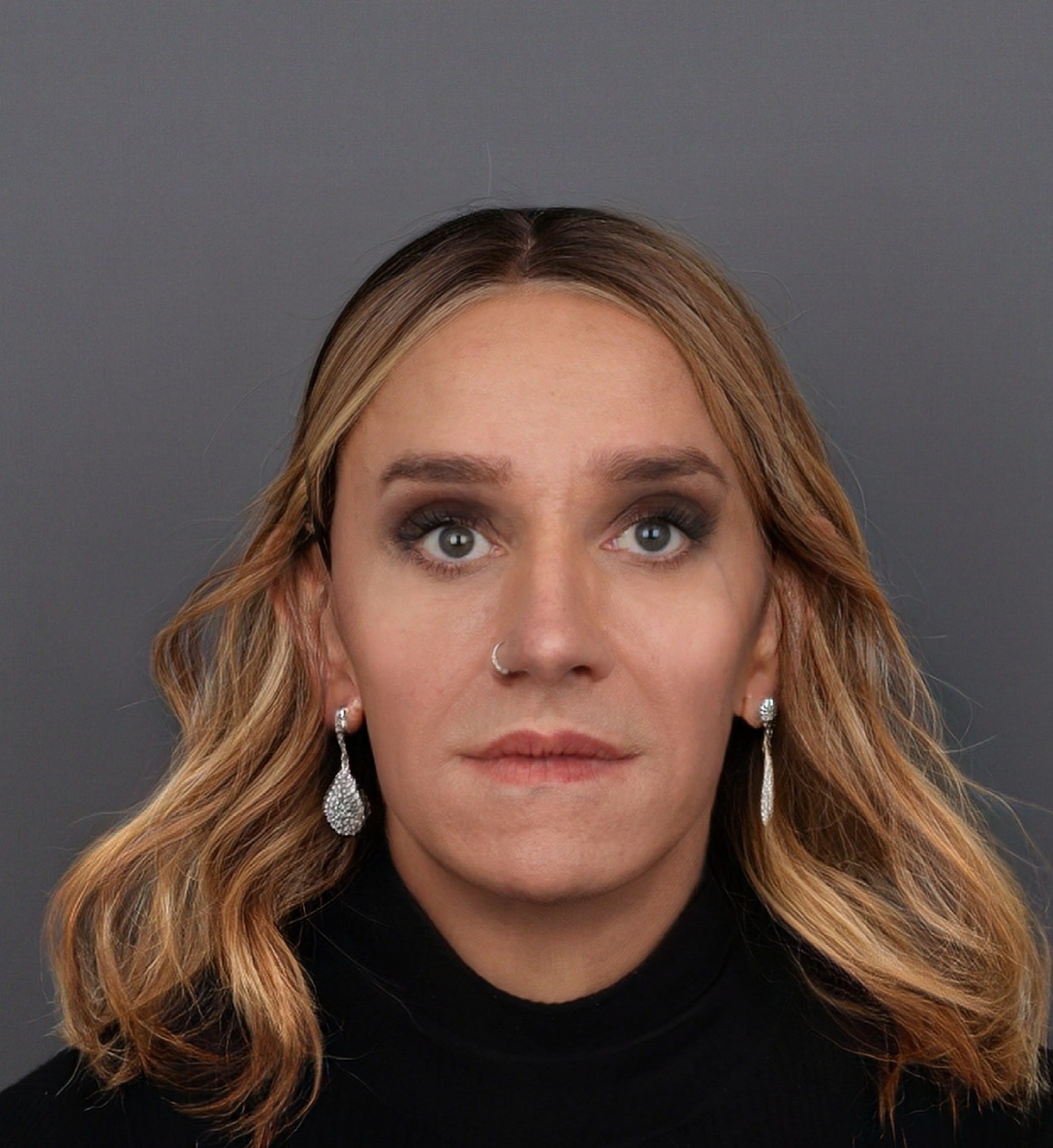
Then the surgeon came in.
He was younger than I expected. Maybe forty. Handsome, competent, vaguely intimidating in the way that only young, handsome, competent men can be when you’re a slightly older trans woman sat across from them hoping desperately to be taken seriously. But he was kind. Warm, even. He shook my hand the way you shake any patient’s hand. He sat down across from me and pulled up the imaging on his tablet.
And then he started showing me my own face.
Not the face I had. The face I could have. The simulations rotated front and profile on the screen. And this time it was not vague reassurance or flattering generalities. It was specific, clinical, almost brutally matter-of-fact.
He pointed out the bossing on my forehead, the heavy prominence I had spent transition trying to disguise with angles, hair, and wishful thinking. He explained the brow ridge, the orbital sockets, and how that whole upper third of the face was reading strongly male.
Then he moved to the nose. It was, he made clear, a substantial job. Large, buckled, structurally masculine. Not a little tidy-up. Not some delicate refinement. It would likely need a full open rhinoplasty, proper surgical work, to bring it into balance.
I mentioned my cheeks, how hollow and sunken they looked to me, and he agreed volume would matter. Significant fat grafting, he said, to restore softness and shape through the mid-face.
Then I asked, almost hopefully, “I don’t really have a very big jaw, do I?”
He looked at me and said, matter-of-factly, “No, you don’t, Stevie, but your chin is very large.”
I could not believe he had said it so plainly, but he had.
“But you can fix it?”
He gave the sort of answer surgeons give when they are being honest rather than charming.
“It depends how close to the mental nerve we can get.”
Even then I understood what he meant. There are limits. Nerves. Bone. Risk. Precision. This was not magic. It was engineering inside flesh.
He also pointed out something important about the simulations themselves. They were largely skeletal demonstrations, showing structural change rather than the full finished result. They did not really account for soft tissue procedures. A facelift, he explained, would change the overall drape and descent of the face considerably, bringing everything into a more feminine position in ways the raw simulation could not fully show.
The forehead reshaped, the brow ridge reduced. The orbital sockets opened. The nose narrowed and lifted. The chin shortened and slimmed. The jawline brought in. Each adjustment small on its own. The cumulative effect, transformative.
I sat there looking at a face that was unmistakably mine and unmistakably hers. Not a stranger. Me. The me that had been buried under fifty years of testosterone and bone.
I kept it together in the room. I had to. But I will say, looking at that simulation was the closest I had ever come to seeing a future I actually wanted to live in.
The technical part of the consultation was where my plan met their expertise. I had wanted to do soft tissue work first. Deep plane facelift, nose job, lip lift, tracheal shave. Then come back later for the bone work. Forehead and chin. My logic was that the soft tissue stuff was less invasive, faster recovery, and would let me see how I looked before committing to the bigger work.
They thought this was ridiculous. Wrong order. Illogical.
Their reasoning was simple. The bone work changes everything underneath. If you do the soft tissue first and then go in and reshape the bone, you are pulling and stretching tissue that has just been operated on, and you are making the second surgery harder and the result less predictable. Bones first. Then soft tissue settles over the new architecture. Then, if needed, refinements. The order matters.
They were totally right. I had been so focused on trying to minimise the damage to my marriage that I had totally inverted the surgical logic. I nodded. Said I would think about it. I knew, even as I was nodding, that I would do it their way.
We wrapped up. They gave me a printed summary, a USB stick with the simulation files, and a follow-up email address. I thanked the surgeon. I thanked the team. I walked out of that clinic into the Barcelona sunshine with a piece of paper in my hand that was, in effect, a blueprint for my own face.
And I called a cab.
The taxi ride to the airport was the strangest forty-five minutes of my life. I was Stevie, in the back of a cab, on a Spanish motorway, with Public Enemy still in my headphones from the morning. The driver had not blinked when I got in. He had not blinked when I gave him the airport in my voice, which I had been working on but which I knew was still a work in progress. He was just driving.
I was just a passenger.
It was the most ordinary thing in the world.
I sat there watching the outskirts of Barcelona slide past the window and I thought about the next twenty-four hours. The flight home. The drive from the airport. The front door. The life I had to walk back into. The man’s clothes I was about to put on in an airport bathroom because I was not yet ready, not quite, to take this version of myself through passport control.
I knew, sitting in that cab, that I was going to have to come back. Not to this clinic. Not necessarily. But to this version of myself. I was going to have to find a way to live as her, not just visit. The morning’s walk had broken something open that I was not going to be able to close again.
At the airport, I went straight to the family bathroom. The big one with the baby-changing table. Lockable door. Mirror. Floor space. The unsung trans-woman travel hack of the century.
And then, finally, I put Stevie away.
Off came the makeup. Off came the earrings. Off came the necklace. Off came the tights, peeled and balled and stuffed into the bag. Off came the skirt, the polo neck, the bra. Off came the woman.
Back came the man.
I looked at him in the mirror. The jeans, the hoodie, the baseball cap. The face scrubbed back to neutral. The same face that had walked into the hotel the night before. He looked exhausted. He looked older than he had that morning. He looked like a costume.
I hated him.
I had not hated him in the morning. I had walked out of the hotel that morning slightly fond of him, even, the way you can be fond of an old jumper you are about to throw away. But now, after a day as her, putting him back on felt like being buried alive in a body I had already started leaving.
I did not want to change back. I did not want to hide again. But I was not quite ready. Not for passport control. Not for customs. Not yet. There was still work to do at home.
But something had shifted. Something fundamental.
I had walked Barcelona as Stevie. I had sat across from a surgeon who had taken me seriously. I had seen my own future face on a tablet. I had taken a taxi as her. I had survived as her. And, more than that, for the first time in my fifty-five years on this planet, I had actually lived as her.
When I boarded the plane home, I was Steve again on the outside. But she was sitting in the seat next to me now, properly, for the first time. And she was not going back in the bag.
Thank you for sharing such a vulnerable and personal story. It is important for spouses of trans women to understand what you have endured both pre and during transition. You story eerily echoes my own wife's to the extent that I feel like I am reading her story, only it takes place in the UK. Otherwise, you two are practically the same people, right down to the career choice, athletic endeavors, etc. Oh and you and I are quite similar too - I am decorating my new house and planning on hanging my single speed cyclocross bike on my guest room wall as art; it's a custom frame that I won an entire series with and I wanted to showcase it properly.