


A brief glossary for my American friends
Wanker: Literally, one who masturbates. Culturally, a fool, poser, idiot, or person taking themselves far too seriously. In this article, mostly me
Scouser: Someone from Liverpool. Or, in my case, someone from near Liverpool who has spent years hoping nobody checks the paperwork too closely.
Red or blue?: Liverpool or Everton. Not a colour preference. A tribal sorting mechanism.
The Arkles: A pub near Anfield Stadium. Not hostile exactly, but not where you want to be testing out a fake football personality.
Football: Soccer. I am sorry, but also not sorry.
Nothing quite matches the terror of sitting in a pub outside Anfield, somewhere like The Arkles, surrounded by rough, tough working-class Scousers when you are supposedly a football fan but secretly know you are playing a part.
Every sentence feels dangerous. Every opinion feels like a landmine. You become hyperaware of statistics, names, eras, managers, defensive pairings, injuries, transfers. It feels like being an undercover cop who has memorised his fake identity backwards but knows full well that two wrong turns in the conversation and the whole thing collapses.
That was me with football.
A fake. A fraud. Somebody performing football fandom rather than living it.
I should probably explain why I tried so hard.
It happened after I tried to get rid of Stevie for good.
By then the vaguely pretty John Taylor crossed with Bono years were long gone. Stevie had been shoved into a locked room somewhere in the back of my mind and in her place stood what I later came to think of as The Fat Man. Bigger. Greyer. Sadder. More desperate to be normal.
I needed something masculine to climb into. Something culturally approved. Football was there, waiting for me, like it always is for British men.
And there was a genuine thread back to childhood in it too. My dad used to take me to matches when I was little. It was also a thread back to Liverpool itself, or at least the idea of Liverpool, which mattered because by then I had long since left.
Although even that is complicated because we were not really proper Liverpool Liverpool. We were satellite Scousers. Skelmersdale. The overspill generation. The people orbiting Liverpool with a permanent tiny chip on our shoulder about not being from actual Liverpool. The same psychology probably applies to Kirkby and places like that too. You grow up close enough to absorb the identity but far enough away to feel faintly illegitimate.
Which makes sense illegitimate was exactly how I felt about football as well.
The thing is, I was never completely uninterested in football. As a kid I followed Liverpool vaguely. European Cup finals were events. I would get sweets in and watch the match. I had newspaper clippings on the wall. But I was never one of those boys who wore football kits everywhere or spent every waking second talking about football. By the time I was thirteen or fourteen, music interested me far more. Style interested me more. Identity interested me more.
And yet somehow, after I buried Stevie, I decided I was going to become Football Man.
The problem was I did not naturally understand football culture in the instinctive emotional way many men seem to. So, being me, I approached the problem in the most catastrophically autistic way imaginable.
I built a football database.
Not a spreadsheet. Not a little list of players. An actual relational database. Tables. Relationships. Historical records. Fixtures. Results. Managers. Players. Trophies. I built a scraper that crawled Soccerbase and sucked the data into my local machine so I could query it properly.
Why?
God knows.
Presumably because some part of my brain thought:
“If I cannot naturally absorb masculinity, perhaps I can construct a queryable model of it.”
Most football fans absorbed football emotionally. I absorbed it through SQL views.
This gave me a strange kind of fake fluency. I knew facts. I knew eras. I knew references. I could surface interesting statistics. If somebody mentioned a terrible Liverpool defensive period, my brain would instantly start searching indexed metadata:
“Ah yes, Julian Dicks. Deploy that reference now.”
But underneath it all I was absolutely terrified of being exposed.
And the thing is, I suspect some people could smell it on me.
I once worked with a Scouse bloke who, if I am honest, was not a particularly nice person. But I think he saw through me almost immediately. I think he sensed that somewhere underneath the pub talk and the match tickets and the Liverpool shirt was somebody fundamentally different.
Which is funny really, because around that same period I ended up drunk in The Adelphi after meeting an 80s icon on a train home from Liverpool, confessing all sorts of things while dressed like a football supporter returning from a match.
The whole thing was like some bizarre undercover operation where the disguise kept slipping.
But perhaps the strangest thing about football was that eventually I realised I did not actually dislike it. I disliked what I was using it for.
Because football had become camouflage.
It was a ready-made British male operating system:
tribe, clothes, pub talk, emotional permission, social belonging, masculine legitimacy, all bundled together under one giant commercially sponsored banner.
And once I noticed the machinery behind it all, I could never quite unsee it.
The official wine.
The official duvet set.
The official noodles.
The official betting partner.
The official everything.
When I was little and being taken to matches, almost everybody around you was local. Working-class Scousers, plus a few Irish lads. By the time I drifted away from football, you would sit in the stadium between somebody from Scandinavia on a package tour and somebody from Portugal doing the full Liverpool experience weekend.
It just fascinated me because the whole thing increasingly stopped feeling like a football club and started feeling like one of the most successful emotional branding operations ever created.
At some point I realised that football clubs were no longer communities with brands attached. They were brands with communities attached.
But the greatest liberation of all came later.
For years, whenever somebody heard my vague Scouse accent, they would ask:
“Red or blue?”
And for years I felt compelled to answer correctly.
Then one day, somewhere around 2007, I finally discovered the freedom of simply saying:
“I don’t really follow football.”
It was brilliant.
No performance.
No masculinity exam.
No panic about saying the wrong thing.
No emergency deployment of Kevin Keegan statistics from a database query I had run three weeks earlier.
Just honesty.
And the funny thing is, I do not even hate football.
I still like the World Cup. If England are playing, I will watch it. I might even care for ninety minutes. I just do not follow football in any meaningful way anymore, and I no longer pretend that I do.
In fact, this whole article started because I noticed in the paper that Harry Maguire had been dropped from the England squad. I looked up the latest England team and was genuinely surprised that I still recognised about six of them.
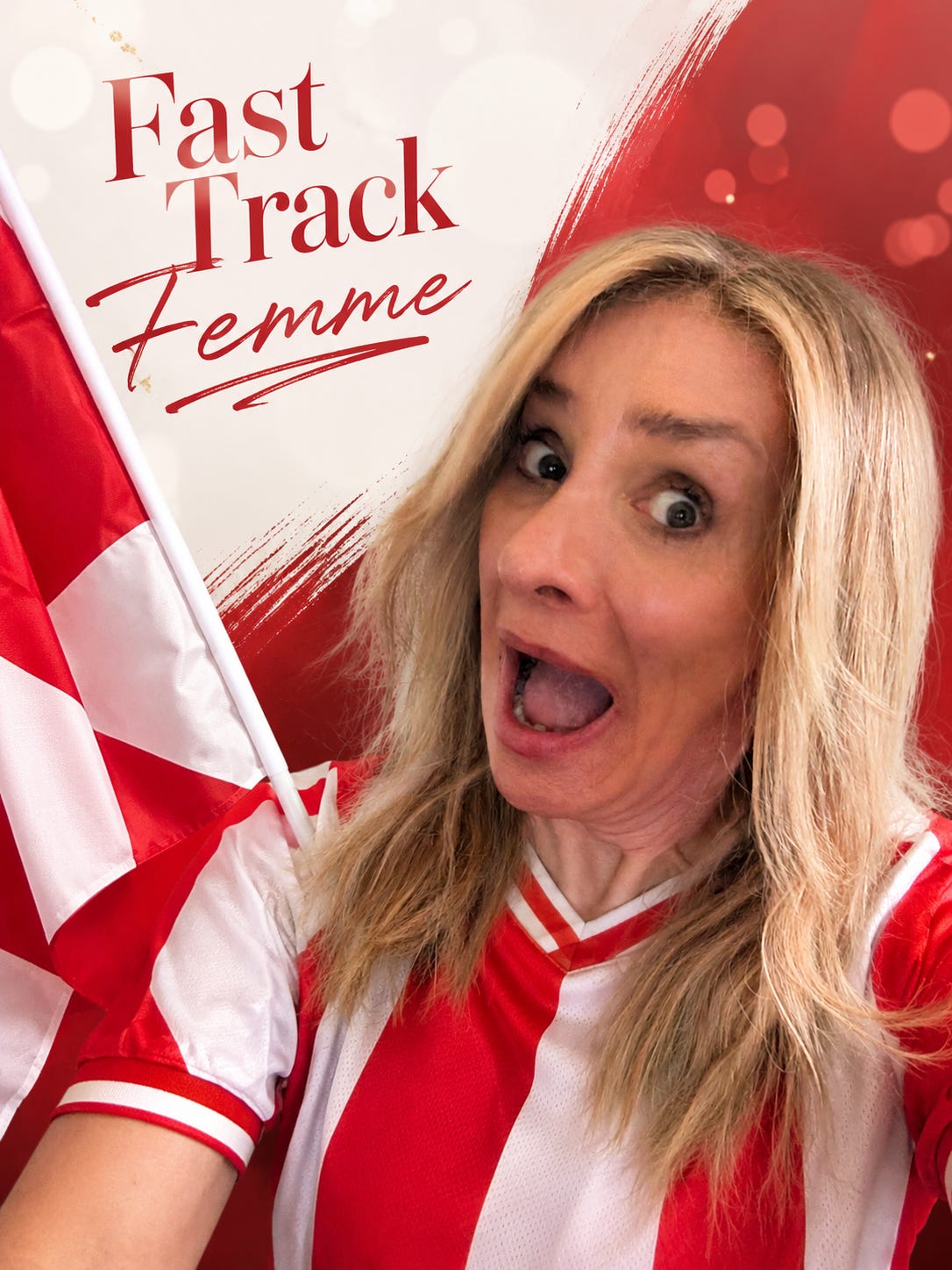
And then, after all of that, I suddenly had this ridiculous mental image of myself watching the World Cup in an England top as a blonde woman with 36C boobs, looking like one of those girls they used to put in The Sun during tournament season.
And at that point I burst out laughing.
Not a delicate feminine laugh either. The booming man laugh. Every trans woman knows the man laugh. The one that escapes when something is so funny you are completely off guard and your entire old operating system briefly comes back online.
Apparently some part of the database survived.