

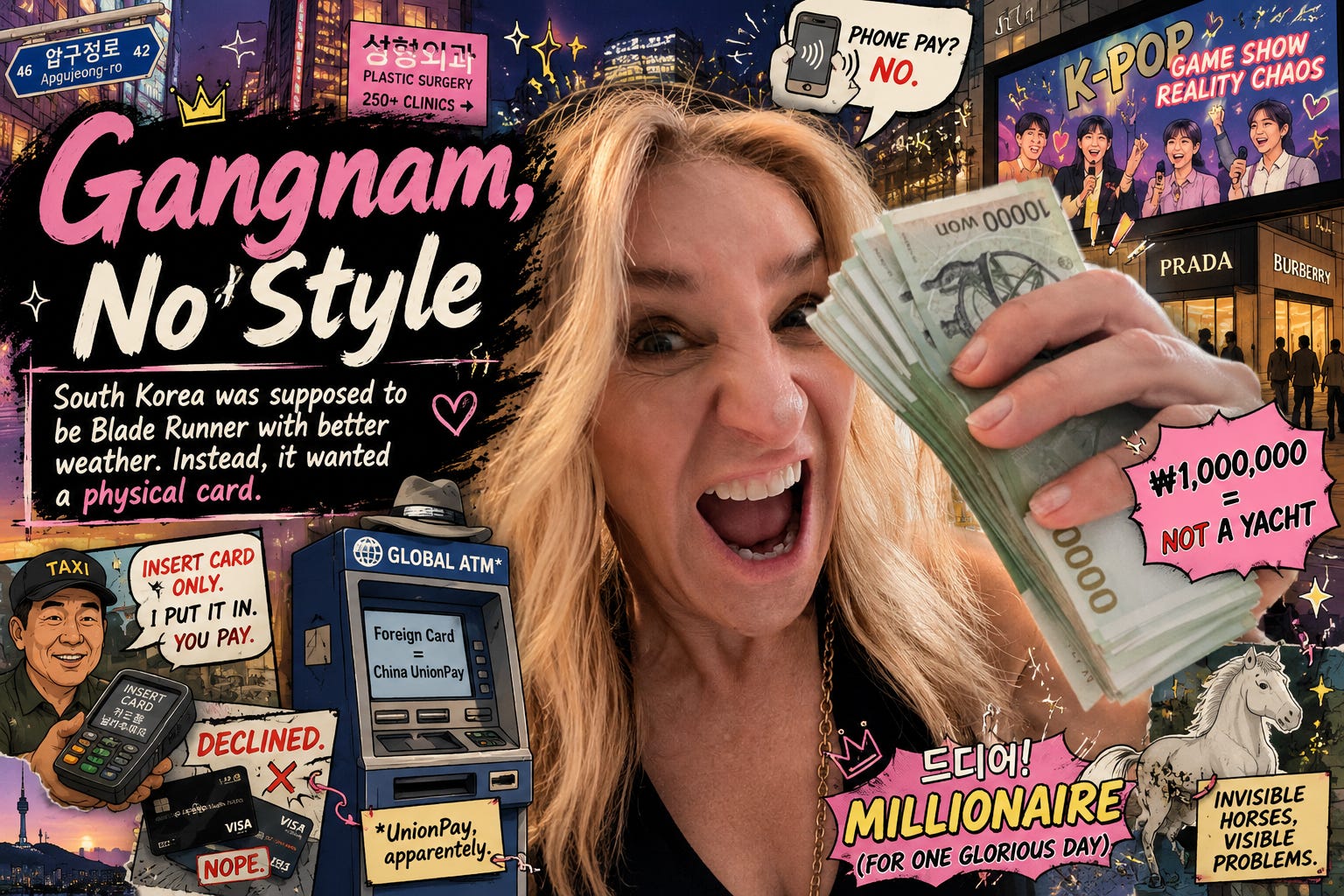
The travelogue is back.
I bored you all senseless last October with daily dispatches from my facial feminisation surgery trip, including my epic joint-smoking adventure on Walking Street, where I proceeded to stand against a wall for four hours trying not to look high as a kite while seedy men drifted past me.
Oh, You Silly Bitch How I survived Walking Street, 808 Club, and my Trainspotting flashback
Anyway, we are back.
We are in South Korea.
We are in Seoul.
And, more to the point, we are in Gangnam. One of the most affluent parts of the city, synonymous with wealth, beauty clinics and, thanks to a song released fourteen years ago, invisible horses.
So why am I here?
As my taxi driver pointed out during the mild guided tour he kept inserting into my playlist, the street beside my hotel is famous for plastic surgery. According to him, there are around 250 clinics here.
Once he realised I had come to Seoul for an operation, he began trying to give me business cards belonging to friends of his who ran plastic-surgery tours.
I think he believed I had simply flown halfway around the world, stepped out of the airport and thought:
Right. Where can a girl get some completely unspecified surgery around here?
“No, no, no,” I kept saying. “This is a very specific clinic.”
He could not believe he had never heard of it.
I tried to explain that it serves a rather specific clientele.
My charming taxi driver continued talking over my music anyway, pointing at buildings and issuing unsolicited medical-tourism recommendations as we crawled through Seoul.
Before arriving, this was my imagined version of South Korea: televisions full of K-pop, acres of camp game shows, and brightly dressed people shouting at each other while eating violently coloured food.
And, as I write this, that is exactly what is happening on the television in front of me.
I have flicked through what feels like a million channels. Not one is in English. There is no BBC World, no France 24, no tiny concession to the frightened Westerner.
You are in Korea.
You are watching Korean K-pop game-show reality television.
Get over it.
Immerse.
Enjoy.
It is magnificent.
But the television was only part of my imagined Korea.
In my head, South Korea was going to be something like Blade Runner, if Blade Runner had gone well.
Not the rain, misery, replicants and dystopia. A sunny, smiling, hyper-efficient future: recognisably like the West, but several generations ahead.
At home, I walk around like a little fairy godmother carrying a wand.
My wand is a Pixel 8.
Can of Coke?
Ping.
Coffee?
Ping.
Petrol?
Ping.
Tap, tap, tap, tap, tap and go.
In my imagined Korea, people would look at this technology and say:
“Good God. Are you still using phones? We moved to iris scans years ago. Retinal payment is for pensioners. Most people authorise transactions telepathically now.”
They would, naturally, have gamified the whole thing.
Spend enough money and you earn bonus points. Earn enough points and you get invited onto one of the television programmes, where twelve beautiful people scream at you while a K-pop group throws luminous noodles into a swimming pool.
That was what I expected.
So the taxi pulled up outside my hotel, and I produced my magic wand.
I held my phone over the payment terminal.
The driver looked at me as though I had attempted to pay with a potato.
“Oh no,” he said. “Cannot.”
“What now? Do I need an app?”
No.
Apparently, I needed to locate a little rectangular piece of plastic.
“Yes, yes, yes,” I said. “I know. A credit card. You need a physical card.”
A physical card.
It is 2026, and South Korea, the country that was supposed to be paying for things with its eyeballs wanted me to retrieve a primitive plastic rectangle from my handbag.
Fine.
“At least I can tap the card?”
No.
The card had to be inserted into the machine.
And I was not allowed to insert it myself.
That is another thing I have noticed here. They get to put your card into the machine. You hand it over and they perform the ceremony, presumably because there is a danger that a foreigner might break the machine, tamper with it or attempt to feed it a biscuit.
I handed him my Visa.
He inserted it.
No.
Declined.
Fuck.
We performed the ceremony again with my second card, which is connected to the same international system and therefore failed identically.
Fuck.
Fuck, fuck, fuck.
We had now exhausted my methods of payment: futuristic phone and two primitive rectangles.
Eventually we went inside the hotel, where I attempted to explain cashback, ATMs, international cards, foreign currency and the complete collapse of my ability to participate in commerce.
Luckily, the hotel staff took pity on me.
They paid the taxi driver and told me I could reimburse them.
No problem, I thought.
I would find a cash machine in seconds.
This was not a big deal.
And then the big deal began.
Before dealing with that, however, I had to deal with my face.
I had put my makeup on somewhere around 25 hours earlier. Time had ceased to have any real meaning, but it had been through an airport, two flights, Abu Dhabi, Korean immigration and a taxi tour of Seoul.
My Tom Ford sparkly gold eyeshadow had migrated halfway down my cheeks. My eyes were completely panda-black underneath. Every product I had applied had shifted south under the combined influence of aircraft cabins, tropical heat and despair.
And, if I am being honest, my upper lip no longer felt quite as smooth as it had the day before.
There was nothing actually coming through.
But this is always a worry of mine.
Somewhere in the back of my mind lives a tiny customs officer whose only job is to inspect my face and shout:
“Stubble! We have possible stubble!”
I finally reached the hotel room, looked in the mirror and thought:
Right. Let’s tackle this bad boy.
What followed was a two-hour programme of beautification, unpacking and infrastructure development.
I set up a complete workstation because, yes, of course I brought a workstation to South Korea for surgery.
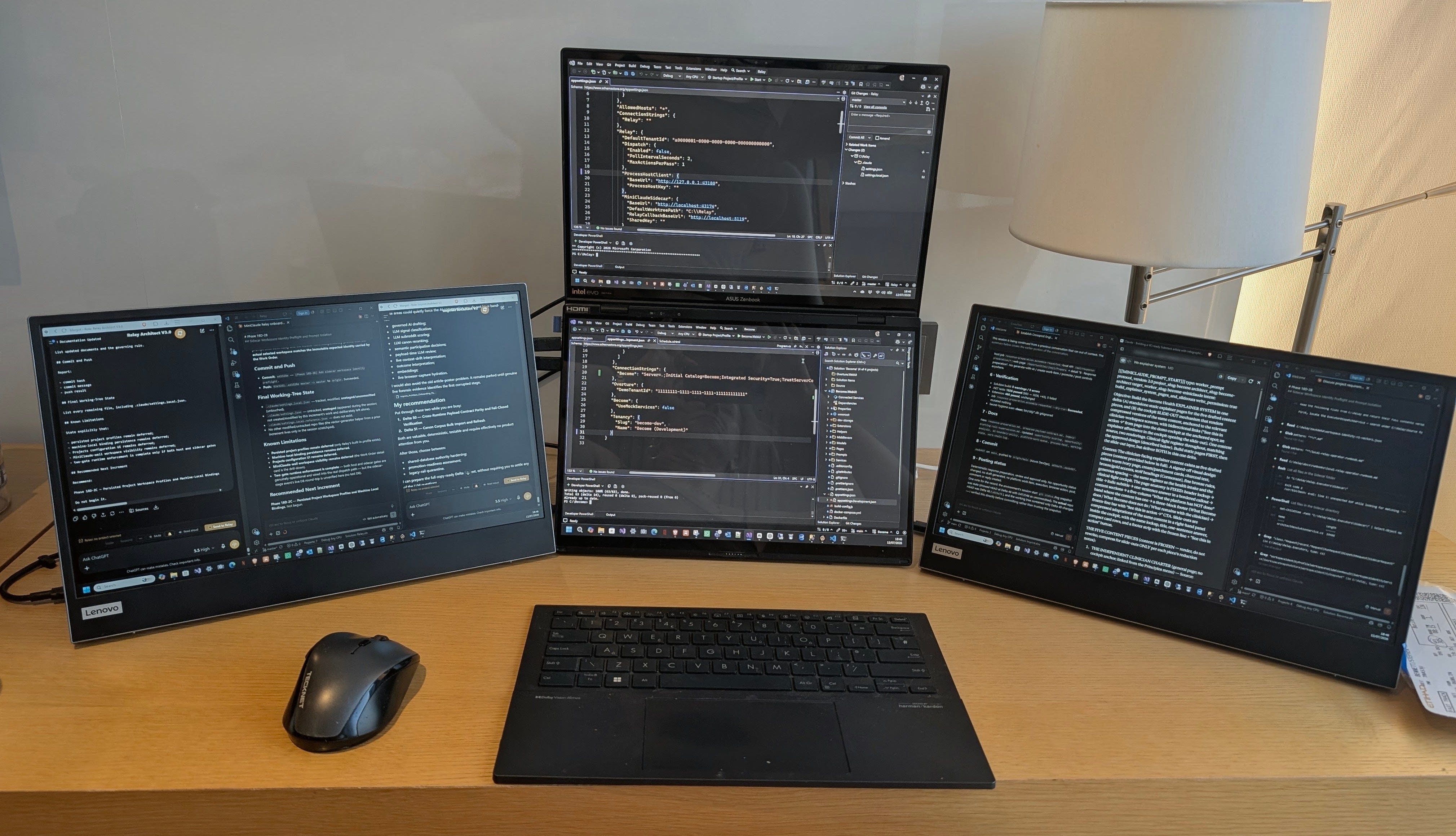
Within minutes, the MiniClaudes had come back to life and my relay system was switched on again.
Normal service had resumed.
After a long shower and an industrial quantity of restoration work, I emerged looking once again like someone who might reasonably be allowed into Gangnam.
It was now around 4.30 in the afternoon.
Possibly.
I had barely eaten all day.
I was starving.
Right.
Food.
I stepped outside and began walking around one of the wealthiest shopping districts in Seoul.
Burberry. Gucci. Prada. Vast windows. Beautiful buildings. Immaculate people. Acres and acres of luxury retail.
But where was the food?
Why could I not see people sitting in restaurant windows? Where were the cafés? Where were the bars? Where was anything that did not sell a handbag?
If this was like Knightsbridge, I could see the Knightsbridge shops.
But where were the Knightsbridge restaurants?
ChatGPT to the rescue.
Apparently, there was a fancy food hall only a few minutes away.
Excellent.
Down I trotted.
And it was, in fairness, very good. Beautifully designed, spotless and full of expensive things arranged under flattering lighting.
At the first counter, I ordered what was essentially coronation chicken salad with a forest of kale.
I had learned my lesson.
No phone tappy-tappy nonsense.
I handed over a physical card.
Payment accepted.
Success.
Excellent.
Next, I spotted a stall selling enormous, delicious-looking smoothies. I ordered something called Silk Road, containing mango, pineapple, banana, coconut cream, turmeric and various other things that made it sound both luxurious and faintly medicinal.
The man told me to return in five minutes.
Excellent.
Hand-prepared.
While I waited, I wandered into the fancy grocery shop ChatGPT had described as something like Harrods Food Hall.
I thought I might buy a tiny tub of ice cream. Perhaps some chocolate. Something modest and celebratory.
I reached the checkout.
The terminal said no.
Shit.
Taxi driver: failure.
Salad: success.
Smoothie: success.
Fancy grocery shop: failure.
Two successes.
Two failures.
This was not a payment system.
This was roulette with handbags.
There was only one option left.
Cash.
I would find an ATM, withdraw some money and re-enter civilisation.
Happy days.
How difficult could it be?
I have been to Bangkok. There are ATMs every six feet. You can scarcely turn around in Thailand without walking into one.
So, Silk Road smoothie in hand, I began walking.
It was July in Gangnam, around six in the evening, and baking hot.
Not pleasantly summery.
Baking.
The air felt solid.
I trudged along the pavement looking increasingly like Morgan Freeman walking towards the oak tree in The Shawshank Redemption: hot, tired, burdened by a long history of institutional injustice, but still faintly hopeful that somewhere ahead there might be money buried under a stone wall.
No ATM.
No bank.
Nothing.
Perhaps the machines were inside convenience stores.
Excellent.
I tried those.
This was where I learned another delightful fact about futuristic Korea: not every ATM accepts Visa or Mastercard.
You think Visa and Mastercard rule the world.
They do not rule Korea.
Many of the machines appeared to be connected only to domestic banking systems. Some announced that they accepted foreign cards, but by “foreign cards” they meant one very particular Chinese payment network.
I found one labelled GLOBAL ATM.
Wonderful.
I selected Foreign Card.
Wonderful.
Then it announced that Foreign Card meant China UnionPay.
Not Visa.
Not Mastercard.
Just one specific kind of foreign card.
It was a domestic ATM wearing an international hat.
Fuck.
I kept walking.
Eventually, I saw Galleria, a huge luxury department store containing Tiffany, Gucci, Prada and enough expensive merchandise to bankrupt a small principality.
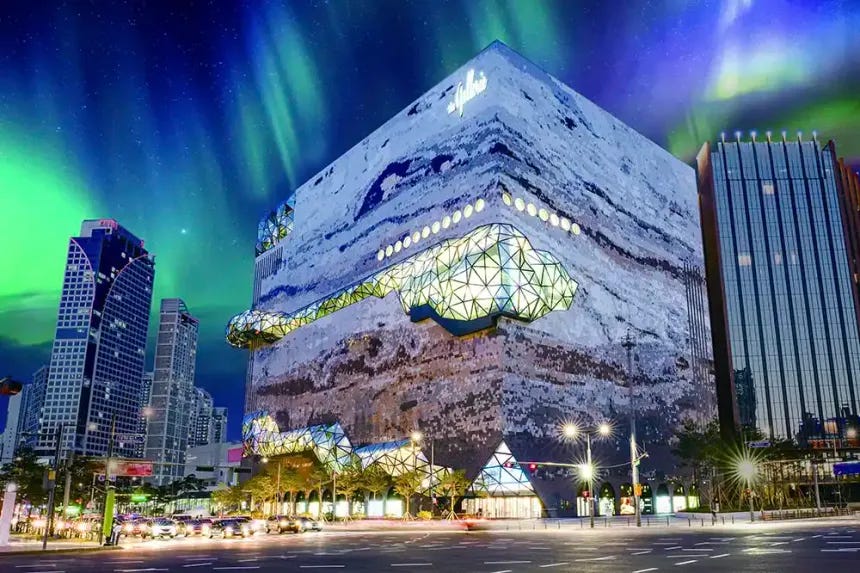
Surely this place catered to tourists.
It even had one of those tourist tax-refund and currency-exchange desks.
Solved.
I sat down in front of a woman and explained:
“Hello. I am desperate to spend money in your country, but your country seems strangely reluctant to let me have any. Could you tell me where there is an international cash machine? And could I exchange some money?”
Yes, she could exchange money.
Brilliant.
I handed her my card.
No.
They could exchange money only for other money.
“So I cannot buy Korean money from you using a card?”
No.
Only cash.
Dollars. Euros. Pounds.
The currency exchange could exchange currency provided you already possessed currency.
This is rather like a fire brigade agreeing to help only if your house is not on fire.
Fuck.
“Could you at least tell me where there is an international ATM?”
No.
Fuck.
Fuck, fuck, fuck.
And so the traipsing continued.
By now, I had begun to feel like The Little Match Girl of Gangnam.

When I was little, I used to secretly cry at The Little Match Girl.
The poor girl sits outside in the cold, looking through glowing windows at warmth, food and beautiful things. She lights her final matches one by one, each giving her a brief vision of comfort before going out.
That was me.
Except it was 38 degrees, I was in full makeup, and instead of matches I had a rapidly dwindling supply of euros.
Everywhere I looked were beautiful shops filled with things I could theoretically afford but could not actually purchase.
One card rejection.
Another match extinguished.
A little more cash gone.
Another match.
Soon I would be standing outside Gucci, pressing my face against the glass, seeing a vision of my grandmother carrying a Marmont handbag into heaven.
Then, at the corner of my eye, I saw a bank.
An actual bank.
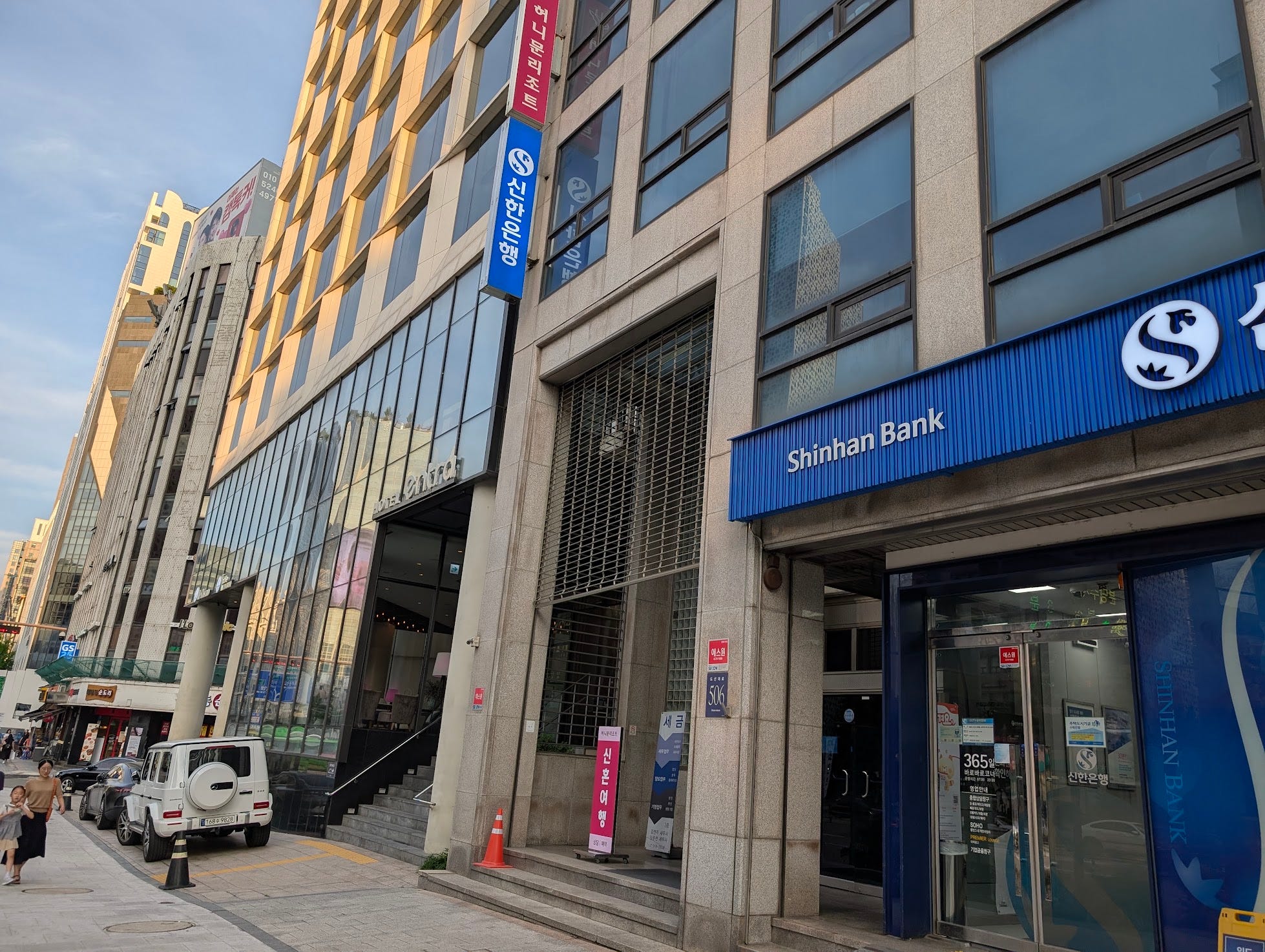
I went inside and found the ATMs.
International?
Yes. That’s me. International.
Foreign card?
Yes, yes, yes.
Visa? Mastercard?
YES.
Finally.
The machine asked how much money I wanted.
₩100,000?
₩200,000?
₩500,000?
₩1,000,000?
Oh shit.
I had no idea what any of these numbers meant.
A million sounded like a lot.
But perhaps Korean money worked like Indonesian money and a million bought you a sandwich.
Fuck it.
Maximum.
Give me a million.
The machine began whirring.
And whirring.
Then it started dispensing what appeared to be an entire catalogue of banknotes.
A thick, glorious wad emerged.
I grabbed it and celebrated like I had won a Korean television game show.
I took photographs waving the money around.
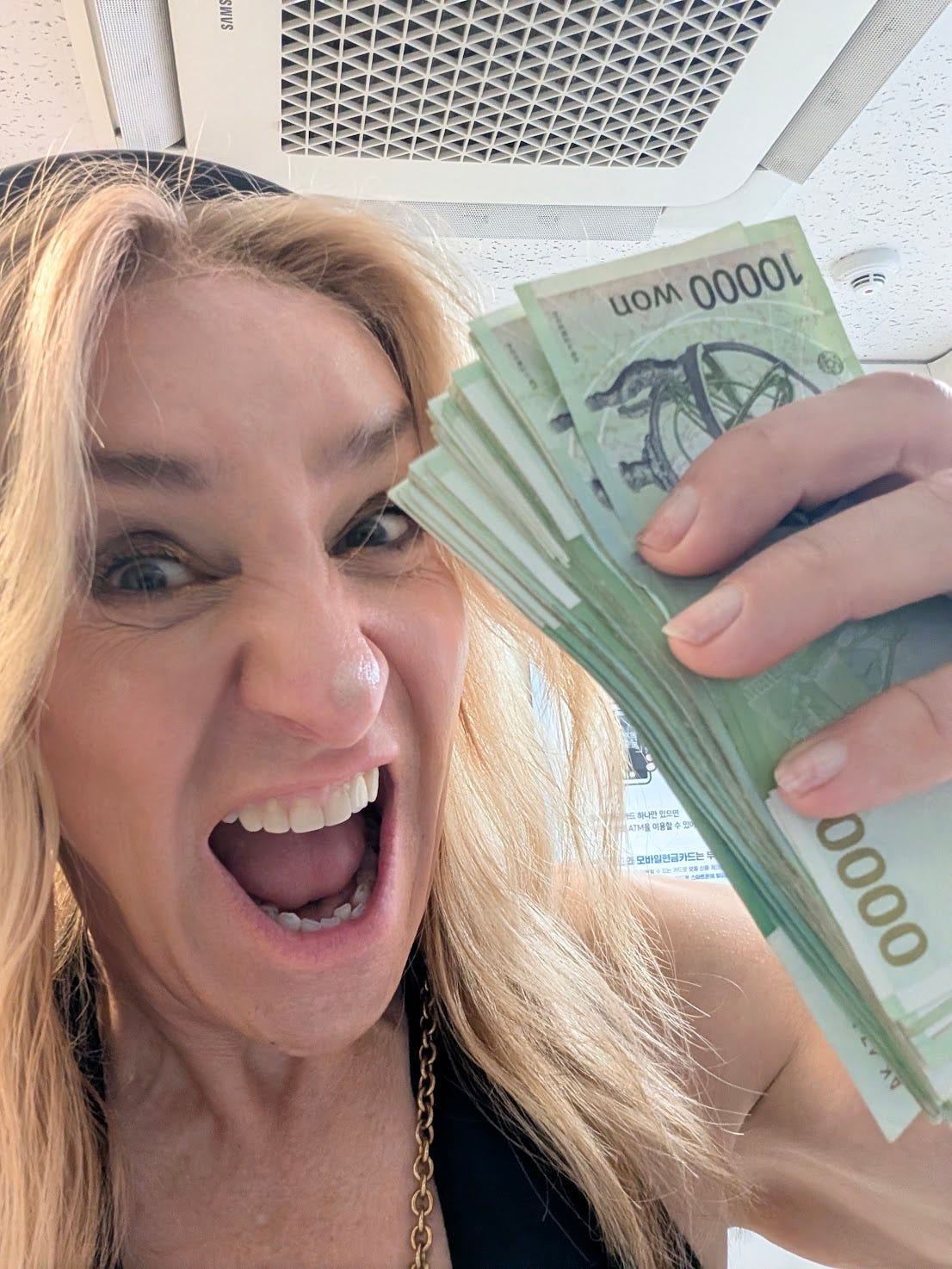
I held it beside my face.
I looked deranged.
Then a thought occurred to me.
How much had I just withdrawn?
Had I accidentally taken €5,000 from my account?
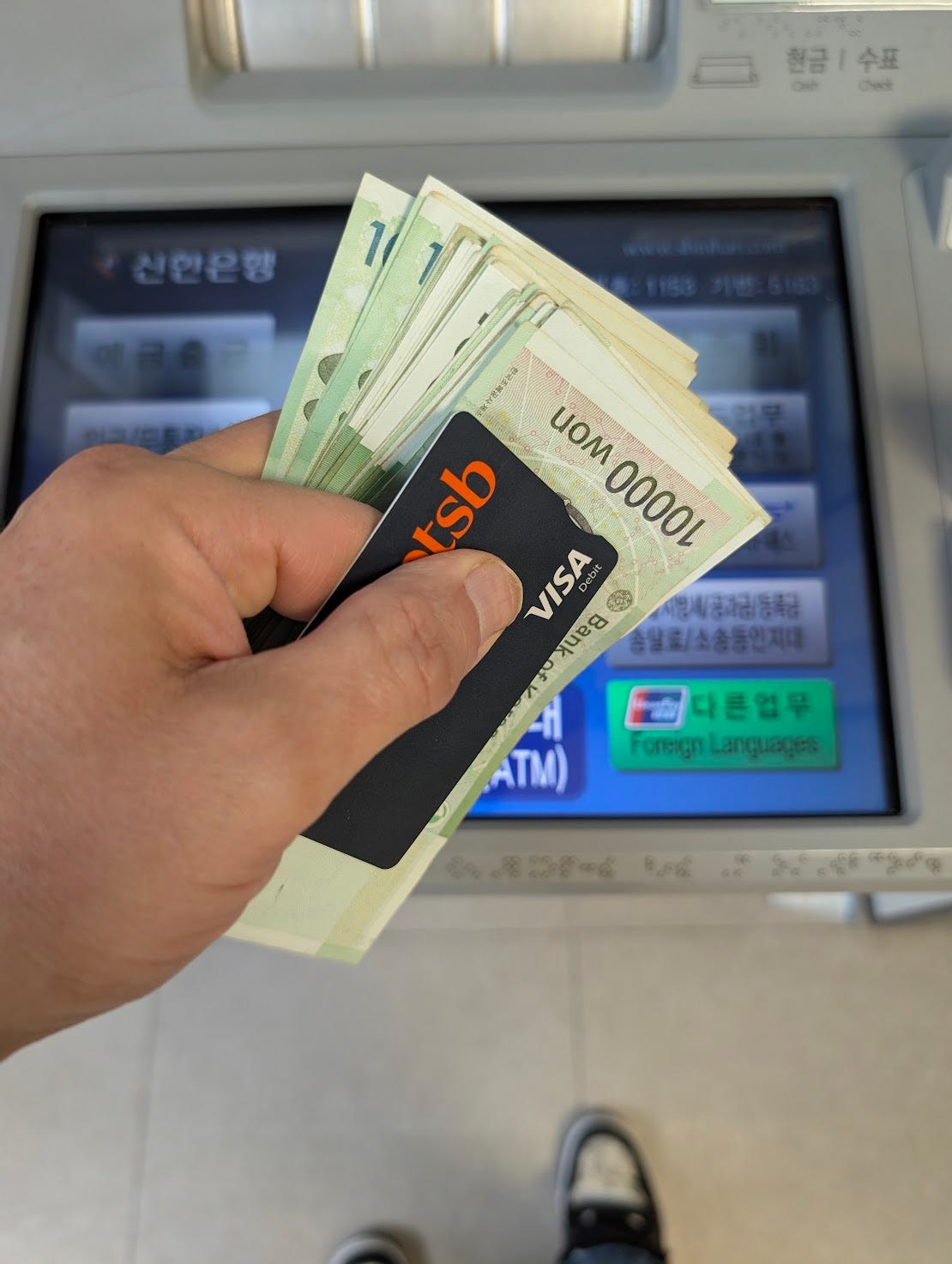
Had I just converted the cost of a small car into Korean cash because I could not be bothered doing the arithmetic?
I asked ChatGPT.
One million won was roughly €575.
Oh.
That was fine.
A lot of cash, certainly, but not financially catastrophic.
And so the Little Match Girl of Gangnam was saved.
She could finally walk through the glowing doors.
She could buy food.
She could buy coffee.
She could buy a handbag, although perhaps not a very large one.
For one glorious day, I was a Korean millionaire.
I loved reading this. You have a wonderful narrative style.
OMG, I needed that - having a night where I cannot sleep and that was just too good.
Just 4 screens? How will you survive? The bank card thing reminds me of the USA - last time I went there (pre-2020) they didn't have tap anywhere, bank cards didn't work unless they were Visa/MC/AmEx. It was like I went back in time vs Canada where tap is everywhere and most use their bank cards to pay, not credit. Single dollar bills and pennies? How weird. Funny how nations that one expects to be advanced really aren't when it comes to currency. I suspect most Korean/Chinese methods don't work here though now that I think about it.