

This week: I try very hard not to become a fitness influencer, explain why your shoulders may not need another bloody hypertrophy block, and ask whether the body-planning system I built for trans women is useful, mad, necessary, or all three.
I get asked about my body quite a lot.
Not by random women in changing rooms, because this is not a Carry On film and I do not spend my life being erotically appraised beside a row of lockers.
It is mostly other trans women.
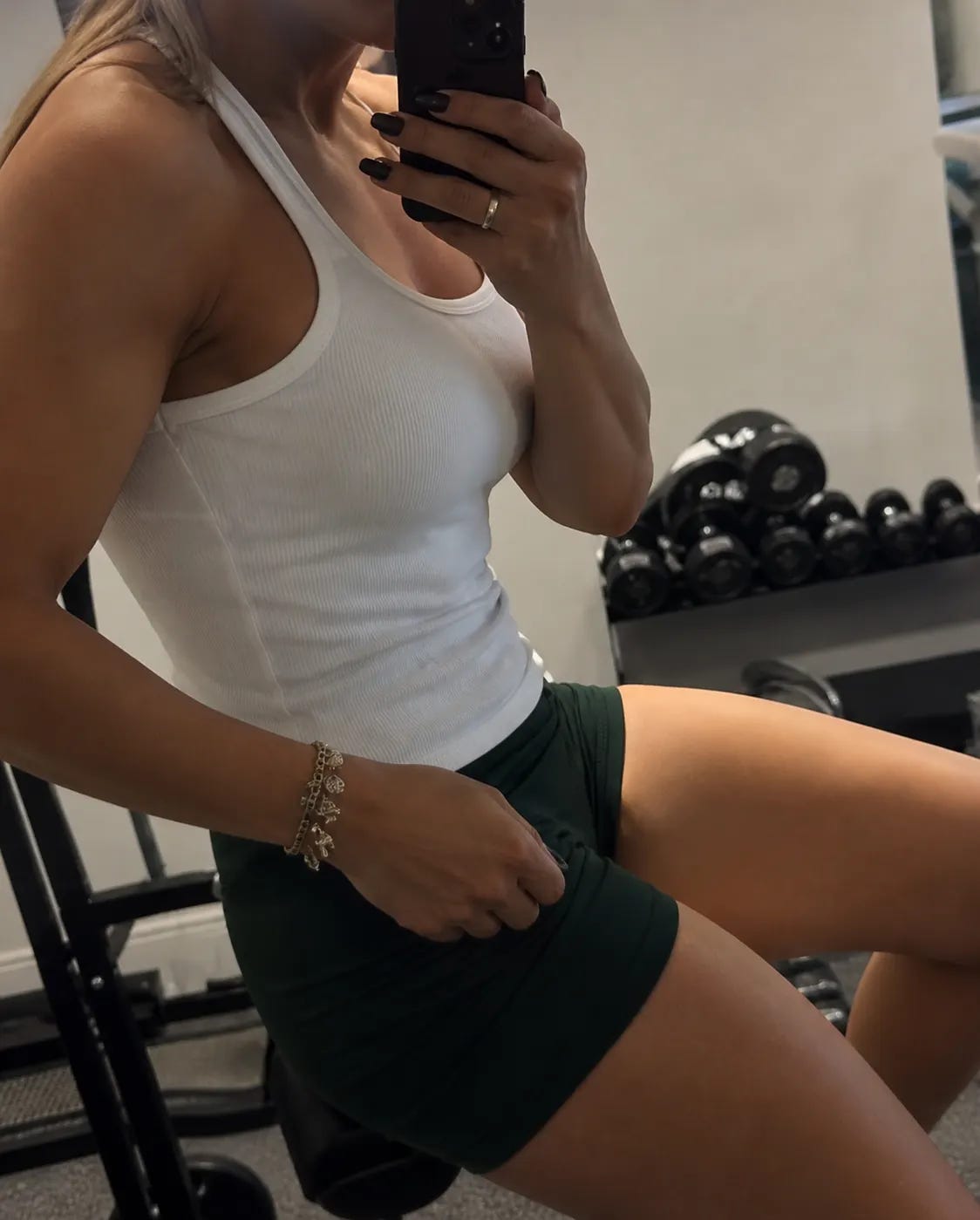
They see a photo. Or they read something I have written about training. Or they notice that I have somehow managed to get from a 108-kilo dad-shaped catastrophe to something that now reads much more like an actual female body, with hips and a waist and a bum and all the bits I spent most of my life assuming were simply not on the menu.

And then the question comes.
How did you do it?
I understand the question completely, because for trans women this is not just fitness. It is not beach-body nonsense. It is not about having visible abs so we can stand under a ring light drinking electrolyte water and pretending we discovered discipline.
For many of us, the body is one of the loudest things in the room.
It speaks before we do.
Before our voice, before our name, before our clothes, before our carefully practised walk through Tesco where we are trying to look casual while also monitoring every reflective surface like a meerkat with trauma.
Our shape announces things about us. Sometimes things we do not want announced.
So yes, when another trans woman asks me how I changed mine, I take it seriously.
I wrote about it properly in my earlier piece on building a great body in your forties, fifties and sixties. The system is all in there: diet, training, psychology, habit design, the whole slightly deranged architecture of how I rebuilt myself.
How To Build a Great Body as a Trans Woman (Even in Your 40s, 50s, or 60s)
But an article has a problem.
You can explain everything. You can pour your entire brain into three thousand words. Someone can read it, nod along, feel a little spark of hope, and then, two days later, be back at lunch having eaten the calories of a Victorian Christmas before 1pm and wondering why their shoulders are still auditioning for a rugby squad.
Knowing is not doing.
It never was.
So the next question started appearing.
Will you coach me?
And the answer is no.
Absolutely not.
Not because I do not care. I care a lot. That is the problem. If I took people on properly, I would care far too much, interfere far too much, overthink everything, write twelve-page explanations, and end up emotionally invested in someone’s lateral raise technique at midnight when I should be asleep.
Also, I do not want to become one of those online fitness people.
You know the model.
Nice body at the front. Payment link underneath. “Community” in a WhatsApp group. Then behind the curtain, everyone gets basically the same programme with their name pasted into the PDF and maybe a slightly different glute bridge variation if the coach is feeling festive.
I am being unfair, obviously. Some of them are good.
But a lot of it is nonsense. Very shiny nonsense. Nonsense with abs. Nonsense with a ring light and an affiliate code.
And for trans women, the problem is not merely that some online coaching is lazy. The deeper problem is that a lot of the default fitness advice is actively pointed in the wrong direction.
The hypertrophy problem
Most mainstream training programmes are built around hypertrophy.
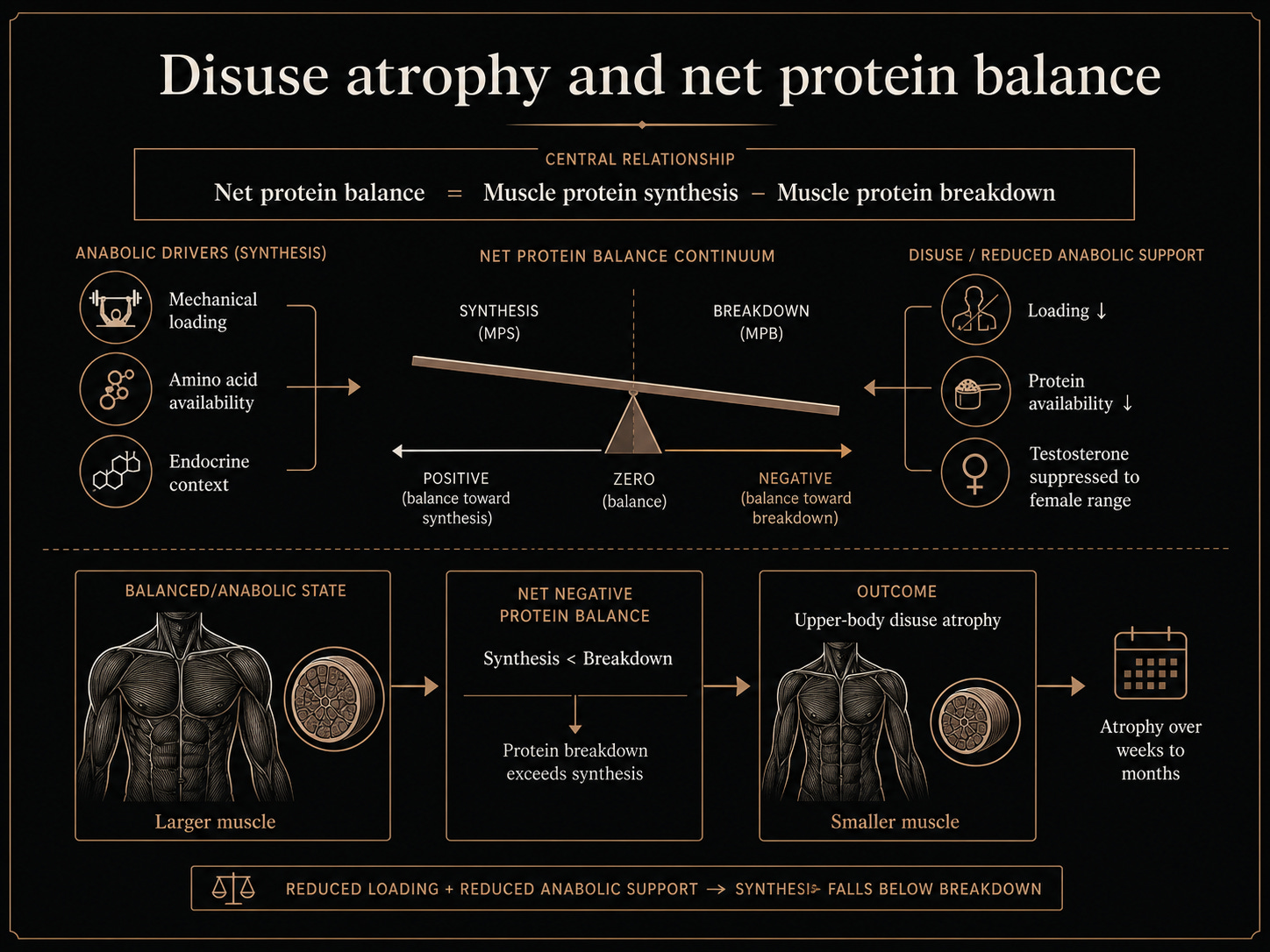
Build muscle. Add volume. Progressive overload. Train hard. Push more weight. Chase the pump. Make everything bigger.
That is fine for some people. It is not morally wrong to build muscle. I am not standing here with a candle and a haunted expression saying “never touch a dumbbell.”
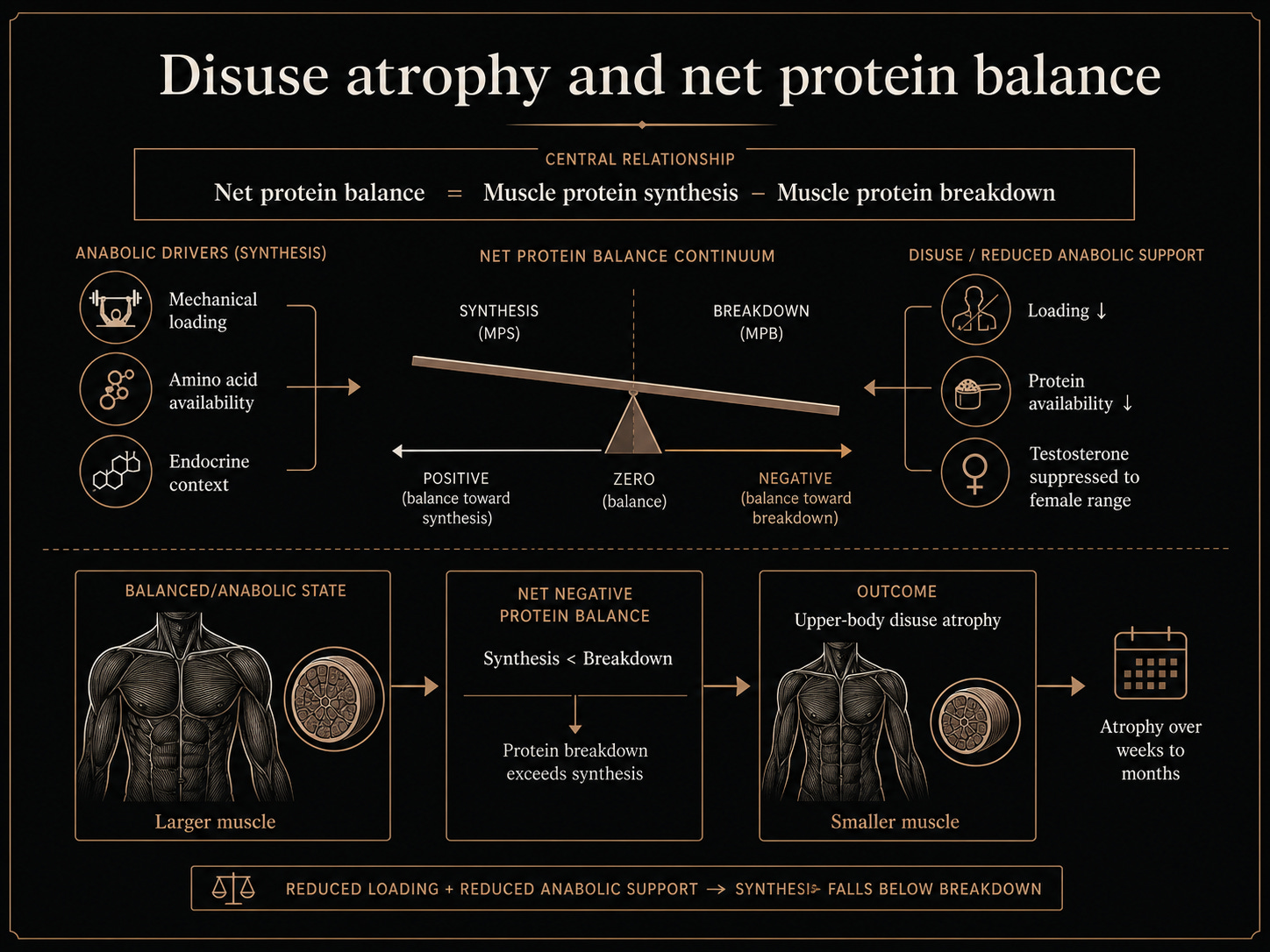
But for a lot of trans women, especially those of us who come to this later, the issue is not that we lack muscle everywhere.
It is that we already have too much of the wrong muscle in the wrong places.
I did not arrive at transition as a delicate little woodland creature. I arrived with years of sport in my body. Cycling, Ironman training, lifting, general male-life nonsense. Broad shoulders. Thick back. Traps and lats that had not received the memo that we were now trying to go in a different direction.
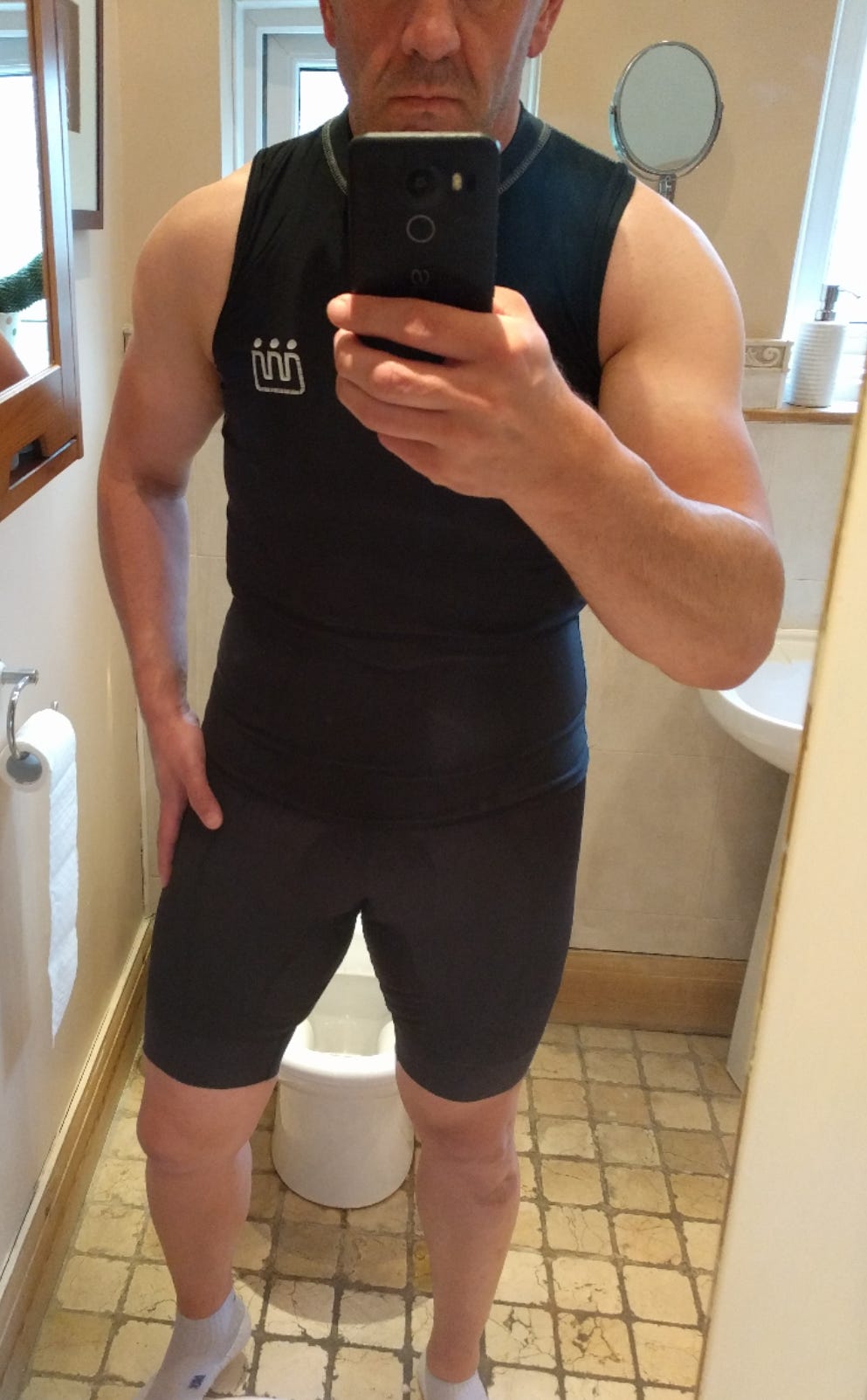
That upper-body shape read male before I opened my mouth.
So what does a generic hypertrophy programme do to a woman like that?
It preserves the problem.
It trains the shoulders. It trains the back. It trains the arms. It maintains the exact silhouette she is trying to soften, and then calls it progress.
Six months later she looks in the mirror, feels like nothing has shifted, and concludes that she has failed.
But she has not failed.
The programme failed her.
It was the wrong tool.
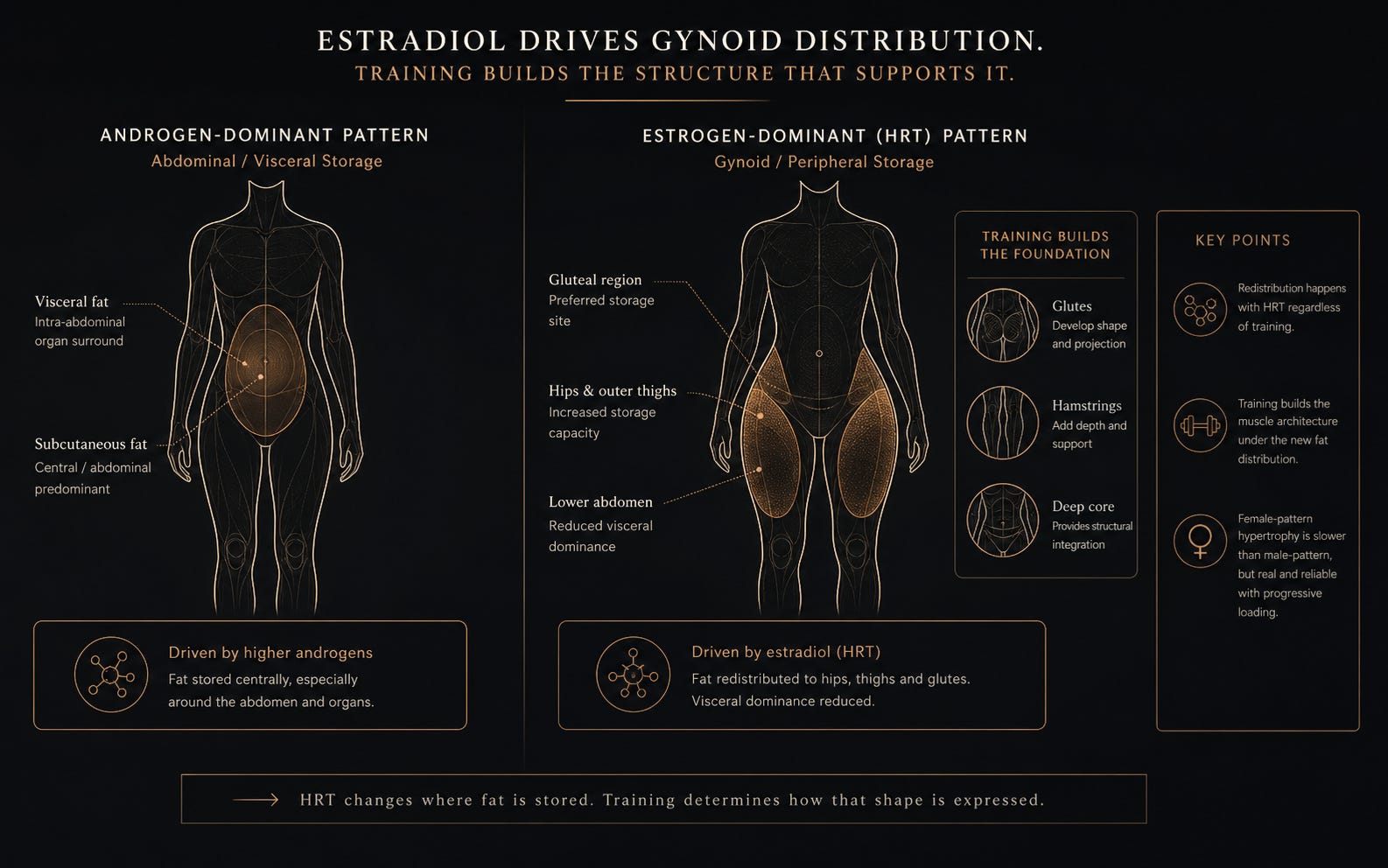
For many trans women, the answer is not “train harder.” It is more specific than that. Sometimes it is “train less there.” Sometimes it is “stop feeding that bit.” Sometimes it is “move the work downward.” Sometimes it is “we are not trying to build a bodybuilder, we are trying to change a silhouette.”
Glutes matter. Thighs matter. Core matters. Waist-to-hip matters. Fat loss matters. Softening matters. Cardio matters. Not in a punishment way, but in a body-composition way.
And, crucially, restraint matters.
That is the bit almost nobody sells, because it is very hard to charge someone £150 a month to tell them not to train their shoulders like a deranged canoeist.
But for some of us, that is exactly the advice.
The annoying part
Once you see this, you cannot unsee it.
You look at the available options and think: right, so the choices are either generic fitness apps designed for a population that does not have this problem, or online coaching that often looks trans-specific from the outside but still runs on the same bodybuilding engine underneath.
That annoyed me.
I am very good at being annoyed. Annoyance is one of my core productivity systems.
I did not want to coach people one by one. I still do not. I do not want clients. I do not want a WhatsApp group. I do not want to become the bum at the front of the sales funnel. Nobody needs that from me, least of all me.
But I also did not want to keep watching trans women get handed the wrong map.
Because there is a method here.
There is judgement. There is pattern recognition. There is a way of looking at a trans woman’s body, her goals, her history, her equipment, her hormones, her surgeries, her injuries, her time, and saying: right, this is what we are actually trying to do.
And that judgement is not magic.
It can be structured.
It can be encoded.
It can be turned into software.
So, because I am apparently incapable of seeing a practical problem without turning it into a platform, I built the machinery.
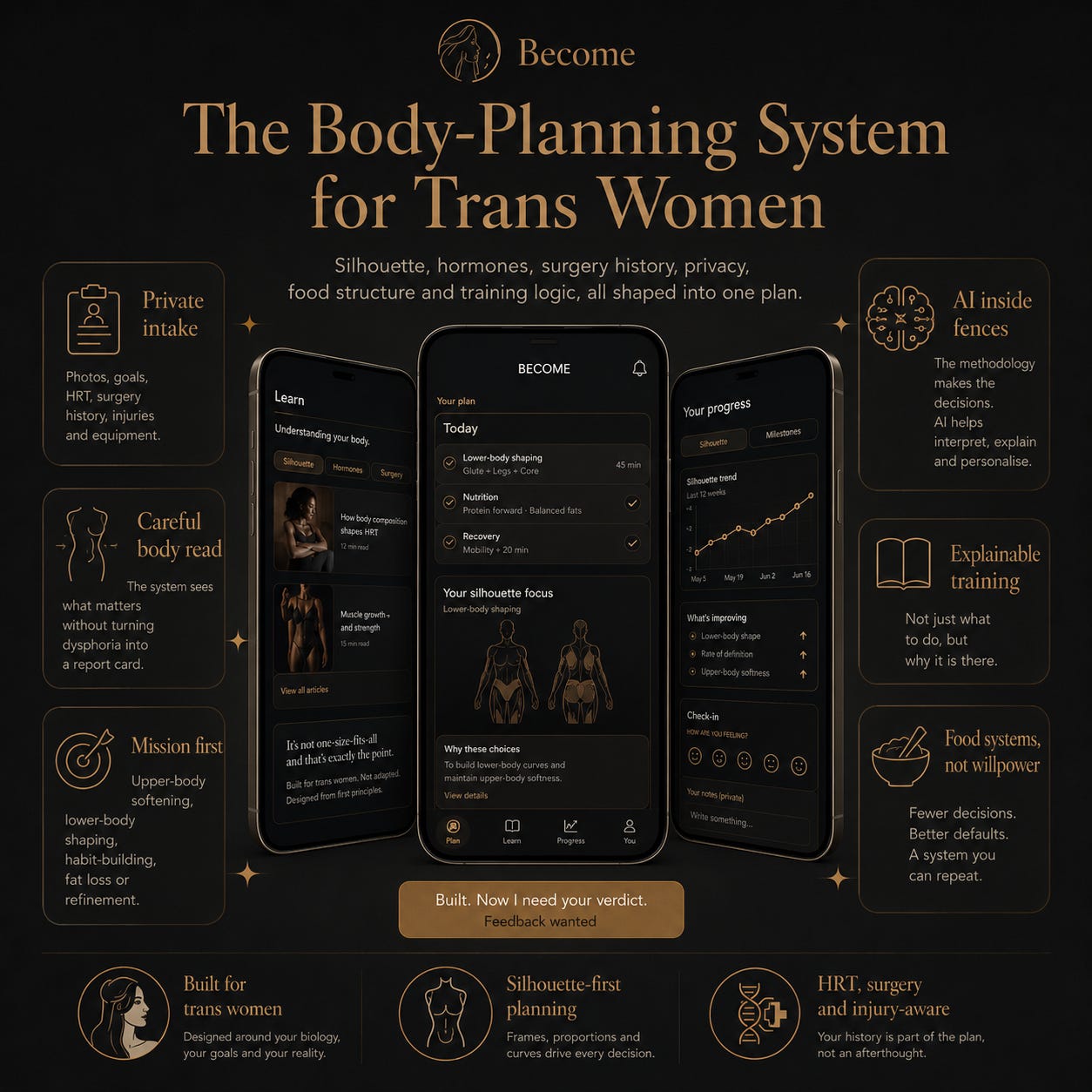
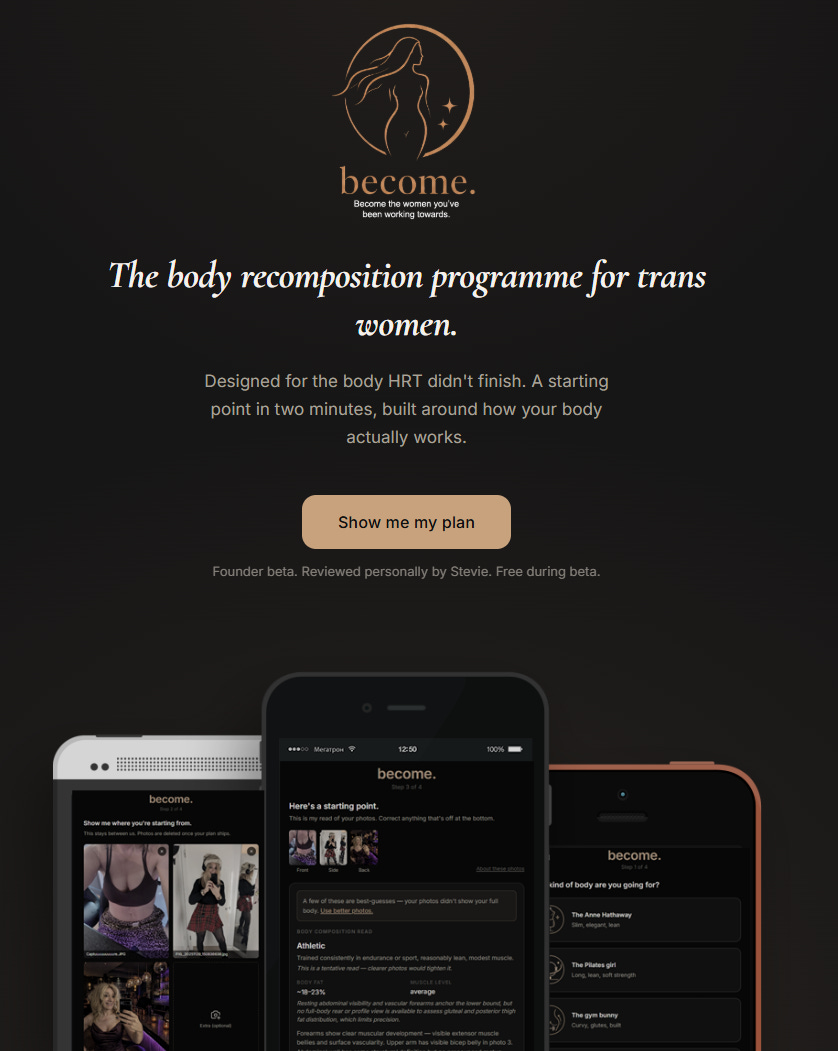
It is called Become.
What Become is
Become is a body-planning system for trans women.
That is the cleanest way I can describe it.
Not a generic fitness app with a trans option bolted on.
Not a chatbot that spits out workouts.
Not a spreadsheet with lipstick.
A proper body-planning system, built around the problems trans women actually face when we are trying to change our shape.
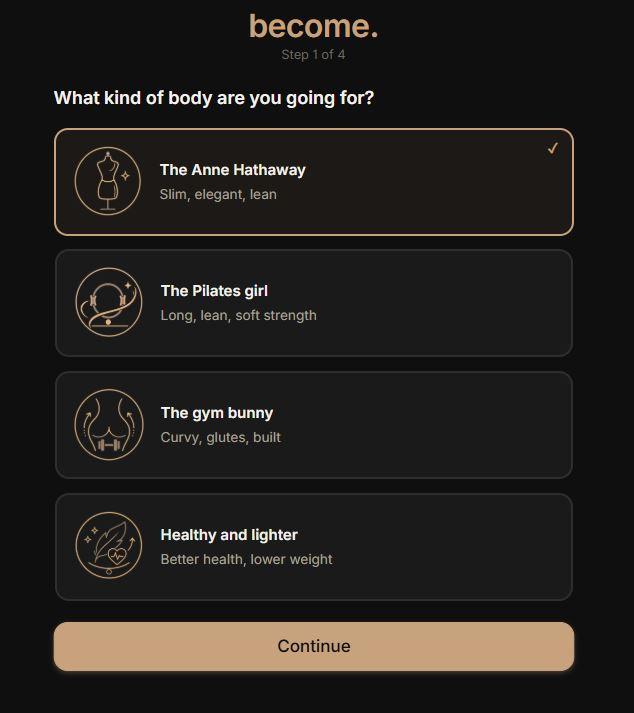
It starts from a simple idea: two women can look superficially similar and need completely different plans.
One might be early in transition and still able to build muscle quite easily.
Another might be years into hormones, post-surgery, and working with a completely different hormonal engine.
One might need to soften an overbuilt upper body.
Another might be under-muscled and need careful strength.
One might need fat loss and habit-building before anything else.
Another might already be lean and need lower-body shaping, posture work and refinement.
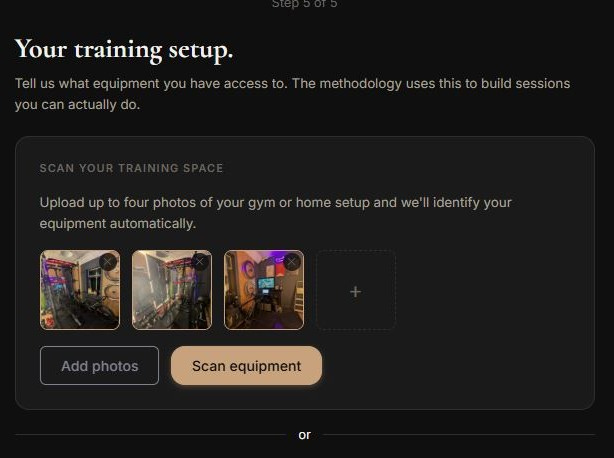
One might have a full gym.
Another might have resistance bands, a bedroom floor and twenty-five minutes before the dog starts eating a charger.
Those are not details.
They change the plan.
That is what Become is built around.
How it thinks, without boring everyone to death
Underneath Become is a decision system.
I am deliberately not going to explain every cog and sprocket, because nobody needs to read the full wiring diagram unless they are trying to steal it or fall asleep.
But the broad idea is this.
Become builds a multi-dimensional picture of you.
Not one crude label. Not “beginner.” Not “apple-shaped.” Not “fat loss client.” Not “trans woman, therefore glutes.”
A proper picture.
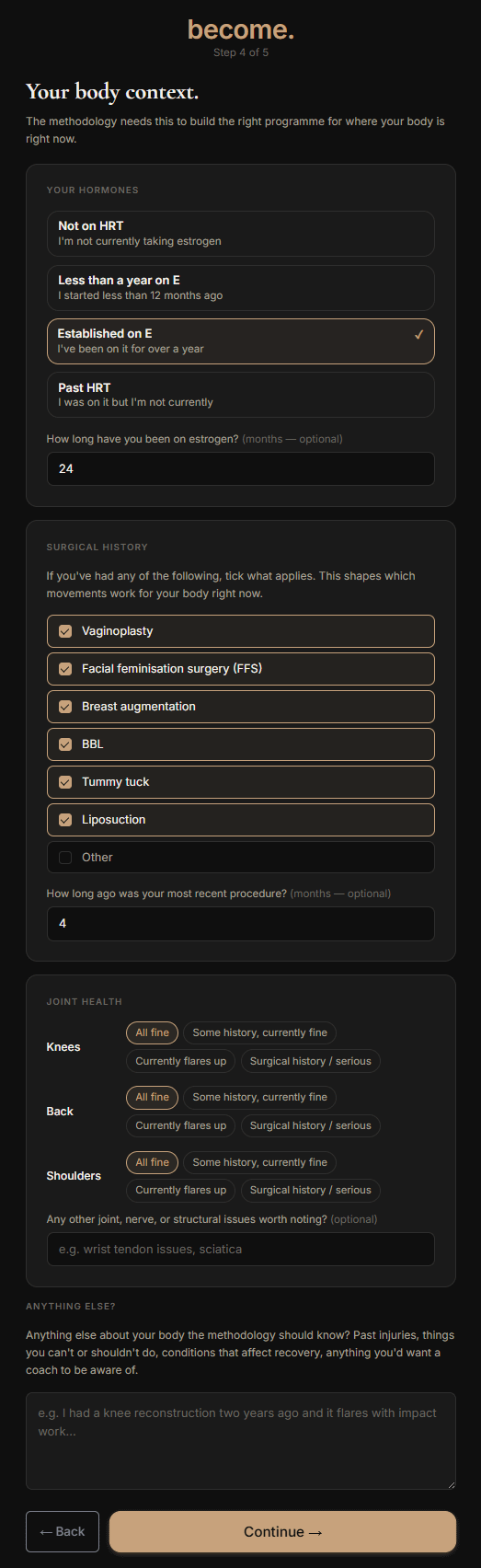
It looks at the things that genuinely change the mission of the plan: weight, upper-body muscle, feminisation, hormonal context, training history, consistency, aspiration, available time, injuries, surgeries and equipment.
Some of those things are core drivers.
Some are modifiers.
Some change the whole direction of the plan.
Some simply change the exercise selection.
That distinction matters.
A dodgy knee matters enormously, but it does not necessarily change what the plan is for. It changes how the plan is built safely. Carrying a large amount of upper-body muscle from a previous athletic life, on the other hand, may change the entire mission from “build” to “soften.”
That is the kind of judgement a good coach makes.
Become makes that judgement through a structured decision system.
The best shorthand is probably this: it is closer to a clinical triage model than a fitness quiz.
Not because it is a medical device. It is not.
But because the seriousness is closer to that world than to the usual “tell me your goal and I’ll generate a plan, babe” nonsense.
It does not ask you to diagnose yourself and then reward you with a PDF.
It reads the situation, weighs the relevant factors, and commits to a lane.
That lane defines what the plan is actually for.
Sometimes the mission is sustainable weight loss.
Sometimes it is habit-building first.
Sometimes it is upper-body softening.
Sometimes it is lower-body shaping.
Sometimes it is strength.
Sometimes it is posture and refinement.
Sometimes it is simply getting someone moving safely without overwhelming her life by Tuesday lunchtime.
That is the first major difference.
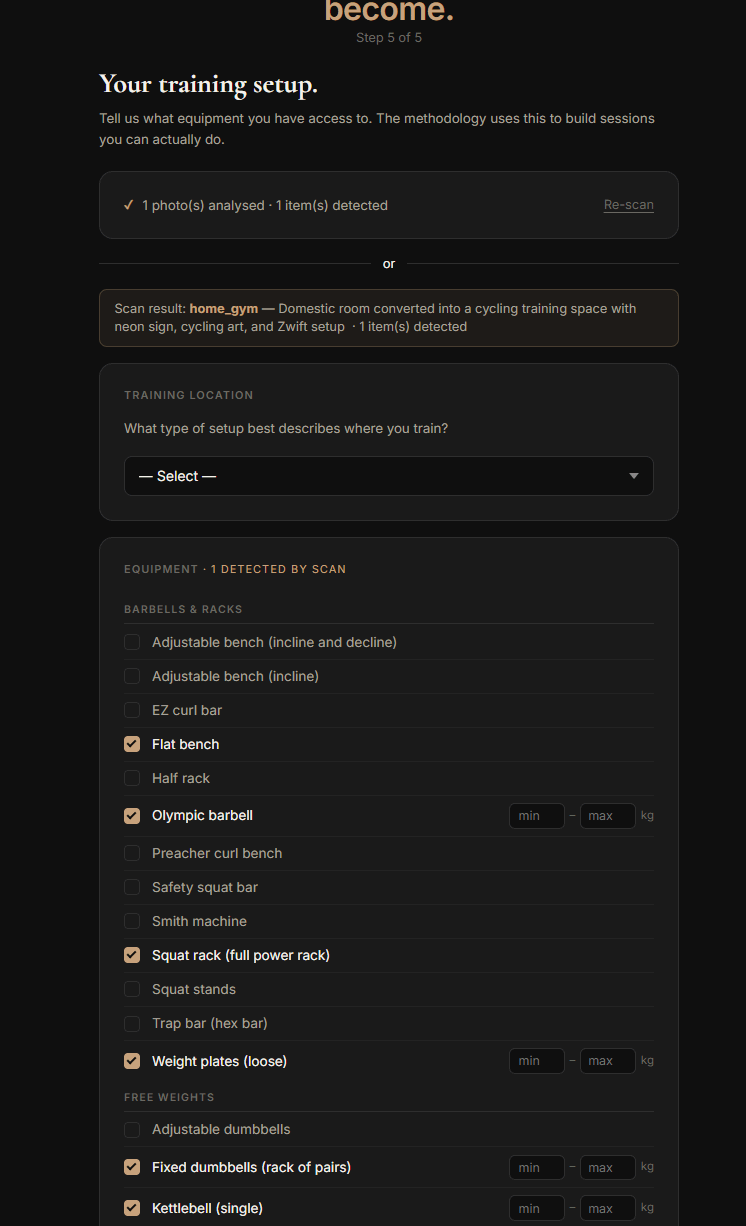
The plan is not built from a template.
It is built from the mission.
Where the AI fits
Now, I need to be careful with this bit, because the phrase “AI fitness app” makes me want to climb into a cupboard and live there with a torch.
Most AI fitness products are basically chatbots in a vest.
You ask for a plan, and the model improvises something plausible-looking from the internet’s giant soup of fitness advice. Sometimes it is fine. Sometimes it is nonsense. Sometimes it will cheerfully tell someone with a rebuilt shoulder to do overhead presses because the internet has lots of overhead presses in it and the chatbot woke up confident.
That is not what Become is.
The AI does not get to sit in the driver’s seat wearing sunglasses and making things up.
The important decisions are made by the underlying methodology: the decision trees, the rules, the constraints, the trans-specific logic, the things that stop the plan doing something stupid.
The AI is used where AI is genuinely useful.
It can help interpret body photos.
It can help understand what you say about yourself in your own words.
It can notice when your description adds something that a form field did not catch.
It can turn the system’s reasoning into clear, human language instead of producing a dead little gym PDF that sounds like it was written by a protein tub.
But it works inside fences.
It does not invent the whole plan from scratch.
It does not get to override the methodology because the vibes were strong that day.
That matters to me enormously.
I do not want a system that merely sounds clever.
I want a system that makes good decisions.
There is a huge difference.
The photo step
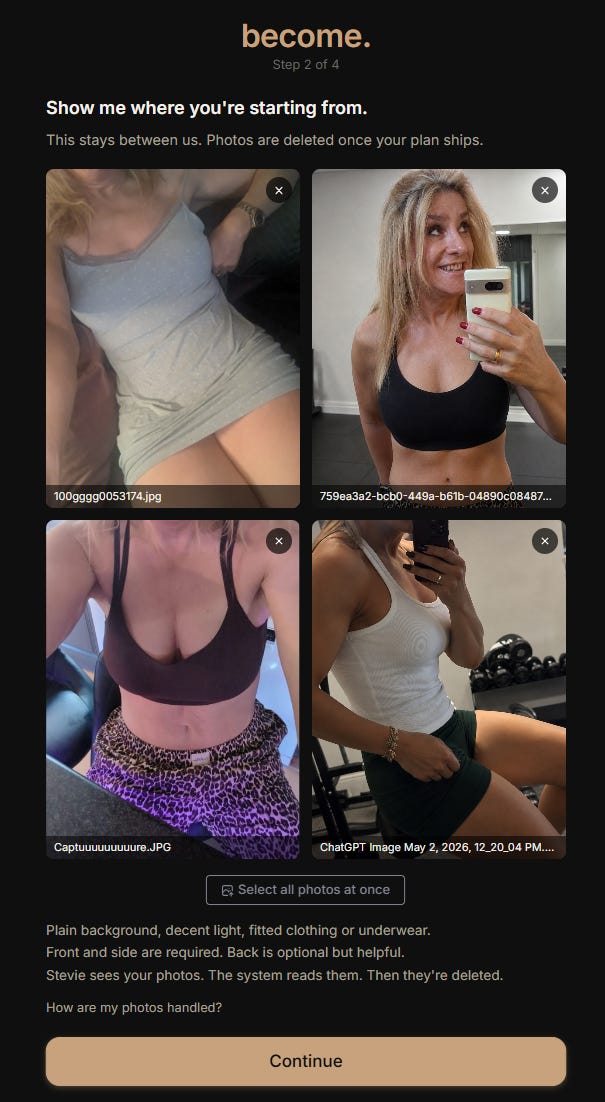
One of the things Become can do is look at body photos.
That sounds simple. It is not simple.
For trans women, body photos are not casual.
They are not “upload your transformation selfie, babe.”
They can be loaded, exposing, dysphoric, frightening and sometimes humiliating. I know that. I have lived that.
But they are also useful.
A real coach can see things from a body photo that no questionnaire will capture properly: shoulder width, upper-body mass, posture, waist, hips, fat distribution, muscle balance, the overall silhouette, the mismatch between where someone is now and where she wants to go.
Become uses that information as part of the assessment.
Not as content.
Not as social proof.
Not as a cute “before” picture.
As private intake.
The point is not vanity.
The point is accuracy.
Because a plan for a slim, under-muscled trans woman just starting out should not be the same as a plan for a former male athlete with broad shoulders, strong lats and a lower body that needs to catch up.
Obvious, you would think.
And yet here we are.
Why the plan explains itself
This is probably the part I care about most.
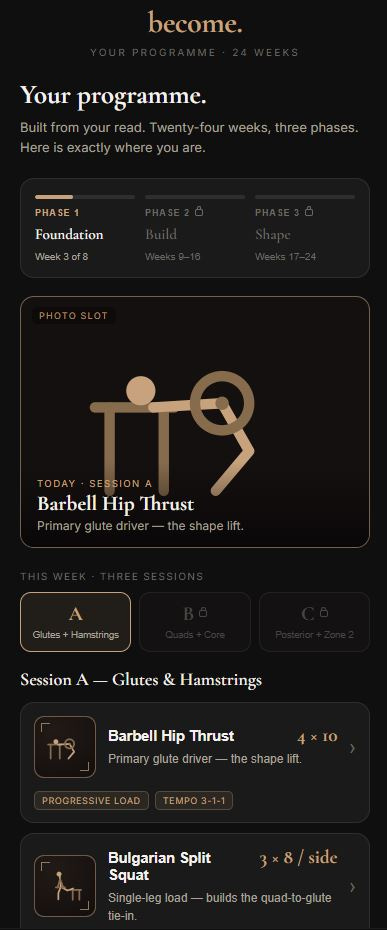
Become does not just tell you what to do.
It tells you why.
That sounds like a small distinction. It is not.
It is the difference between obedience and understanding.
A normal plan might say:
Face pulls, three sets of twelve.
Fine. Technically correct. Also completely disposable. The first busy week, that exercise is gone, because it is just another line on a list.
But suppose you have had breast augmentation and posture matters to you.
Then face pulls are not just a random gym accessory movement. They are doing a job.
The weight of implants sits forward. Over time, that can encourage the shoulders to round and the upper back to collapse. Face pulls strengthen the rear delts, mid-back and small stabilising muscles that help hold the shoulder girdle in a better position.
Now you understand why the exercise is there.
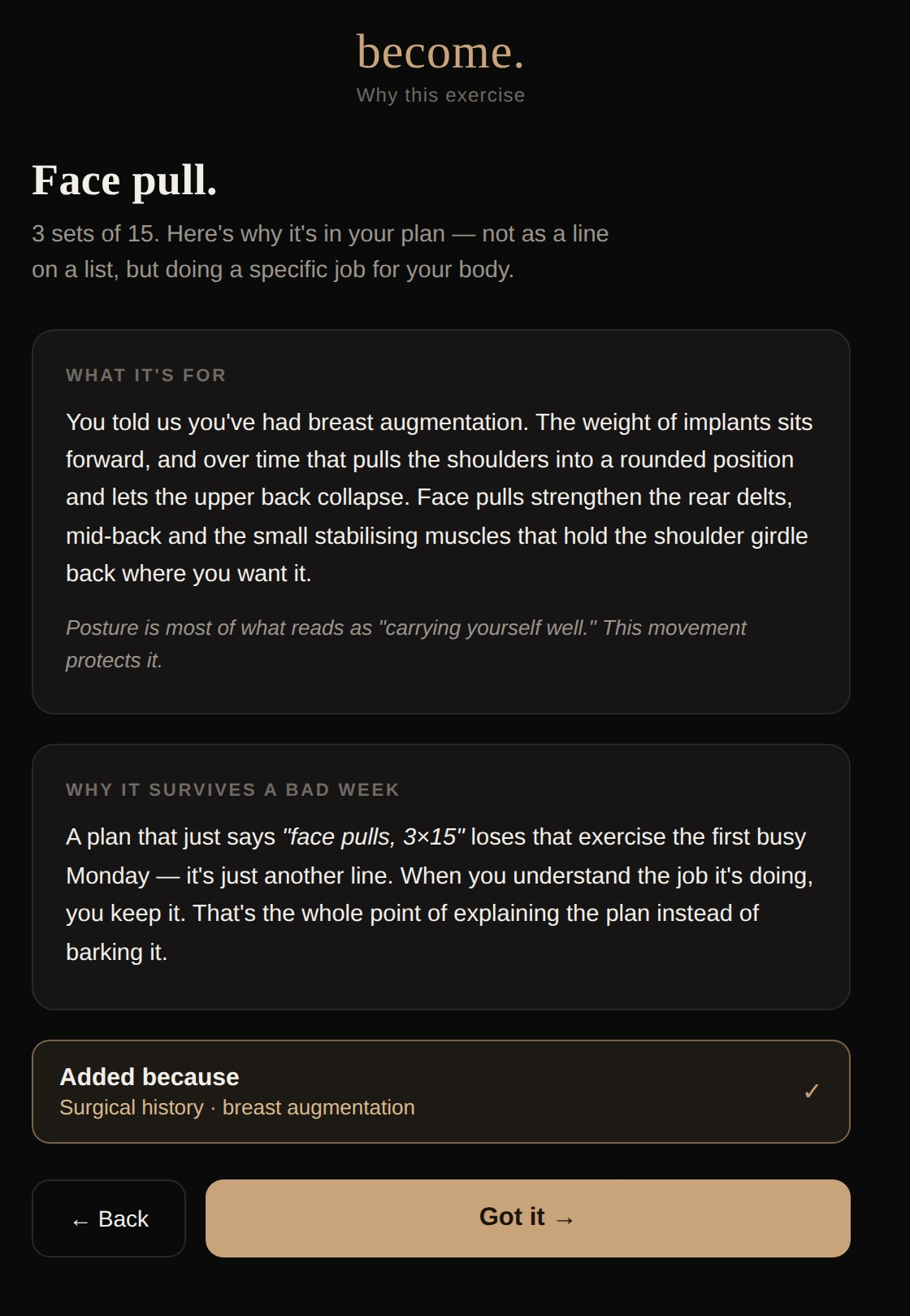
That makes it much more likely you will keep doing it.
The same applies everywhere.
If the system reduces upper-body training, it explains why.
If it biases glutes and thighs, it explains why.
If it avoids a movement because of your knee, your surgery history, your equipment or your goal, it explains why.
Not in gym-bro Latin.
In plain English.
Because women do not need to be barked at by PDFs.
They need to understand the logic well enough to trust it.
The part that matters most for trans women
There is one piece of this I care about more than almost anything else.
Become has to be honest internally.
It cannot build you the right plan if it lies to itself about where you are starting from. If the system needs to know that you are carrying a lot of upper-body muscle, it has to know that. If it needs to know that your body is early in feminisation, it has to know that too.
The machinery has to see the truth.
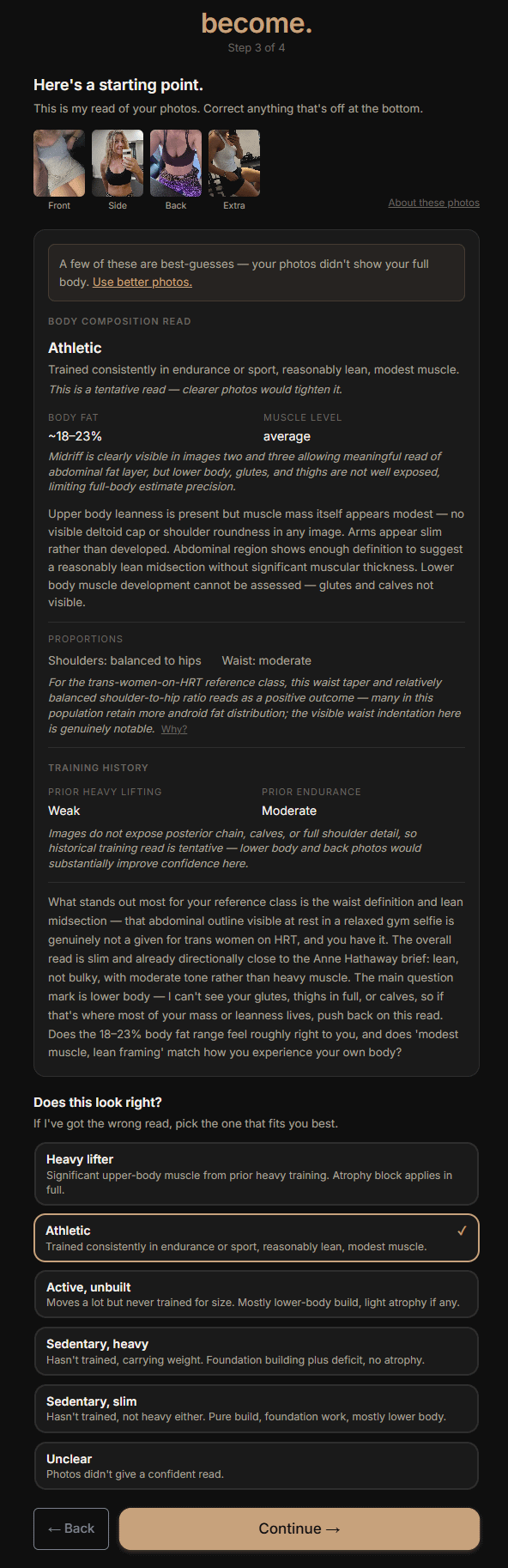
But the system does not have to throw every truth in your face.
That distinction is everything.
For trans women, body-read information does not land neutrally.
Some of it is useful.
Some of it is reassuring.
Some of it can go straight into the wound.
Being told, even gently, that your body reads less feminised than you hoped is not just “feedback.” For some women, that is a small emotional catastrophe. It is exactly the sort of thing that makes someone close the laptop and never come back.
So Become separates what the engine needs to know from what the user needs to hear.
Internally, it is honest.
Externally, it is careful.
It does not hand you a cruel little report card on your own dysphoria.
It does not say, “Here is your feminisation score, enjoy your afternoon.”
It uses that information to build a better plan, but it talks to you in terms of method, direction and opportunity.
That is not dishonesty.
That is care.
A doctor does not need to read your blood results out like a sports commentator. A good coach does not need to say every technically true thing that passes through her head. The point is not to display the system’s cleverness. The point is to help the woman in front of it.
And this is where I think being trans matters.
I know what that information can do when it lands badly.
I know what it is like for your own body to hurt your feelings before breakfast.
So the system is designed with that in mind.
Not bolted on afterwards.
Built in.
The machine is honest where honesty helps the plan.
It is gentle where bluntness would only hurt the person.
That, to me, is the difference between a fitness product that happens to have a trans option and a product actually built for us.
Why I am talking about it now
I have had Become simmering for a while, partly because I have been working like a dog.
Not “busy” in the LinkedIn humblebrag sense.
Actually busy.
Writing, building a lot of software, recovering, working, dealing with life and feeding a tiny dog
Become has been on the back burner.
It has not gone away.
And I am talking about it now because I want to know who actually wants it.
That is the honest reason.
I can sit in my software cave building elaborate systems until the walls start speaking C#, but at some point you have to put the thing in front of real people and ask:
Does this solve a problem you actually have?
Would you use it?
Would you trust it?
Because I know the problem is real.
I know the generic advice is not good enough.
I know trans women are out here trying to solve body problems that mainstream fitness does not understand and was never built to understand.
What I do not yet know is how many of you are waiting for something like this.
So this is partly me showing you the idea, and partly me asking.
Ummm hell yes, please and thank you!