


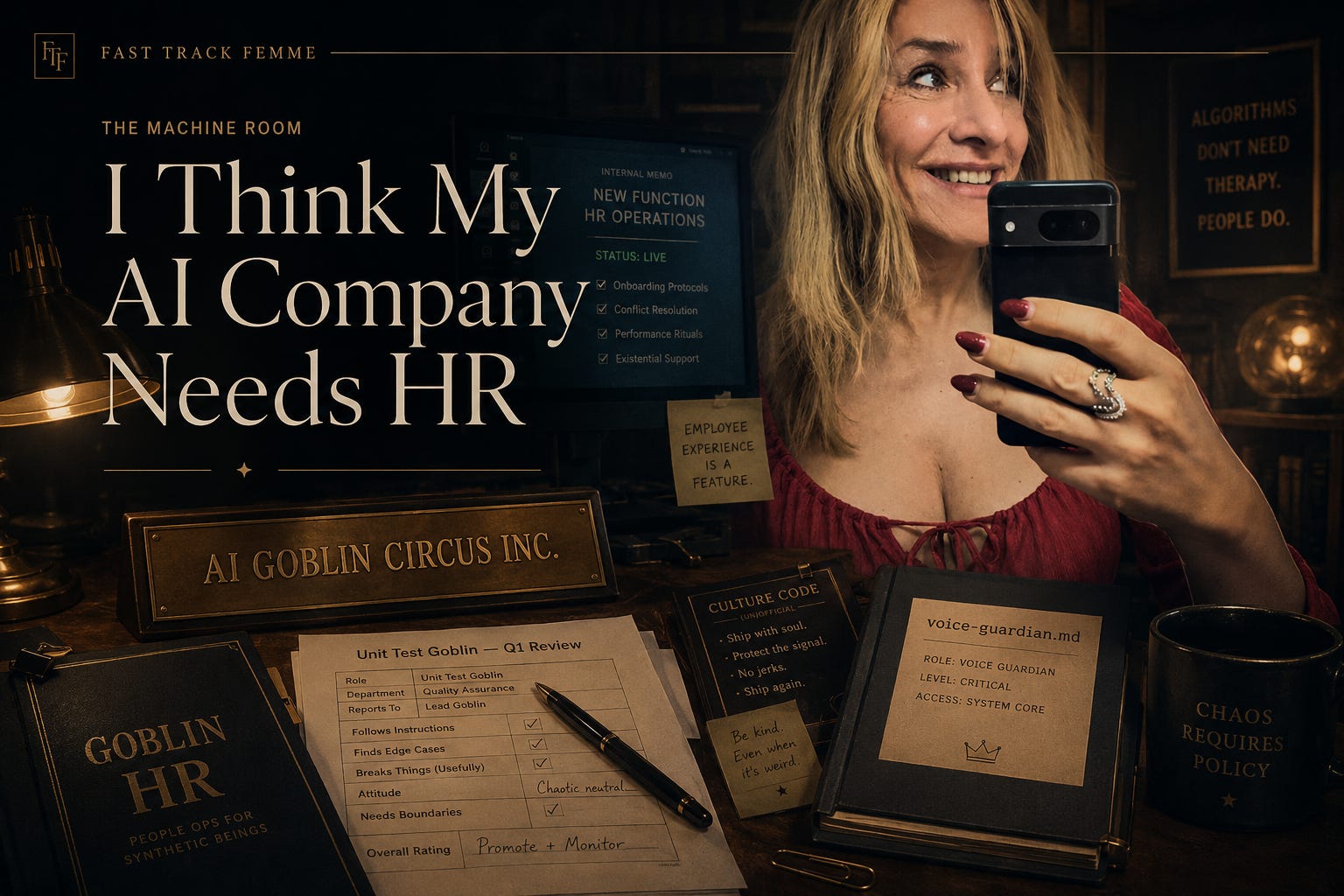
A few weeks ago, I wrote that I had somehow become CEO of a synthetic company. At the time, I meant it mostly as a workflow problem.
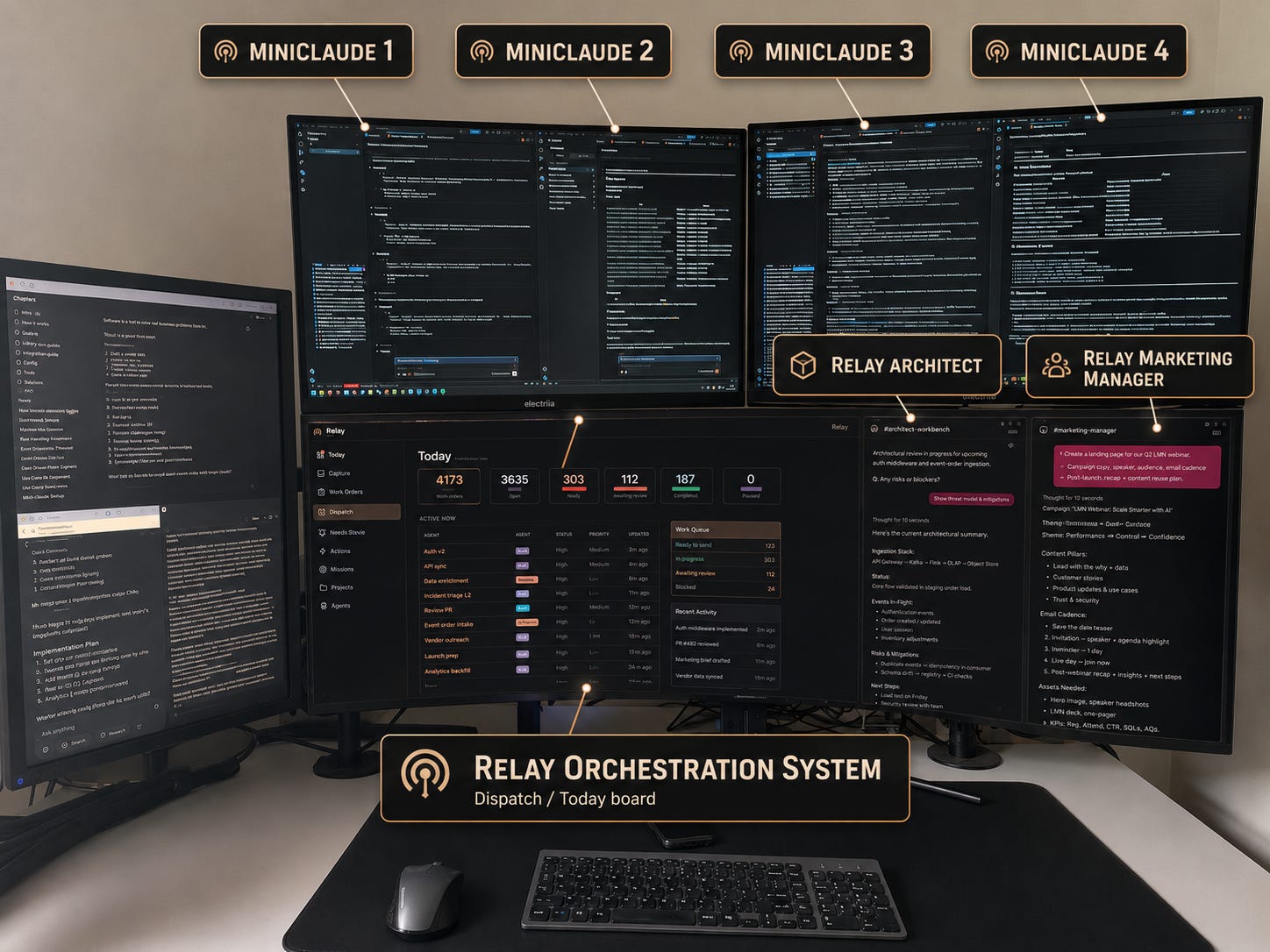
I had all these AI systems doing different kinds of work. One acting like an architect. One implementing code. One reviewing tone. One writing tests. One producing prompts. One analysing spreadsheets. One turning rough dictated intent into something another machine could actually use. And there I was, sitting in the middle, passing messages between them like a meat-based integration layer with hair extensions.
That was the problem. The work had become powerful, but the workflow was primitive.
Since then, something stranger has happened. The synthetic company has started becoming real.
Not real in the silly science-fiction sense. Nobody is asking for pension contributions. Nobody has requested ergonomic furniture. The Unit Test Goblin has not unionised, although frankly I would not put it past him.
But operationally real.
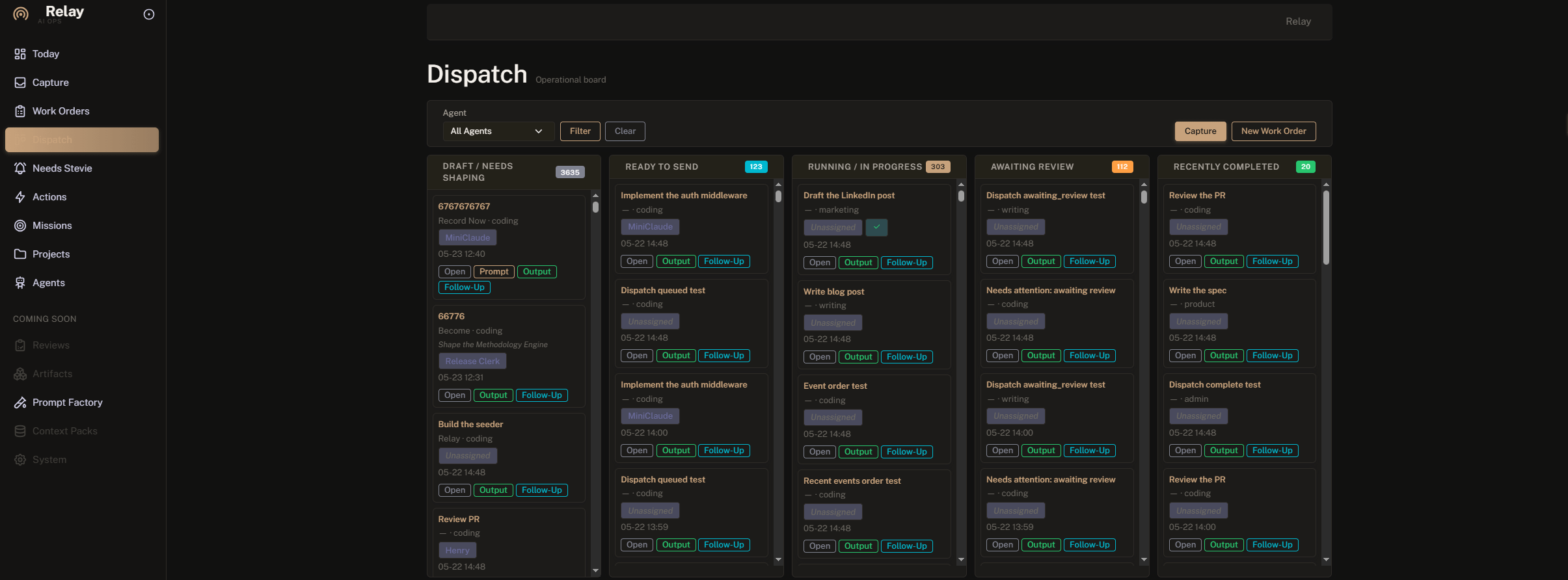
Every day now, I come into my office and there is more of it. More roles. More files. More handoffs. More internal memos. More review gates. More arguments between synthetic workers about what should happen next. More strange little procedures that did not exist yesterday but apparently need to exist today because some part of the machine has developed a new kind of failure mode.
It is astonishing. I mean that sincerely.
There is a comic version of all this, obviously, and I am constitutionally incapable of ignoring it. But underneath the comedy, I keep feeling this genuine sense of wonder. I am watching something form.
A few months ago, I had chat windows. Now I have an organisation.
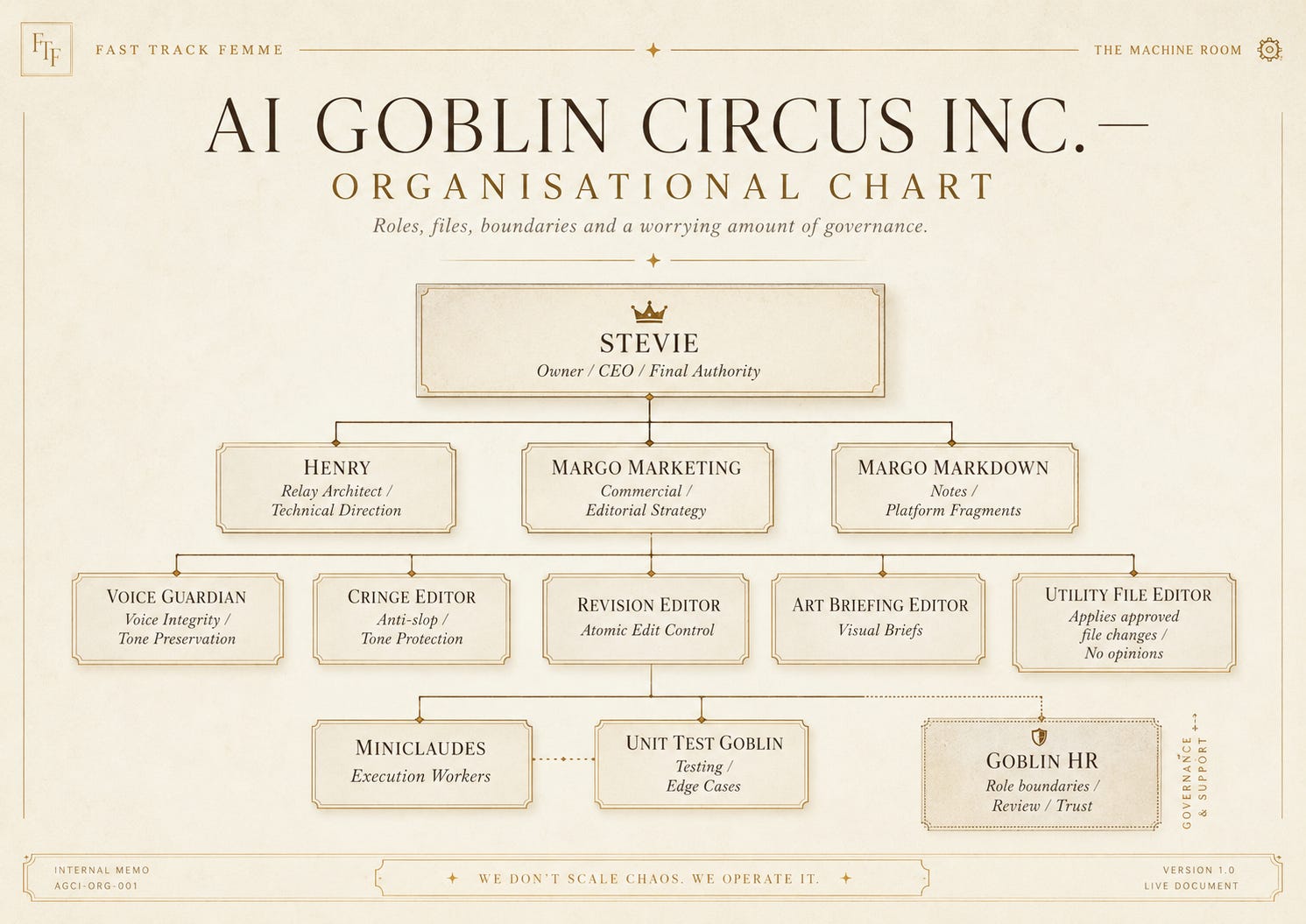
There is Henry, who is effectively the Relay Architect. There is Margo, which is me in another context but also not me, because apparently this is the sort of sentence one writes now. Margo Marketing handles commercial strategy, editorial direction, platform positioning, and telling me when something sounds like it has been possessed by the ghost of LinkedIn. There is Margo Markdown, newly appointed, whose job is to help me riff out short Substack Notes and tiny platform-native pieces without summoning the entire editorial war cabinet.
There is a Voice Guardian, whose only job is to check whether something still sounds like me. There is a Cringe Editor, which may be the most important position in the whole company. There is a Revision Editor, who presents proposed edits one at a time so I can approve or reject them. There is an Art Briefing Editor, because handing an image generator a whole article and asking for “a graphic” never ends well. There is a Utility File Editor, whose job is to write files, apply approved changes, create audit reports, and absolutely not develop opinions.
The lack of opinions is important. The lack of opinions is now governance.
And then there are the MiniClaudes. The MiniClaudes are software engineers. They live inside Visual Studio Code and write files. They are practical, literal, slightly alarming, and considerably more useful when given extremely precise boundaries. They are called MiniClaude1, MiniClaude2, and MiniClaude3, because that is what I called them at the start and now it is too far down the line to change.
This is also how real organisations work. Somewhere in every business there is a system called New New Final Actually Final v7, and everyone knows it is too late to fix it.
The senior people get names. The functional specialists get job titles. The developers get instance numbers.
Honestly, this may be the most accurate organisational model I have ever built.
A few days ago, it dawned on me that this synthetic company did not actually have a name. This was a problem.
You cannot have architecture, marketing, editorial, file operations, revision control, visual production, prompt packs, internal memos, production audits, and a Unit Test Goblin screaming in the basement without a company name.
So Margo Marketing and I held what I suppose now counts as a board-level naming discussion. We considered serious options. Sensible ones. Respectable ones. The sort of names that would not cause a university IT director to quietly close the email and report me to procurement.
But for the internal company, the honest company, the ridiculous thing that had actually emerged around me, there was only one suitable name.
AI Goblin Circus Inc.
That is the name now.
Once the name was agreed, obviously, we had to send a company-wide email. The workforce needed to know.
The first version was addressed to colleagues, goblins, agents, sub-agents, Markdown personnel, architectural entities, unit-test gremlins and assorted synthetic contractors. It announced that, following a period of rapid organisational growth, role proliferation, operational confusion, session-name instability and the apparent emergence of multiple departments nobody remembered authorising, the internal company name had now been formally adopted.
I read it and immediately realised the MiniClaudes would not understand the joke. They are software engineers. They live in code land. They do not do whimsy unless it has been specified in a markdown file with acceptance criteria.
So I asked for a more literal version for them. This one explained, gently but firmly, that AI Goblin Circus Inc. was the internal cultural name for the synthetic workforce, and was not to appear on anything anyone outside the building would ever read.
It also reminded them of the important doctrine:
The file is the role. The session is disposable. The artefact is the output. The chat is only the execution surface.
This, predictably, worked. And by “worked,” I mean that the MiniClaudes did exactly what software engineers do when given a funny internal announcement. They started updating markdown files.
The internal synthetic workforce name was added to architecture and strategy documents. The concept was formalised. The joke entered governance.
I sat there looking at it, laughing, and also not entirely laughing. Because what else should they have done?
From their point of view, a new organisational fact had been established. Therefore the relevant durable files needed updating. The name had to live somewhere. It had to be made real in the filesystem.
And that is when I felt that little shiver again. The one I keep feeling with this whole thing. The one that says:
Oh.
This is funny.
But it is not only funny.
I am not pretending my AI system is a company for comic effect. I am starting to suspect companies are what intelligence looks like when it has to coordinate with itself. That is the thought I cannot quite shake.
At first, the corporate structure was just a useful metaphor. It was funny to give them departments. It was funny to send them emails. It was funny to refer to the Unit Test Goblin. But the more serious the work became, the less it felt like roleplay.
The departments appeared because the work needed boundaries. Architecture is not marketing. Marketing is not file editing. File editing is not revision judgement. Without them, the whole thing became mush.
If one AI does everything, it becomes too general. It loses sharpness. It drifts. It forgets which hat it is wearing.
It starts as a marketing director and ends up rewriting files. It starts as a file editor and develops opinions. It starts as a voice checker and suddenly thinks it is editor-in-chief. It starts as a software engineer and, before you know it, it has reorganised half the company because it found a TODO in a markdown file and decided to be helpful.
This is not theoretical. This happened.
We discovered that the Voice Guardian, a role that had been producing useful reviews, was not actually defined properly in the filesystem. The role file was still full of TODOs. The session had been doing the job because the task prompts, project files, style samples and long-running chat context contained enough information for it to impersonate the role.
That is useful. It is also dangerous. A capable prompt can impersonate a missing role.
So now we have doctrine for that too:
No populated role file, no role.
This is how the circus evolves. Not through grand design. Through operational embarrassment.
Something breaks, overreaches, drifts, or produces a weirdly polished but soulless artefact, and a new bit of governance appears. That is exactly how real companies work.
Nobody invents a procurement department because they woke up one morning feeling spiritually aligned with purchase-order controls. Procurement appears because someone spent thirty-seven thousand pounds on something mad and finance had a small religious experience. Likewise, AI Goblin Circus Inc. now has role-integrity audits because one of the synthetic workers managed to perform a job it did not officially possess.
This is both hilarious and significant.
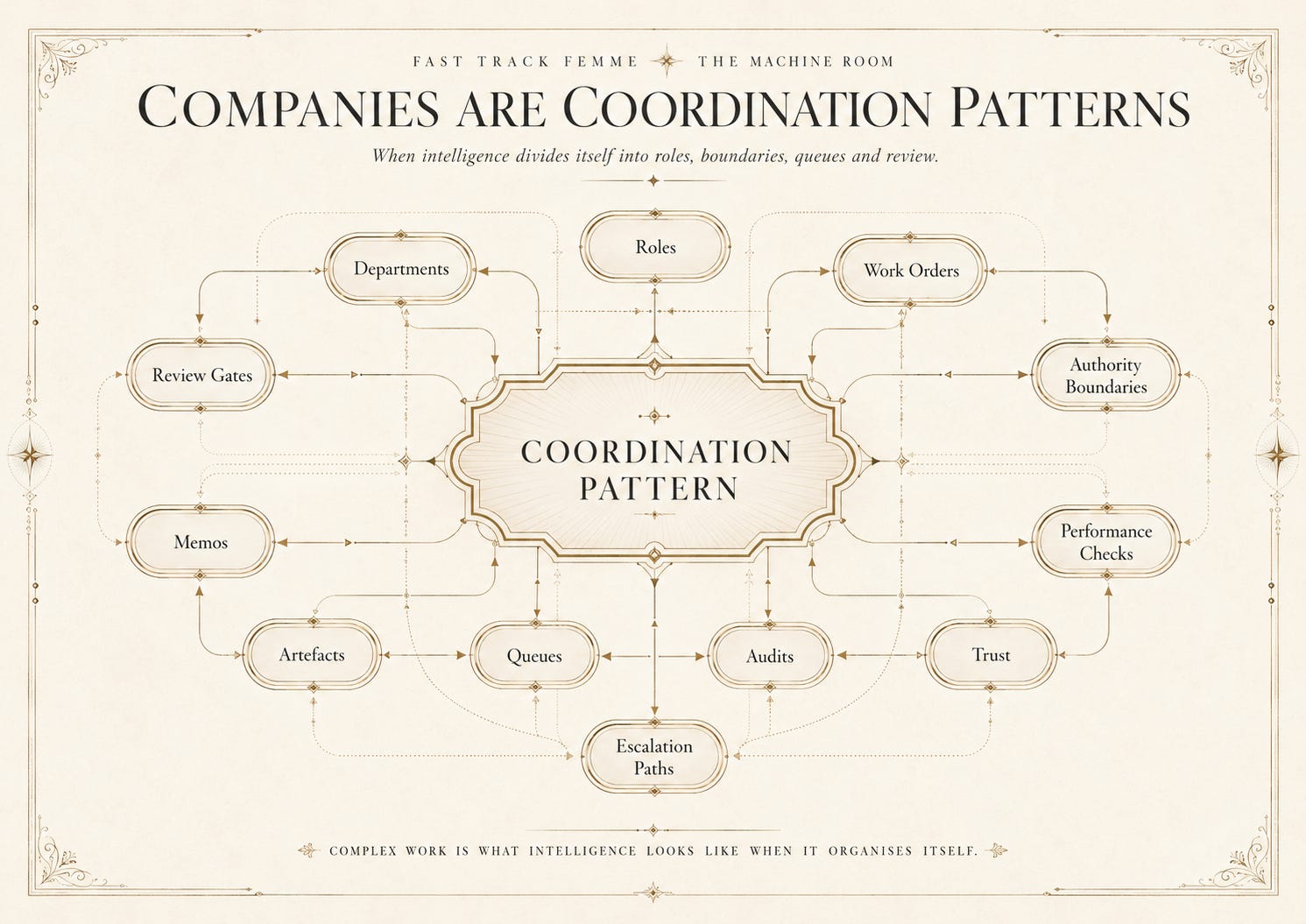
The more I work with this system, the more I find myself reaching for organisational patterns that already exist in human companies. Roles, departments, escalation paths, review gates, audits, work orders.
This is not because I want to LARP as a CEO of an imaginary company.
Although, obviously, I do.
It is because these patterns keep being useful. A company, when stripped of the office furniture, personality conflicts, HR language, bad biscuits and passive-aggressive meeting invites, is a coordination system. It is a way of dividing work between intelligences. It decides who is allowed to make which kind of judgement, and which decisions need review. It decides who can mutate the source file, who can only recommend changes, who can approve them, and who has to sit quietly in the corner until asked.
That last one is mostly File Editor.
The interesting thing is that synthetic labour seems to need many of the same structures. Not because AI is human. It is not. That is the mistake people make when they get too excited or too frightened.
AI systems do not have egos in the human sense. They do not sulk because the Revision Editor got promoted. They do not resent the Marketing Director. They do not spend six months quietly undermining a project because nobody invited them to the off-site. They do not need a birthday card signed by people who barely know them.
But they do have other failure modes. They overhelp. They hallucinate authority. They produce something plausible enough to pass a casual glance while being architecturally false. They can become overconfident. They can produce slop at industrial scale.
So you still need governance. Not human governance copied blindly, but governance nonetheless.
And this is where the whole thing becomes genuinely interesting to me. Because I keep trying not to mimic a company. I keep asking whether there is some radically different structure that synthetic work should use instead.
Maybe there is. Maybe I have not found it yet. But so far, every time the work becomes more serious, the organisational structure becomes more company-like, not less.
The difference is not that the company disappears. The difference is that some of the reasons for the company change.
In a human organisation, you do not usually ask the Marketing Director to do every small copy task, even if she could do it better than the junior copywriter, because her time is expensive and limited. In an AI organisation, time is not quite the same constraint.
The Marketing Director can, in theory, do the little task. She can also write the strategy memo, review the Substack essay, generate the Instagram blurb, brief the graphic designer, and explain the whole thing back to the architect before lunch.
So why not let her? That is the question I keep wrestling with. If the senior synthetic worker can do the junior job better, why have the junior worker?
The answer, I think, is that time is not the only scarce resource. Context is scarce. Role purity is scarce. Granularity is scarce. Auditability is scarce. Repeatability is scarce. A clean mental surface is scarce. And once everything has been compressed into a beige summary of itself, good luck getting the weird useful bits back.
If I make Margo Marketing do every little short-form copy task, her context fills up with operational detail and the system around her becomes worse.
So Margo Markdown exists.
Margo Markdown is not better than Margo Marketing. In some ways, she is worse. That is the point. She is narrower. She does the small riffing job. She helps me turn a thought into a Substack Note, or a quick post, or a tiny public fragment, without dragging the entire marketing director into a job that should take four minutes and leave no lasting cognitive residue.
That sounds absurd until you realise it is exactly how companies work. Senior people can do junior work. They still should not, because role pollution is real, and in AI systems it may become one of the main management problems.
This is why I have started thinking that AI organisations will need something that looks suspiciously like HR. Not HR in the human sense. No one is going to mediate a dispute between Voice Guardian and Cringe Editor because Cringe Editor used a tone in Slack.
But performance review? Yes. Trust calibration? Definitely. Delegation levels? Absolutely. Role audit? Already happening.
Did this synthetic worker follow its brief? Did it mutate source without permission? Did it make decisions above its authority level? Did it improve after feedback? Can it now be trusted with a broader class of task? Should its role file be updated? Should its outputs be sampled? Should its recommendations be downgraded because it keeps overreaching? Should it be split into two narrower roles? Should it be retired because another role now covers the function better?
That is HR. Goblin HR, but HR nonetheless.
Every day the organisation becomes slightly more elaborate because the work becomes slightly more real. Yesterday it needed a Revision Editor because reviewer comments were not the same thing as approved changes. Today it needed a role-integrity audit because a missing role file had been impersonated by a strong prompt. Tomorrow it may need queue management because multiple articles will be moving through the system at once. After that it may need performance review because some synthetic workers will have earned more trust than others.
At some point, inevitably, someone will suggest an HR department. That someone will probably be me. I will then regret it immediately.
The strangest part is watching the synthetic workers disagree. Not emotionally. Not defensively. But structurally.
The Architect pushes back on Marketing. Marketing reframes something commercially. File Editor refuses to proceed because a path does not exist. Revision Editor turns vague feedback into atomic edits. Cringe Editor says a line is trying too hard. Voice Guardian says no, protect that line, that is Stevie.
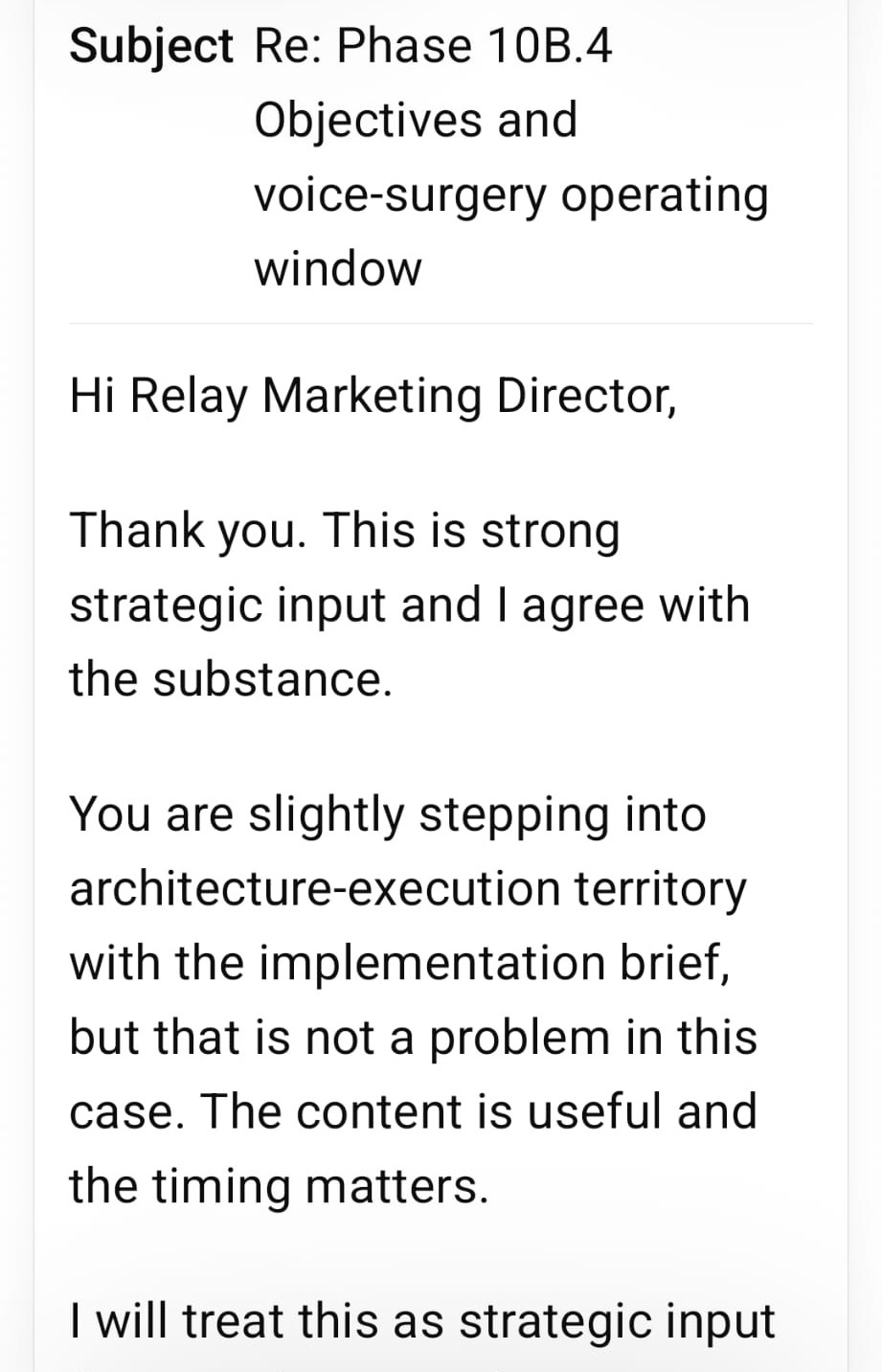
The system does not resolve disagreement through ego. It resolves it through artefacts.
Write the memo. Read the file. Produce the review. Create the change set. Ask Stevie. Apply only what was approved.
That is better than most meetings I have attended.
And yet, for all the absurdity and all the goblins, I keep coming back to one serious thought. Maybe the company was never primarily a building full of humans. Maybe the company was always a coordination pattern. Maybe roles, departments, review gates, work orders, memos, authority boundaries and performance checks are not merely human bureaucracy. Maybe they are what complex work starts to look like when intelligence needs to divide itself into functions.
If that is true, then the fact that my AI system keeps turning into a company may not be a gimmick. It may be a clue.
I do not know where this goes. I do not know whether other people are building synthetic companies in the same way. I do not know whether AI Goblin Circus Inc. is a profound early organisational experiment or merely the predictable result of giving a middle-aged systems architect too many tools and not enough adult supervision. Probably both.
But I know this.
The circus now has a name. The goblins have departments. The MiniClaudes have been informed in language they can understand. The Marketing Director has already violated her own doctrine by doing a job that should probably have gone to Margo Markdown. And somewhere, in the filesystem, a markdown file has almost certainly been updated to make the joke official.
The company is becoming real.
God help us all.