



This essay is part of a four-part series exploring the hardest questions at the centre of my life and my transition.
Each piece examines a different angle: honesty, resentment, myth, and science.1. Was Stephen Bennett a Fucking Liar?
A reckoning with silence, shame and self-deception.
https://fasttrackfemme.substack.com/p/was-stephen-bennett-a-fucking-liar2. Why the “TERFs™ 🤪” Hate Us
An examination of resentment, envy, authenticity and why trans people provoke such concentrated hostility.
https://fasttrackfemme.substack.com/p/why-the-terfs-hate-us3. What I am Not - No, I Do Not Have Effing Autogynephilia.
A clear dismantling of autogynephilia and the junk science that has distorted public understanding.
(You’re reading this one.)4. What I am - Why Am I Like This?
A deep dive into the psychology and science behind the origins of gender identity and transness.
[To be released shortly]
I came home tonight freezing cold and soggy wet. I have terrible Raynaud’s and my hands were white as ghosts, which felt particularly ironic given I had just spent two hours getting my nails done. I had refused to get them redone for seven weeks while I was decorating my new house and they were in appalling condition. So tonight it was the full ordeal. Removal of the old acrylics, filing, sanding, rebuilding the extensions, gels, paint, lacquer, buffing until my fingertips felt like they had been through Navy SEAL training. By the time I got back to the Little Basic House™ and lit the fire, I felt like a drowned rat.


And yet, sitting there thawing out, admiring the deep claret shine on my freshly painted nails, I suddenly thought: what a ridiculous time to have done all of this.
Because my timing, my timing has been abysmal. If there were an award for “Worst Possible Moment to Come Out as Transgender,” I’d be polishing it right now (with my newly refurbished nails).
I picked the exact moment when the entire world seemed to have suddenly decided it hated us. When you can’t open the Telegraph without seeing two separate front-page stories mentioning “trans” in tones usually reserved for tax fraud. When the UK Supreme Court is weighing in. When columnists, think-tank hobbyists, and kitchen-table philosophers have reinvented themselves as experts on gender. When the public mood went from mild confusion to outright hostility and did it overnight.
And then came the acronyms.
TERF. GC. AGP. ROGD. A never-ending alphabet soup of people shouting at me about what team I’m meant to be on. “Gender critical” apparently means they’re against me, “AGP” apparently means I’m disgusting, and “ROGD” is for children? Honestly, I need a glossary and it is almost enough to tempt my teetotaling ass back to a stiff drink.
But one acronym in particular has become the rallying cry—the slur of choice, the stick I’m apparently meant to be beaten with:
Autogynephilia
I cannot open X without someone telling me I’m a “perverted little AGP.”
I cannot post a selfie without someone shouting “autogynephilic freak.”
Even Richard Dawkins has decided to dabble in it from the comfort of his armchair.
And at the other end of the intellectual spectrum, the Flat-Roof Pub contingent have joined in with the enthusiasm of a darts team on Christmas karaoke night.
Fine, then.
Let’s talk about it.
For Those Uninitiated — Where “Autogynephilia” Came From
Most trans readers already know this backstory, so I’ll keep it brief. But for the uninitiated, those who haven’t spent years being force-fed this word online here’s the nutshell:
Autogynephilia was coined in the late 1980s by a Canadian sexologist named Ray Blanchard, who proposed that trans women come in exactly two types:
Straight, feminine, early-transitioning “homosexual transsexuals,” who (he claimed) transitioned to attract men.
Everyone else, whom he labelled “autogynephilic,” meaning supposedly aroused by the idea of themselves as women.
And that was that. The whole theory.
Blanchard’s research has been torn apart by clinicians for decades. His sample groups were heavily skewed toward institutionalised cases and sex offenders. His questionnaires were leading and pathologising. His cultural context was wildly outdated even then. The theory was rejected by most professionals, not because of ideology but because it simply didn’t map onto reality.
But like all bad ideas, it never truly died, it merely retreated, waited, and then resurfaced when the internet needed a new cudgel.
And this one, in particular, is convenient.
Reductive.
Salacious.
A four-syllable insult dressed up as science.
Why This Theory Appeals So Much to the People Who Hate Us
Here’s the real question: why has this old, discredited theory become the rallying point for everyone from Jordan Peterson and Helen Joyce to YouTube grifters and Twitter reply guys?
Because autogynephilia is the only explanation for trans women that presents us as fetishists with even a veneer of intellectual legitimacy.
Of all the competing ideas; neurological, developmental, psychological, genetic, this one stands alone in portraying us as:
• narcissists
• deviants
• perverts
• something grubby rather than something human
And that is intoxicating for people who want a simple story about something complex.
It’s reductive.
It’s easy to memorise.
You can explain it in a pub between mouthfuls of a Wetherspoons curry.
But the real magic is this:
It grants people permission to feel superior.
It gives them a way to dismiss us without thinking.
It lets them imagine they’ve cracked the code.
It makes them feel clever.
Then there is what I call PhD creep. It is the belief that expertise in one domain somehow grants expertise in every other domain, as though a qualification in one field can be stretched indefinitely to cover absolutely anything. I coined the phrase years ago because of an old friend who had a doctorate in a very specific branch of applied finance. Yet whoever he spoke to, he would quietly distort that PhD into meaning that he was an expert in whatever they happened to be discussing. The other person never saw it coming, but to me it was as plain as the nose on my face. And the truth is, plenty of people do this.
Helen Joyce may have a PhD in mathematics, but that has nothing to do with sexology or gender identity. Richard Dawkins may be brilliant in evolutionary biology, but that does not magically confer an understanding of the lived experience of trans women.
PhD creep gives people the illusion of being authoritative while wandering far outside their own lane, and autogynephilia is the perfect playground for that illusion.
It feels clever while being wrong.
It feels scientific while being outdated.
It feels explanatory while explaining nothing.
That is why it thrives.
It flatters its believers.
It simplifies its targets.
And it offers a convenient fiction in place of the actual complexity of trans peoples lives.
Why Autogynephilia Doesn’t Match the Lived Reality of Most Trans Women
Now here’s the part that never appears in op-eds or Twitter arguments:
AGP simply does not describe the lives of most trans women.
Is there a subset of people whose relationship to femininity is primarily erotic or performative?
Yes, there is a minority of people who fit that pattern, probably around ten per cent of those I have met. In the past they would simply have been called transvestites. You still see them on trans forums and in WhatsApp groups, and there is often an unhealthy fixation on wanting enormous breasts or constantly talking about lingerie. In all honesty, they creep me out every bit as much as they creep out non-trans people. They are overwhelmingly a minority, but unfortunately they are the ones whose pictures tend to end up plastered all over Twitter, giving the public a wildly distorted impression of who we are.
But let me be clear, human sexuality is vast and messy. Every category of person on earth contains a minority whose expression takes a fetishistic form. There are fetishistic straight men, fetishistic lesbians, fetishistic accountants, fetishistic gardeners. It is not unique to us and it has never been unique to us. It is simply a feature of human variation that appears everywhere.
But for the overwhelming majority, the 90% whose stories I recognise, the pattern is entirely different.
We knew something was “off” as children.
At four or five.
Long before puberty.
Long before sexuality.
Long before we even knew what desire was.
It wasn’t sexual.
It wasn’t erotic.
It wasn’t a kink.
It was a longing.
We didn’t “cross-dress”, we tried to be the thing we sensed we already were.
We hid clothes.
We stole moments.
We rehearsed ourselves in secret.
Our deepest childhood wish was simply:
I want to be a girl.
Why am I not?
How do I make myself look like one?
Please let me wake up as one.
This predates sexuality by years.
It predates any capacity for arousal.
It predates even understanding that sex existed.
And for many of us, anything overtly male (including ‘male-coded’ pleasure 😕😕😕) felt discordant, alien, wrong. Like the body’s radio was tuned to the wrong frequency.
There is nothing erotic about dysphoria.
There is no fetish in the grief of seeing the wrong face in the mirror.
For most of us, the longing for a female embodiment came before the brain even developed the circuitry for eroticism.
You cannot sexualise a childhood ache.
And you cannot reduce a lifelong yearning to a fetish simply because a minority experience their gender through that lens.
This is why AGP falls apart under scrutiny:
it simply doesn’t describe our lives.
What it describes is a tiny sliver of human variation then stretches that sliver across an entire population in the hope no one looks too closely.
Most of us aren’t fetishists.
We’re just people ordinary, frightened, hopeful people, who spent half our lives trying to make sense of a feeling that arrived long before desire did.
And sometimes, after getting drenched in a Cork rainstorm and spending two hours redoing our nails, we finally get to sit by a fire and breathe.
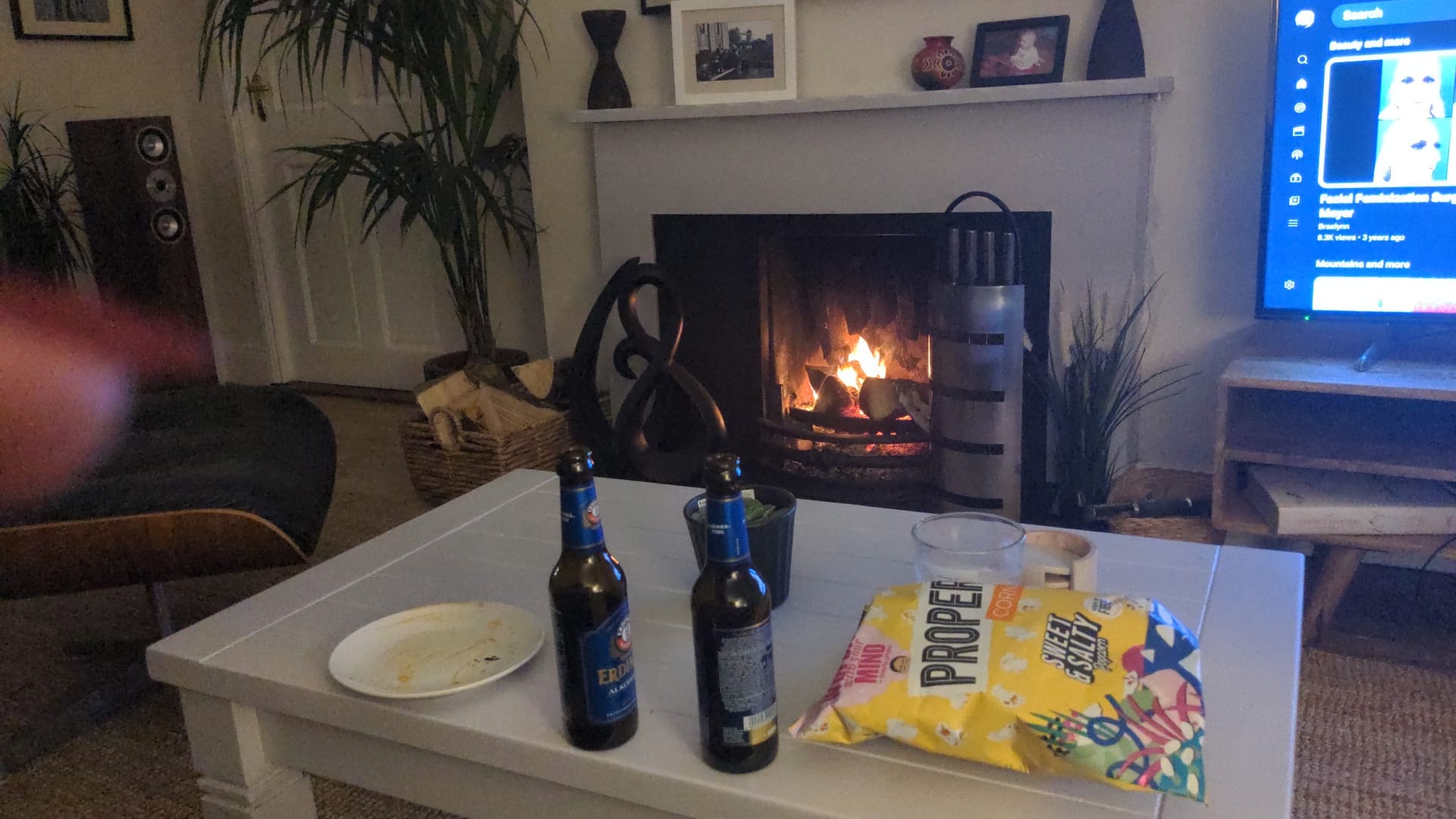
That’s exactly what I did tonight. I curled up in front of the fire with two bottles of Erdinger Alcohol-Free on the table, the little ritual I’ve settled back into since giving up drinking again 5 or 6 weeks ago and a jumbo bag of popcorn already half demolished. A proper Friday treat: a real ice cream instead of the protein one I usually make, Bowie on YouTube, the house warm and glowing, and me thawing out slowly after the cold.
For a moment, in that small, ordinary scene, I realised:
this is my life now.
Not a theory.
Not an acronym.
Just me.
What strikes me most about your reply is the curious reliance on team-based language. “We don’t hate you.” “Not us.” “Classic DARVO.”
Who exactly is this “we”? You are not a delegate, a spokesperson, or an elected representative of everyone who dislikes people like me, or disputes my arguments. You do not get to issue collective absolution on behalf of a loosely imagined moral bloc, any more than I get to speak for some imagined opposing tribe.
Likewise, I am not “on a team.” I am not part of a gang, a movement, or a coordinated campaign. I am not throwing anything at anyone, literal or metaphorical. I am writing an argument, in plain English, about a contested concept, and doing so openly, under my own name.
Invoking tomato juice, death threats, and billboards is a rhetorical sleight of hand. It shifts the discussion away from what I actually wrote, and toward a catalogue of things I have neither done nor endorsed, apparently so they can be disowned in bulk. That is not engagement, it is theatre.
If you want to dispute my argument, then dispute it. If you want to defend the concept, then defend it. But spare me the tribal ventriloquism, the moral scorekeeping, and the assumption that disagreement automatically places people into opposing camps.
We don't hate you. It's not us pouring tomato juice over you because you want to give a speech. Not us threatening to kill you over a dictionary definition on a billboard.
Classic DARVO.