



You probably haven’t ventured right down to the bottom of my Substack, have you? That’s where I hide all the articles about AI, investing, economics and financial markets.
And I’ll let you into a little secret. A decent article on Fast Track Femme gets anywhere between 300 and 3,000 reads. My articles on investing and finance get about 30. Thirty very loyal people, I might add.
Anyway, I rather liked this one, so I thought I’d inflict it on the main Fast Track Femme readership instead.
Don’t worry, I’ll be back to normal next week. I’ve got an article called Joy coming, which is the companion piece to my earlier article Shame.
I thought I’d better balance things out before you all start worrying about me.
A few years ago, my ex-wife developed a particular expression whenever I started talking about economics. It was a mixture of resignation, exhaustion and the unmistakable realisation that the next half an hour of her life was about to disappear.
“Oh, here we go again. It’s the ‘The world’s going to hell in a handcart’ lecture”
And off I’d go. The debt. The currencies. The decline of the West. Why the next fifteen years were going to look nothing like the previous fifty. I could turn a perfectly pleasant Sunday afternoon into a lecture on the collapse of Western civilisation before she’d finished making the tea.
In fairness, she had a point. I was obsessed. I’d spent three years as a quantitative trader, working alone, and long after I’d stopped, the obsession remained. I wanted to understand how the machine worked, and where it was going.
Then something rather unexpected happened. I transitioned.
And, remarkably, the future of Western civilisation became considerably less interesting than the future of Stevie Bennett. The world could get on with falling apart without my supervision.
Then, this morning, I sat down to breakfast and looked at the news. Massive riots in France. Unrest in Italy. An American woman in Florida, whom I occasionally speak to on Instagram, messaged me about it.
“Jesus Christ, Stevie. Is this actually real, or is it fake?”
“Oh, it’s real,” I told her. “The French love a riot. It’s practically their national sport. They did rather invent the modern tradition of taking to the streets and telling the establishment to fuck off.”
But then I thought something I hadn’t thought for quite a while.
Hang on. I’ve seen this pattern before.
Not these riots. The pattern.
And suddenly, after a couple of relatively peaceful years, Doomer Stevie was back.
The Big Cycle
There’s a book that had an enormous influence on the way I think about the world: Principles for Dealing with the Changing World Order, by Ray Dalio, the founder of Bridgewater Associates.
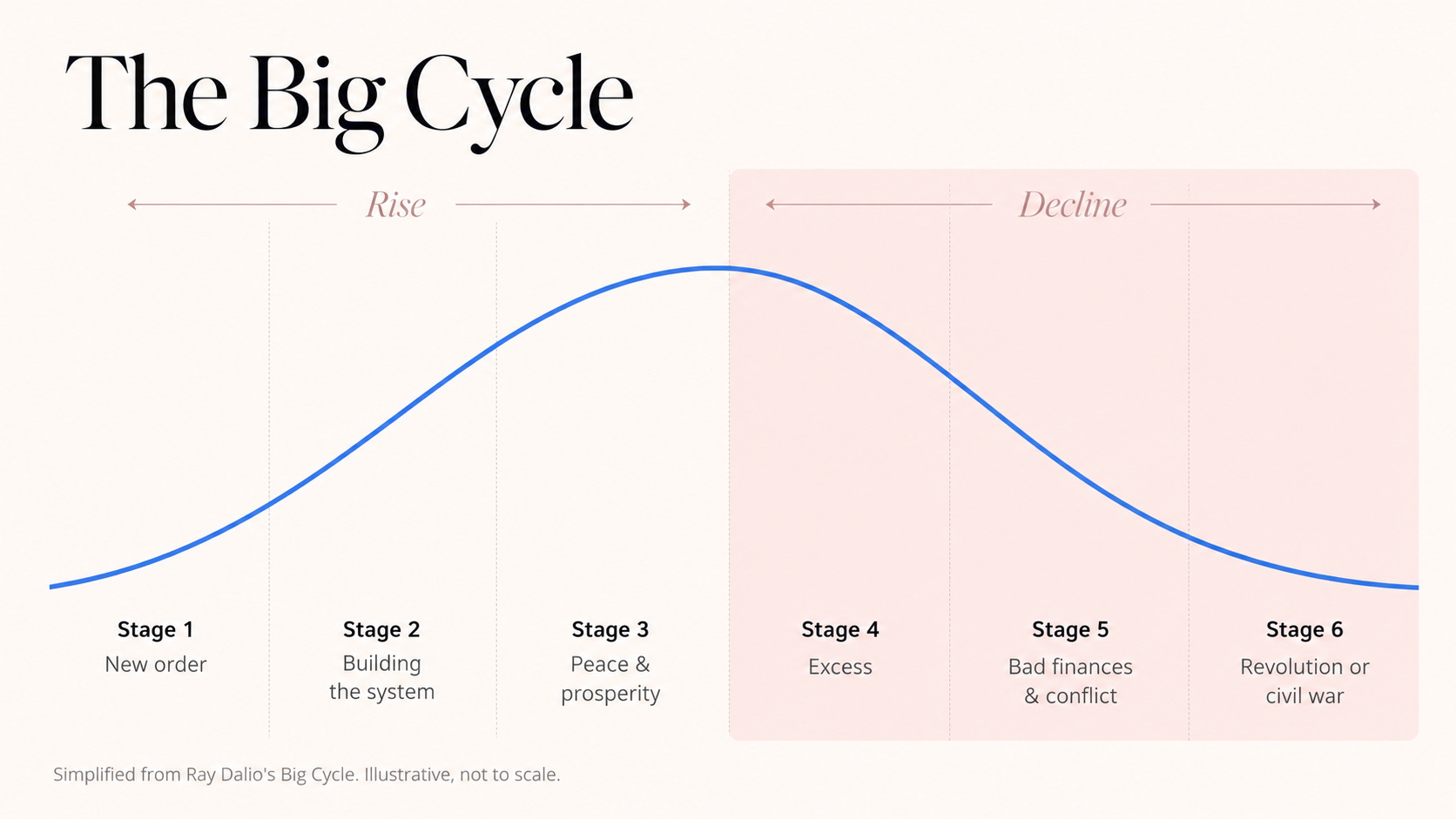
Dalio studied the rise and decline of great powers, from the Dutch and British empires to the modern United States, and found remarkable similarities. Successful nations build productive economies, strong institutions and sophisticated financial systems. Wealth accumulates and influence expands.
But prosperity encourages excess. Debt piles up, governments make ever more ambitious promises, wealth concentrates, competitors catch up, and eventually the tensions become politically explosive.
He calls this the Big Cycle.
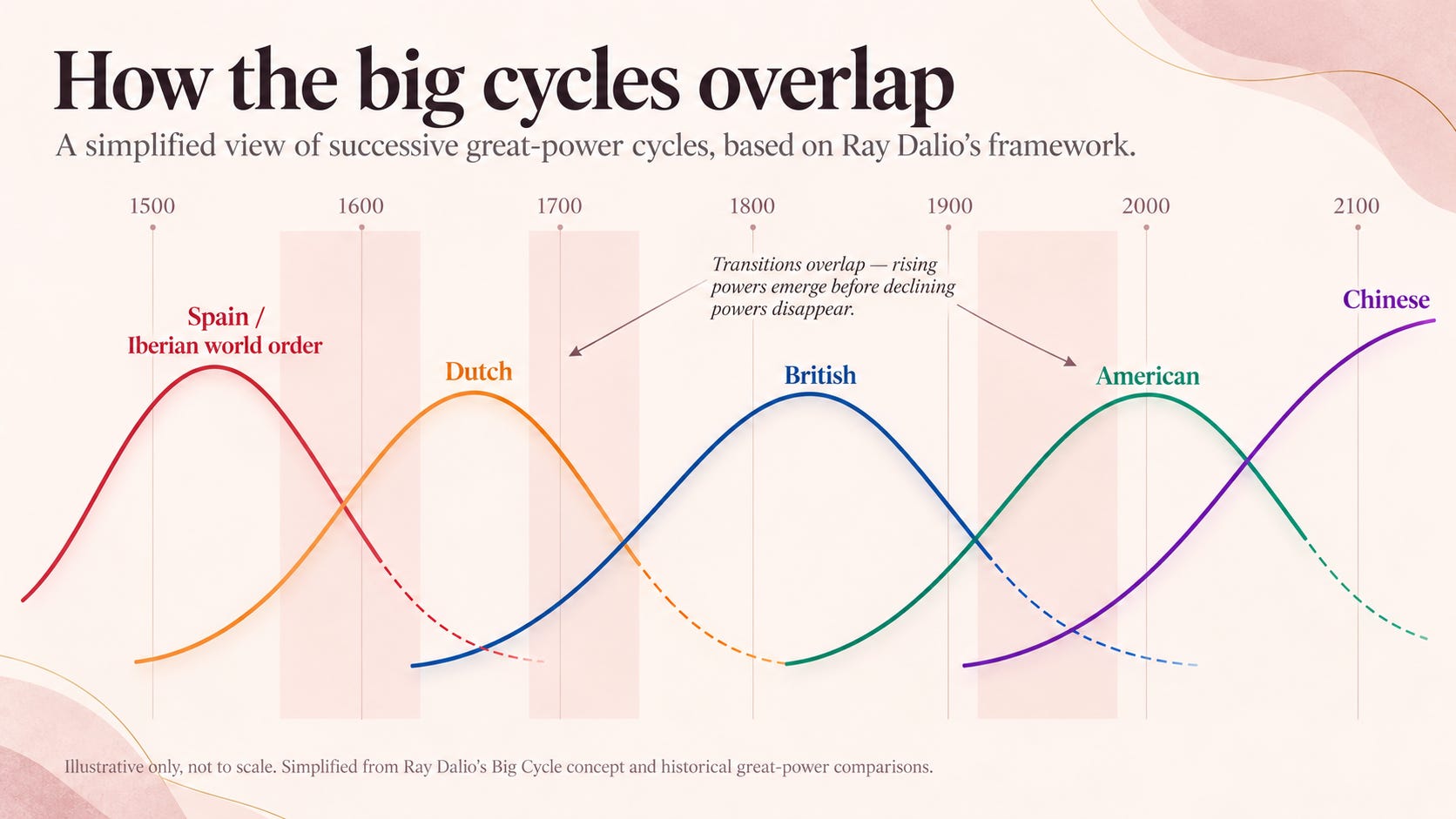
Economies aren’t Swiss watches, and empires don’t collapse precisely 250 years after somebody cuts a ribbon. But the framework is enormously useful, because it identifies three forces that bring a great power down: the debt cycle, internal disorder and external disorder.
When all three start reinforcing one another, things become decidedly unpleasant.
The canaries are getting rather noisy
Have you ever watched one of those Hollywood disaster films? A volcano behaves strangely in the Pacific. There’s an inexplicable earthquake in South America. Somebody notices the ocean temperature doing something alarming. The film keeps cutting between them until the scientist puts the pieces together, looks horrified, and announces that something enormous is about to happen.
Naturally, nobody believes him.
That’s increasingly how I feel. Except I’m sitting in my kitchen in Cork, flicking through Instagram.
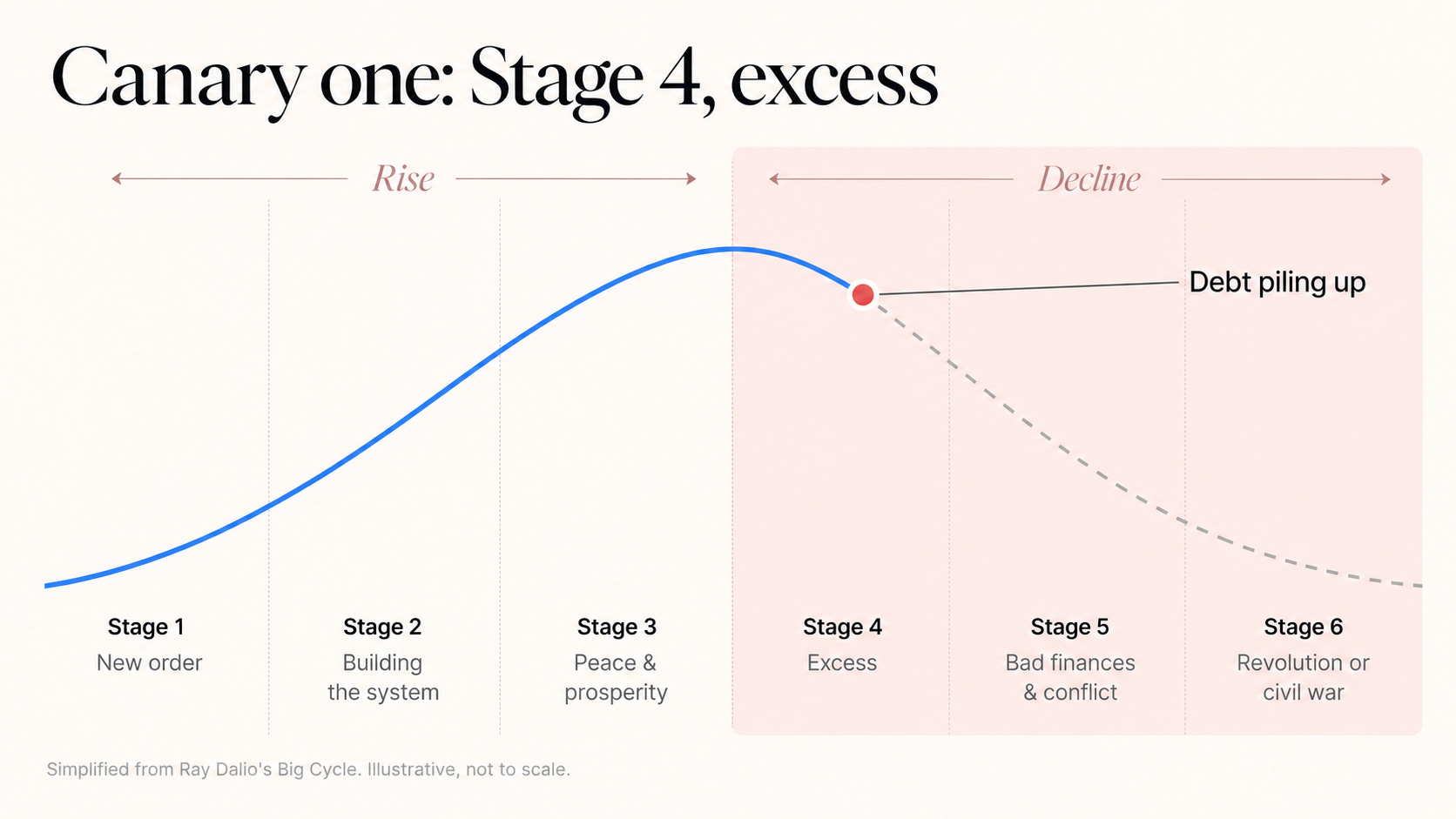
Canary one: we’ve maxed out the credit card
We are living beyond our means. We are like profligate little children who have inherited an enormous fortune, discovered the family credit card and decided the good times will simply continue forever.
The United States has now passed $40 trillion in federal debt. In the financial year ending September 2026, it ran a deficit of almost $2 trillion, and net interest on its debt passed $1 trillion. Interest payments now exceed its annual defence budget.
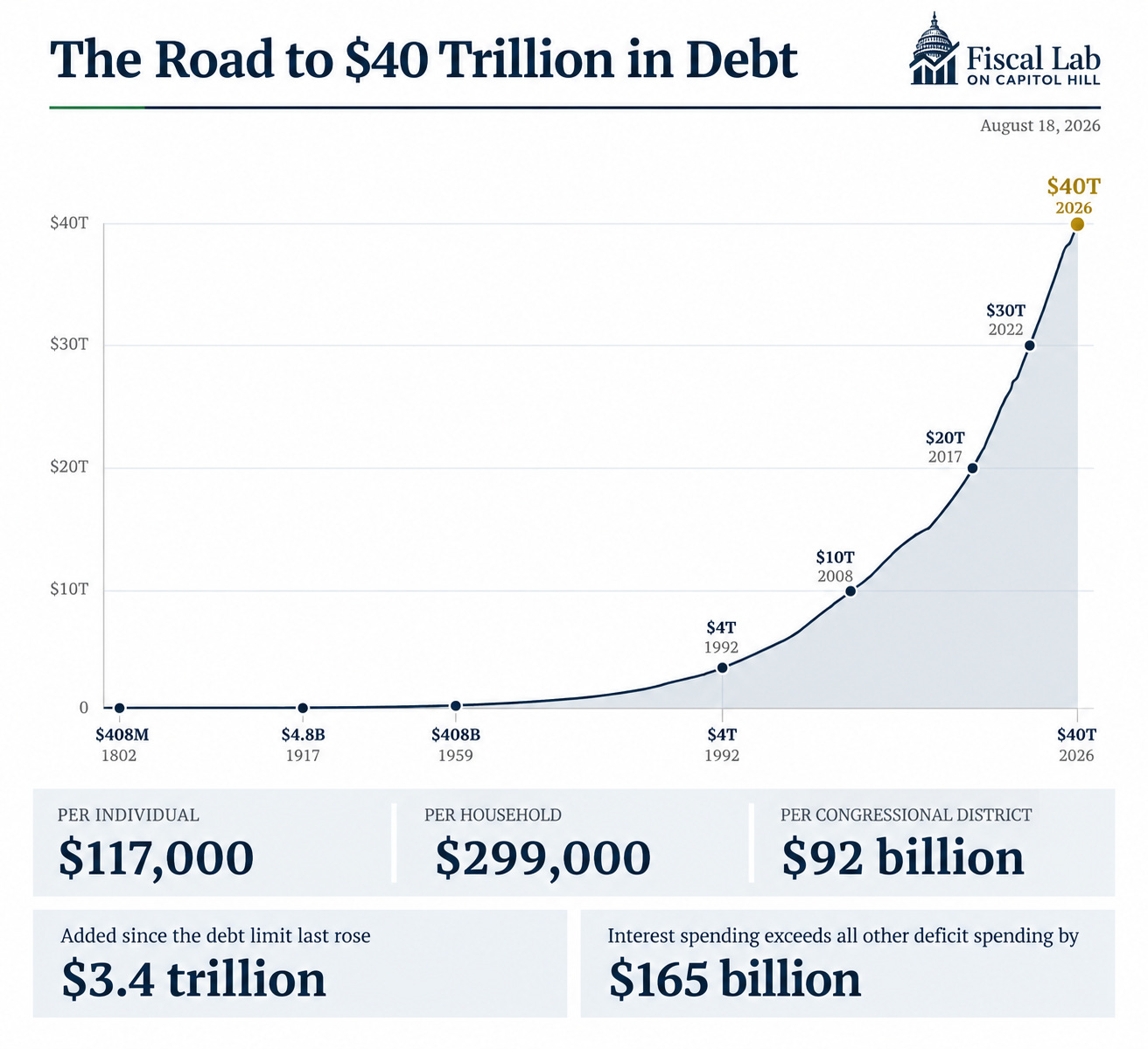
This is the wealthiest major economy on the planet.
The options aren’t particularly complicated. Grow the economy faster, raise taxes, cut spending, inflate away the debt, or ultimately restructure it. The problem is that almost all of these involve telling the electorate something it really doesn’t want to hear.
Imagine standing before the electorate and saying:
“I’m terribly sorry, but the standard of living you’ve become accustomed to simply isn’t sustainable. You’re going to have to work longer, save more, accept fewer benefits and pay more tax. And, incidentally, the correction could take twenty years.”
Good luck winning an election with that.
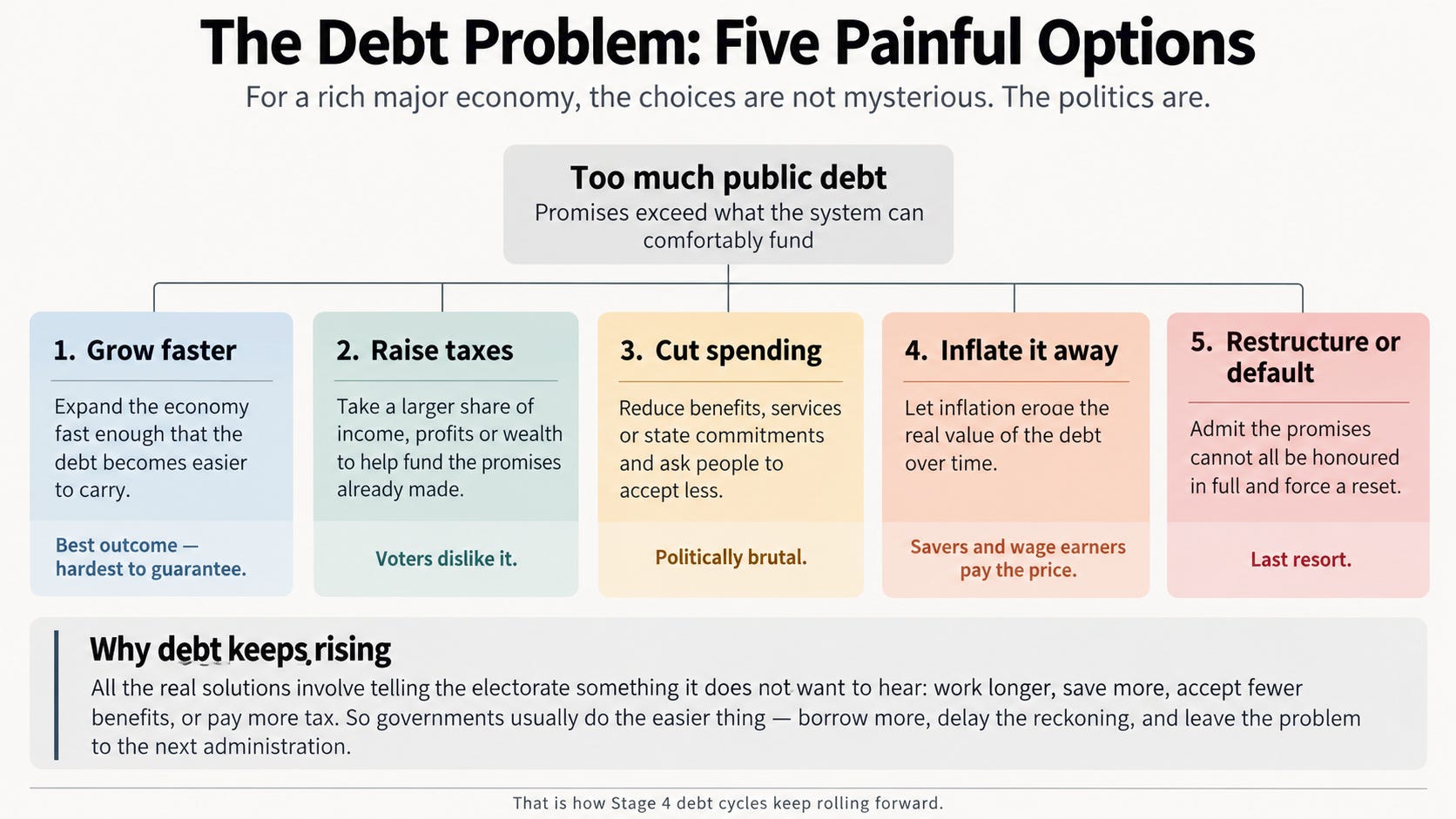
So governments do what governments do. They rummage around down the back of the sofa, dreaming up ever more ingenious and complicated ways of extracting a few extra pounds in taxation.
But mostly, they just borrow more money.
Kick the can down the road. Keep the promises coming. Hope the economy somehow grows fast enough to make the problem disappear.
And, if all else fails, leave the whole bloody mess for the next administration to sort out.
Which, of course, does exactly the same thing.
And that’s how the debt keeps growing, the promises keep accumulating, and nobody ever quite gets around to paying the bill.
That’s the debt cycle doing precisely what Dalio describes in Stage 4.
Canary two: the centre stops holding
One of the clearest warning signs, for me, is what happens to politics when people lose faith in the centre.
When the established parties have spent decades promising prosperity, security and a better future, and people increasingly feel they’ve delivered none of those things, the electorate doesn’t simply shrug its shoulders and give them another chance.
It starts looking elsewhere. And increasingly, it looks towards the extremes.
You can see this happening right across Europe and across the Atlantic. Alternative für Deutschland (AfD) in Germany, Reform in Britain, the National Rally in France, and of course the whole MAGA movement in America.
These movements aren’t identical, but they have something important in common. They offer apparently simple answers to enormously complicated problems.
Immigration is a particular favourite. Control the borders, get rid of the immigrants, reclaim our national identity, and somehow we’ll all be transported back to those wonderful halcyon days of the 1950s, when apparently everything worked beautifully.


On the other side, you have movements such as the Greens, offering their own radical departures from the economic consensus, including programmes of rapid decarbonisation and economic intervention that I personally regard as excessively restrictive.
The policies are very different, and I’m not suggesting these movements are morally equivalent. What interests me is the underlying phenomenon.
When people stop believing the centre can fix their problems, they become increasingly willing to believe somebody at the edges who promises they can.
And sometimes those promises involve identifying somebody who can conveniently be blamed for everything.
This last part is particularly entertaining when you happen to be transgender. Apparently, somewhere along the way, I’ve become one of the people responsible for the decline of Western civilisation.
“Look over there! A trans woman!”
Quickly, everybody stop discussing public debt, stagnant productivity, housing affordability and the rather awkward question of why ordinary people feel increasingly poorer.
There’s a trans woman in a dress!
It’s an old trick. Only the scapegoats change.
And this is precisely what interests me about Dalio’s internal cycle. Political fragmentation isn’t necessarily the cause of the underlying economic deterioration. It can be one of its consequences.
As faith in established institutions disappears, people become more polarised, compromise becomes harder, and the very political systems needed to address the economic problems become less capable of doing so.
The fourth stage is where things go wrong economically. The fifth is where people start turning on one another.
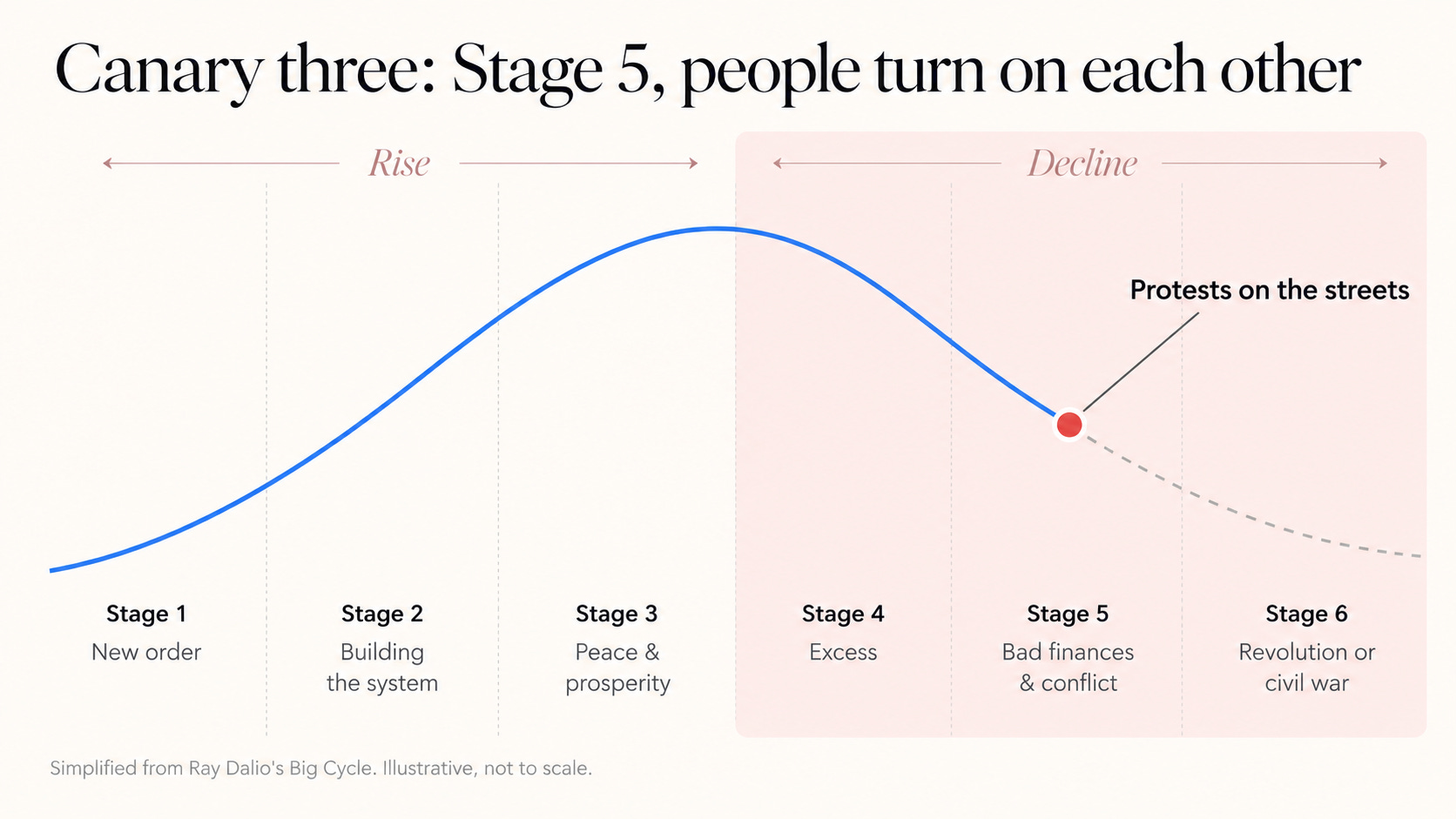
And when I look at what’s happening across Europe and America, I think we’ve crossed that boundary.
Canary three: the streets begin filling up
I don’t believe every riot means civilisation is collapsing. The French have been enthusiastically protesting governments for centuries, and I rather admire their refusal to suffer fools quietly.
But when protests over living costs, public services, housing and pensions break out across several countries at once, it’s worth asking whether there’s a common denominator.
The historian Peter Turchin’s answer, broadly, is that instability builds when ordinary people are squeezed, elites compete for a shrinking pie and state finances weaken. His theory is contested, but it names the moment that matters: when people stop believing hard work will produce a better life.
Consider housing. When I left university, you could buy an ordinary semi-detached house in parts of Britain for around £40,000. Today, the median English home costs about £300,000, around 7.6 times median full-time earnings.
And people congratulate themselves on their wealth.
“My house has made me £300,000!”
Has it? Or has something fundamental to human existence simply moved beyond the reach of the next generation?
I’m not romanticising the economic dependence many women lived with in the past. But today, two decent incomes can struggle to buy the security one once provided. When that becomes widespread, an economic problem becomes a political one. And when institutions can’t solve it, the streets become the alternative.
Canary four: the international order begins fracturing
After the Second World War, the United States emerged as the world’s dominant economic and military power.
And the financial system we live with today didn’t simply happen by accident. In 1944, representatives of 44 Allied nations met at a place called Bretton Woods in New Hampshire and set about designing a new international monetary order, with the American dollar at its centre.
The original arrangement, which linked the dollar to gold, eventually broke down in 1971. But the dollar’s dominance survived, and much of the international financial architecture that emerged from that period still shapes our world today.
For eighty years, we’ve grown up treating this American-led order as though it’s a permanent feature of civilisation.
But it isn’t.
It was built. And what was built can eventually be replaced..
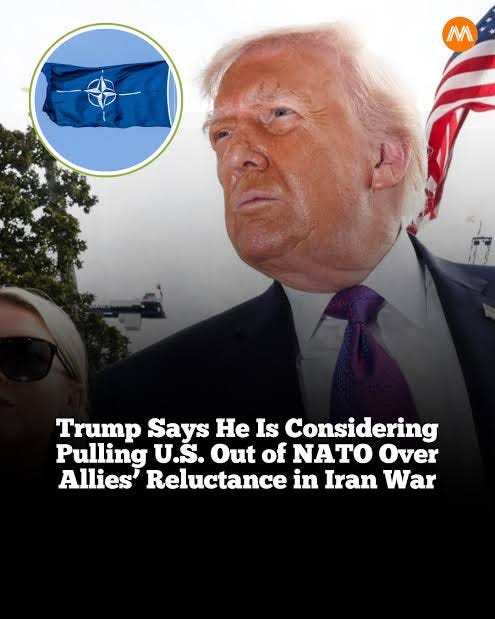
China has become an enormous industrial and technological competitor. The United States now reaches readily for tariffs, export controls and financial pressure. Even the relationship between America and its European allies, which defined the Western world for generations, can no longer be taken for granted.
In February 2026, Dalio published a piece titled It’s Official: The World Order Has Broken Down, arguing that the external cycle had reached Stage 6.
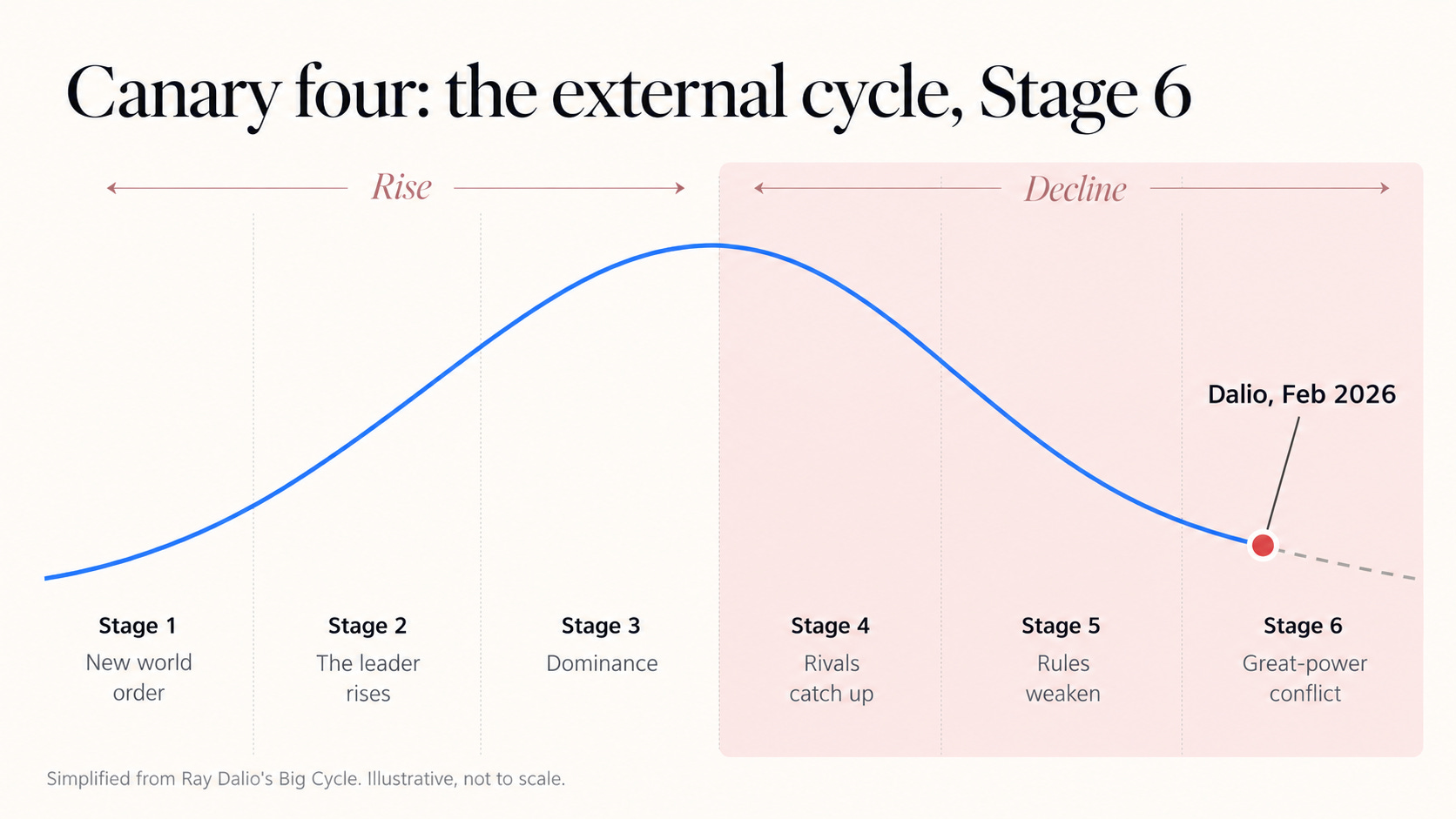
That’s his assessment but I find it increasingly hard to argue with.
When the canaries sing together
The really frightening thing about Dalio’s model isn’t any one of these problems. It’s how they feed each other.
A country with enormous debts needs difficult decisions. Its divided, angry population won’t accept them, so the radical parties grow and compromise becomes impossible. Meanwhile a rival senses weakness and starts pushing, which demands more spending the country can’t afford and decisions its politics can no longer make.
That’s the feedback loop. And just like the scientist in the disaster film, I find myself staring at the screen thinking, Oh, for fuck’s sake. It’s all happening together.
Where I think we are
So here’s my assessment.
The American-led Western order has entered Stage 5 of Dalio’s internal cycle. We’re not waiting for the political division, the collapse of trust in institutions and the hostility between sections of society. We’re living through them. And externally, Dalio’s Stage 6 looks right to me.
Does that mean civilisation collapses next Thursday? No.
But whenever somebody calls it the “cost of living crisis”, as though it’s a temporary inconvenience caused by the latest unfortunate event, I want to scream. The financial crisis, Brexit, COVID, inflation and energy prices were all genuine shocks. But what if they were acting on a system whose resilience had been eroding for decades?
What if the normality everybody is waiting to return to no longer exists?
And now I’m building the thing
Just to make matters even more entertaining, we’re throwing artificial intelligence into the mix.
Now, I’m not going to spend too much time on AI here. I’ve written about it extensively elsewhere, and frankly, it’s an entire subject in its own right.
But it introduces an enormous unknown into everything I’ve just described.
We’re at the very beginning of this revolution. We really are. And I say that as somebody who is, excuse the expression, absolutely “balls deep” 😕 in AI and autonomous agents.
I spend my working life building systems that increasingly perform work previously requiring teams of human beings. I’ve seen what these things can already do, and I can tell you that the disruption over the next ten years is going to be extraordinary.
But here’s what fascinates me.
Imagine a world in which energy becomes extraordinarily cheap through technologies such as solar, and intelligence becomes almost infinitely abundant through AI. The marginal cost of producing enormous categories of goods and services could fall towards zero.
That ought to be wonderful, shouldn’t it?
An explosion in productivity. Enormous increases in wealth. Things that were once expensive becoming almost free. Perhaps even an escape from some of the economic constraints I’ve spent this article worrying about.
But there’s another possibility.
What happens if the economic value created by all this technology flows overwhelmingly to the people who own it, while millions of people find that their labour is no longer particularly valuable?
Where does the tax revenue come from? How do governments finance themselves? How does purchasing power get distributed? What happens to the political stability of societies in which work has always been so central to people’s economic lives?
And perhaps most importantly, how do people respond?
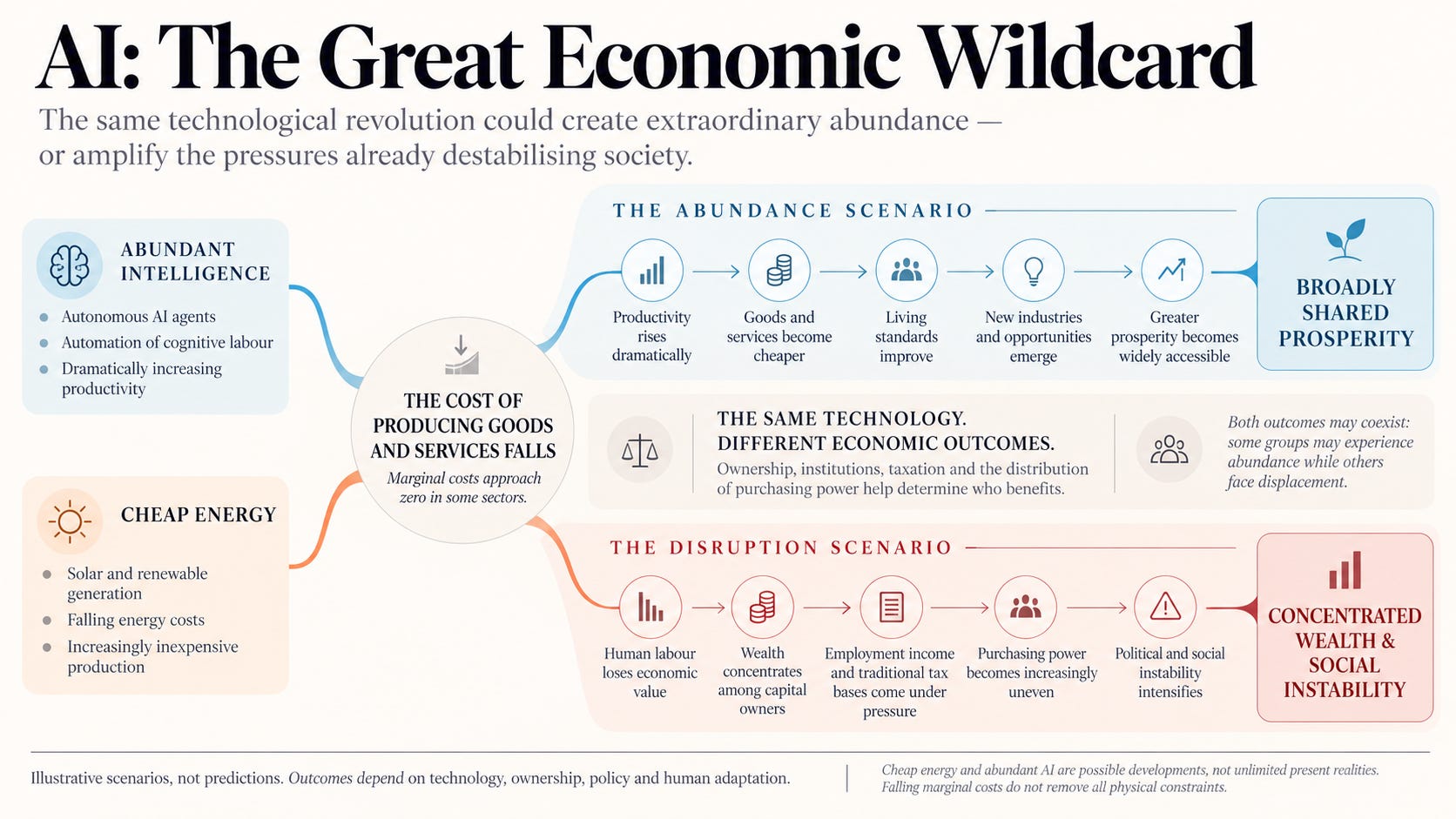
We could be heading towards an extraordinary age of abundance, a deeply unpleasant period of economic dislocation, or, more probably, some complicated mixture of both.
And all of this is arriving at precisely the moment when our existing financial and political systems are already under enormous strain.
Predicting the next twenty years was difficult enough before AI came along. Now somebody has effectively thrown the entire economic model up in the air.
And here I am, enthusiastically helping to build the bloody thing.
The return of Doomer Stevie
We’re bad at imagining a future outside our own experience. For most of us, a really bad future means an expensive mortgage and a government we detest. History offers considerably worse: currency collapses, political breakdown, wars. We miss slow deterioration because we adapt to each step, and we underestimate how quickly a stable-looking system can give way once it reaches a tipping point.
Perhaps I’ve become oversensitive to the signals. That’s always the danger with a framework. But underneath all the technology, we’re still the same creatures who have spent thousands of years competing, cooperating, building and occasionally tearing everything apart.
For all my gloom, I’m actually rather optimistic about human ingenuity. We’ve recovered from extraordinary catastrophes before. The trouble is that the recovery tends to arrive after an awful lot of suffering.
So perhaps the world’s going to hell in a handcart. Or perhaps we’re heading into a particularly uncomfortable adjustment before something better emerges.
I certainly hope it’s the latter.
But after a couple of years of being far more concerned with my own transformation than the transformation of the global economic order, the old obsession has returned.
Steve the Doomer is back.
Except she’s now Stevie the Doomer.
Damn. Would like to disagree but have had similar, not as detailed, thoughts for a few years. COVID could've been the big shift needed to clean up these problems but instead of wealth taxes and other items to rebalance the economy and release the stress we saw the opposite happen - more to the wealthiest, bigger debt, and more unrest. Living next to the USA is like being next door ro a drug den. Very scary, but hoping the owners want a safe place for themselves thus for you by accident. Sadly the owners if that home went to the Mediterranean and the house is getting worse by the day. I have a plan for hiding if needed but far from ideal.