


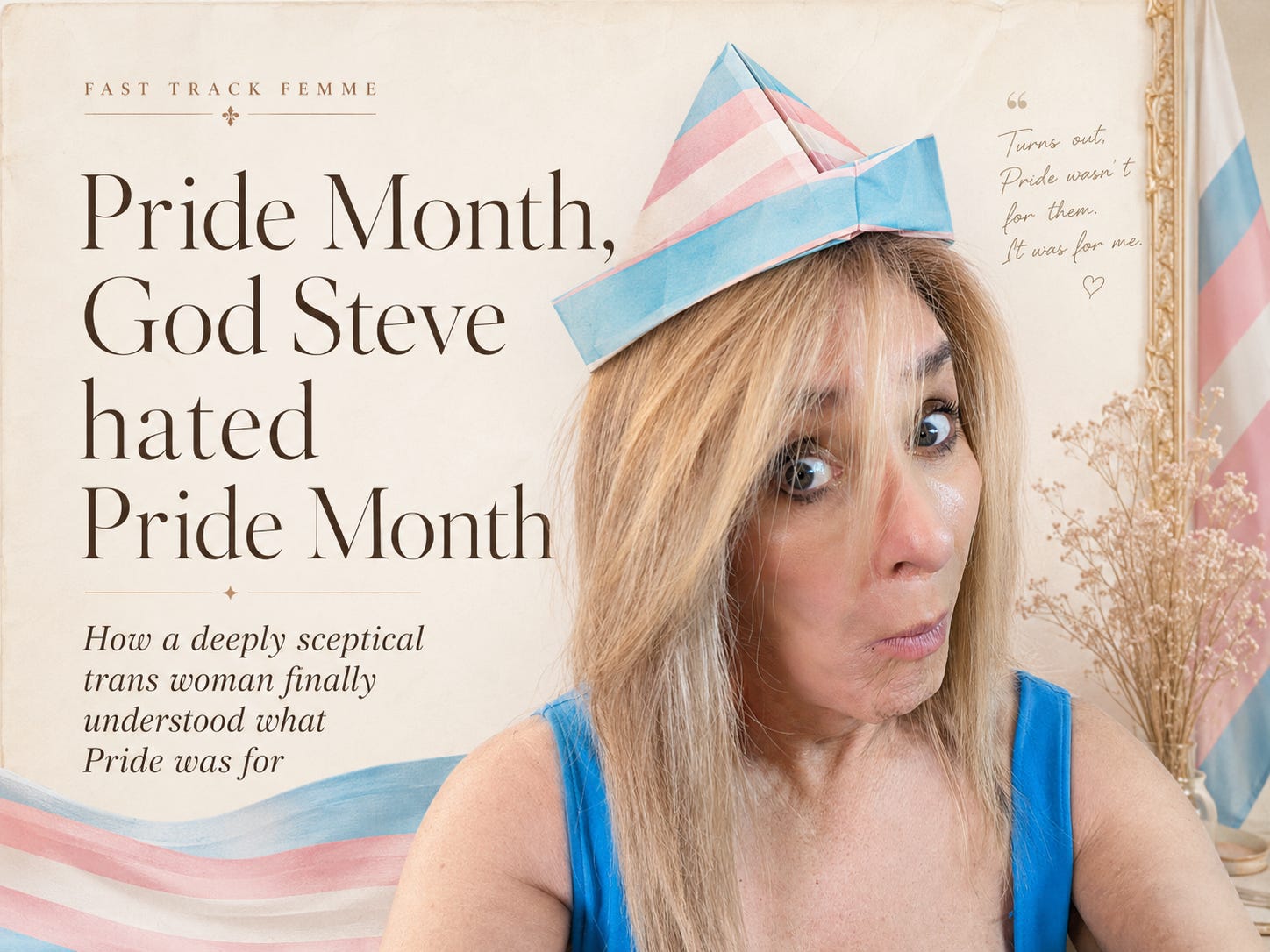
Another day, another germination of an uncomfortable thought.
It is almost Pride month again.
Pre-transition Steve used to look at Pride month and roll his eyes so hard they nearly detached from his skull.
I remember looking at Regent Street covered in Pride flags and thinking the Third Reich had moved back in, only this time in glorious Technicolor.
“The whole bloody month? Are you serious?”
That really was my attitude.
And if I am being completely honest, part of the reason I resisted transition for so long was because I had a profoundly uneasy relationship with the idea of being “in the LGBT”.
I still remember the day, in front of the mirror in my office, and I started repeating the words over and over to myself.
“I am transgender.”
Again.
“I am transgender.”
Again.
“I am transgender.”
Acceptance was hard.
Discovery was not hard. I had known for decades in the strange submerged way trans people often know things long before they admit them. But acceptance was another matter entirely.
The words felt radioactive.
Then, later, sat in front of my computer, something else hit me and I burst out laughing.
“Oh my God.”
“I’m in the LGBT.”
“What the actual fuck?”
I, Stephen Bennett, was in the LGBT.
This came as a considerable shock to Stephen Bennett.
You see, I had spent most of my life psychologically standing outside all of that.
I would see Pride marches and sometimes recoil from them. I would see leather outfits, gimp masks, fetish aesthetics, public sexuality, rainbow hair, shouting, slogans, and what looked to me like social chaos. And my reaction, if I am honest, was often something between discomfort and embarrassment.
Part of that was probably straightforward prejudice. Some of it was social conditioning. Some of it was class instinct. Some of it was fear.
But a large part of it, I now realise, was that I did not want any of it to have anything to do with me.
Because if those people belonged to the same category as me, then suddenly my problem stopped being abstract.
It became personal.
I also think I had a very specific discomfort with overt sexuality in public. I am actually quite prudy. I always joked about this in my early transition videos. Somewhere inside me there lives a slightly horrified 1970s school prefect and a small amount of Mary Whitehouse.
I do not like public sexual theatrics, regardless of who is doing them.
But here is the interesting contradiction.
At the exact same time as I was rolling my eyes at parts of queer culture, I secretly envied the living hell out of some of it.
Growing up in Britain in the 1970s and 80s, I absolutely loved those funny, cheeky, camp public figures who everyone knew were gay but nobody officially said were gay. Men like Kenneth Williams. Later people like Graham Norton and Alan Carr.
I loved the freedom of it.
The wit.
The looseness.
The theatricality.
The escape from rigid masculinity.
I wanted to sit at that table.
Not because I wanted public sex or fetish parades or slogans.
I wanted the release valve.
I noticed something throughout my life. Whenever I spent time around very camp gay men, if I trusted them, something in me relaxed. My guard dropped. I became softer. More honest. Less frightened.
Back in the 1990s, one of the very few people I ever came out to was a gay couple I knew in Nottingham. They gave me some dresses. I was eternally grateful for that.
That sounds like such a small thing, but it mattered enormously.
Around straight men, especially in the world I grew up in, there were invisible walls around masculinity. You did not admit softness. You did not admit femininity. You certainly did not admit wanting to be a woman.
But with certain gay men, the walls briefly disappeared.
They disarmed me.
I could breathe.
And then something else happened recently.
I was in Boots buying yet more hair nonsense, because transition appears to involve spending the GDP of a small nation on hair products, and there was another trans person in the shop.
Very visibly trans.
Rainbow-coloured hair.
Receding hairline.
Masculine face.
Standing out enormously.
Six months ago, maybe even less, part of me would have looked at that and thought:
“Why would you draw more attention to yourself?”
“If you are already visibly trans, why add rainbow hair on top of it?”
But this time I saw something completely different.
They were not making it worse.
They were taking it back.
And suddenly I understood something I had not properly understood before.
Not everyone survives this by blending in quietly and trying to look as socially acceptable as possible.
Some people survive by becoming louder.
More visible.
More deliberate.
By refusing shame.
And I realised something else too.
My experience of being trans has been easier than some people’s.
I pass reasonably well.
I live a fairly normal life.
I walk around Cork buying makeup and hair products and coffees and nobody really bothers me very much.
And the uncomfortable truth is this:
Part of the reason I get to do that is because other people absorbed the social punishment first.
The flamboyant gay man in 1987.
The activist I rolled my eyes at twenty years ago.
The visibly trans woman walking into Boots anyway.
The people who were prepared to look ridiculous, threatening, embarrassing, political, weird, too loud, too feminine, too obvious, too much.
People suffered so that other people could quietly exist later with less suffering.
That does not mean I suddenly agree with every part of LGBT culture.
I still roll my eyes sometimes.
I still do not naturally think in group identities.
I still dislike ideological conformity.
I still do not trust groups not to colonise individual thought.
I still have a strong instinct toward independence.
And I do not believe being trans automatically makes somebody wise, moral, or correct any more than being straight does.
But I understand something now that I did not understand before.
You do not have to become identical to people to recognise what they carried for you.
And that, I think, is why I now find Pride month oddly moving.
Not because I have suddenly become a perfect Pride person.
God no.
But because I finally understand that I am not standing outside the glass anymore.
I am on the inside now.
Which means when I see irritated middle-aged men rolling their eyes at the flags, I sometimes laugh quietly to myself.
Because I know exactly where they are psychologically.
I used to live there too.
And despite all my instincts toward being a solitary creature, despite all my resistance to group identity, despite all my hesitation around slogans and collective language, I have finally arrived at the conclusion:
We are all in this together, aren’t we?