


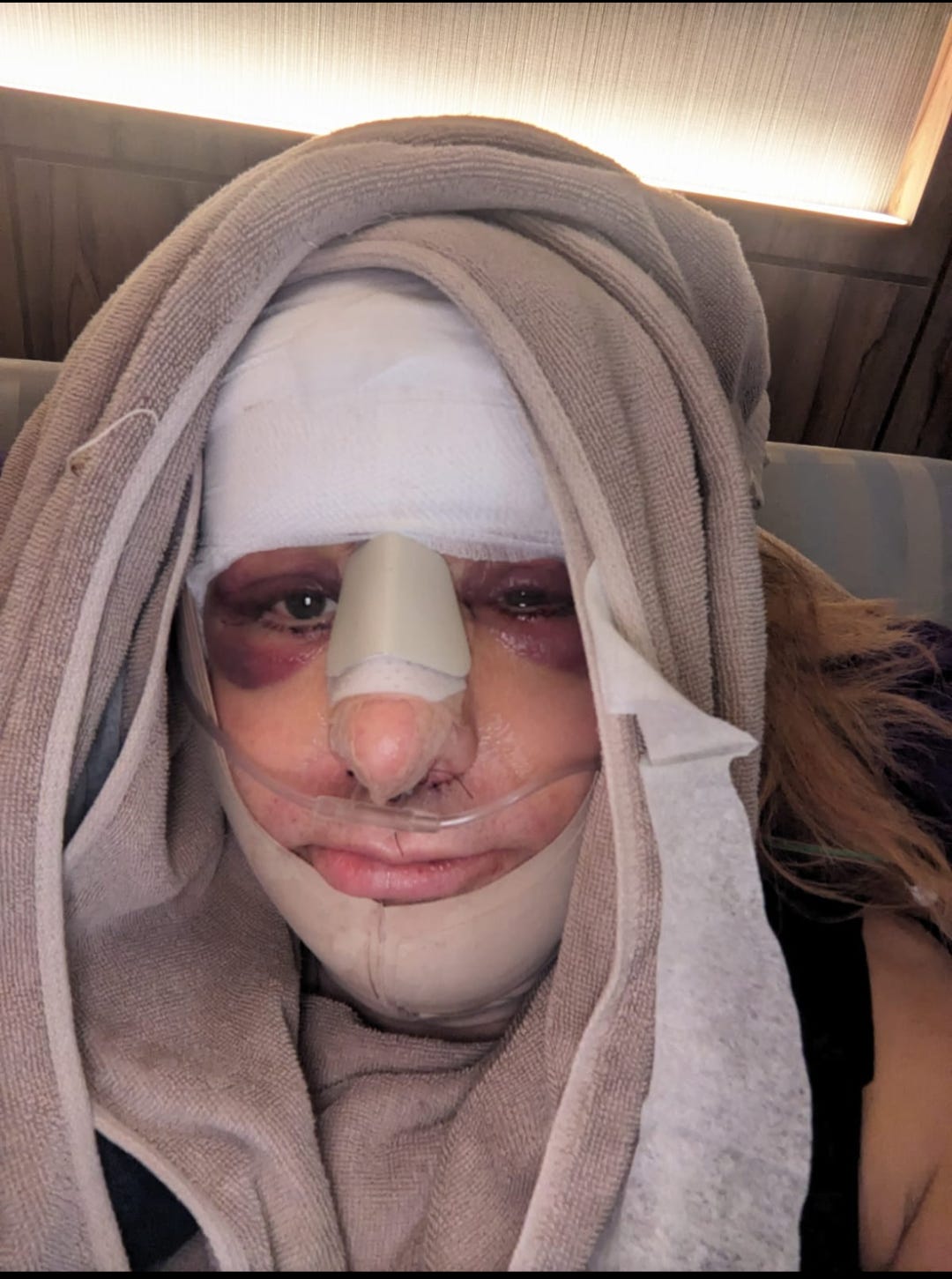
It’s Saturday morning, and I’m still here in this hospital room. The plan was to discharge me today after lunch, but now it’s been pushed back to Tuesday. Too much swelling. Monday was five hours of surgery. Tuesday was twelve. Seventeen hours in total. Now my face is the size of a balloon, and when I look in the mirror, the person I used to know is gone.
Gone. Dead. Steve is dead.
I don’t know exactly who’s looking back at me yet. It doesn’t look like a man, that much I can say. But it also doesn’t look like me. It’s someone else. And that’s terrifying and exhilarating in equal measure.
What they did to me
Day one was breasts 405cc implants, bigger than I originally wanted but, as it turns out, not ridiculous. They suit me. Rib cartilage harvested. Nose done. Lip lift. Tracheal shave. Five hours of that, and then straight into recovery.
Day two was the marathon: Type 3 forehead recontouring with a titanium plate. Orbital rims and brow bossing removed. Fat grafts to my temples. Scalp cut and advanced by a couple of centimetres. Eyes reshaped and filled. Cheeks fat-grafted. Sliding genioplasty and chin V-contour. And, to pull it all together, a deep plane facelift and neck lift.
It’s absurd when you write it out. It doesn’t sound like one person’s face, it sounds like an architectural renovation project.
The mirror moment
The biggest tell that Steve was gone was the eyes. The brow bossing, the nose, the mouth, all of that is different. But the eyes are what really struck me. They’re more open, more exposed. They belong to someone new.
The first time I looked in the mirror, I thought: he’s gone. Instantly. Dead.
What replaced him is still swollen and alien, and I don’t know if she will be beautiful, pretty, or just acceptable. But she will be a woman. And that, finally, is non-negotiable.
Hope and fear
There’s hope that I might pass as mid-forties, maybe even younger, that strangers won’t immediately read me as a man. There’s hope that, bizarrely, people might even try to pull me.
But there’s fear too. Fear about my children, who already felt their dad was gone before this. Fear of what family will think when they see a completely different face. Fear that I’ll look in the mirror one day and not like what I see.
It’s a strange balance, hope braided tightly with fear.
Hospital life
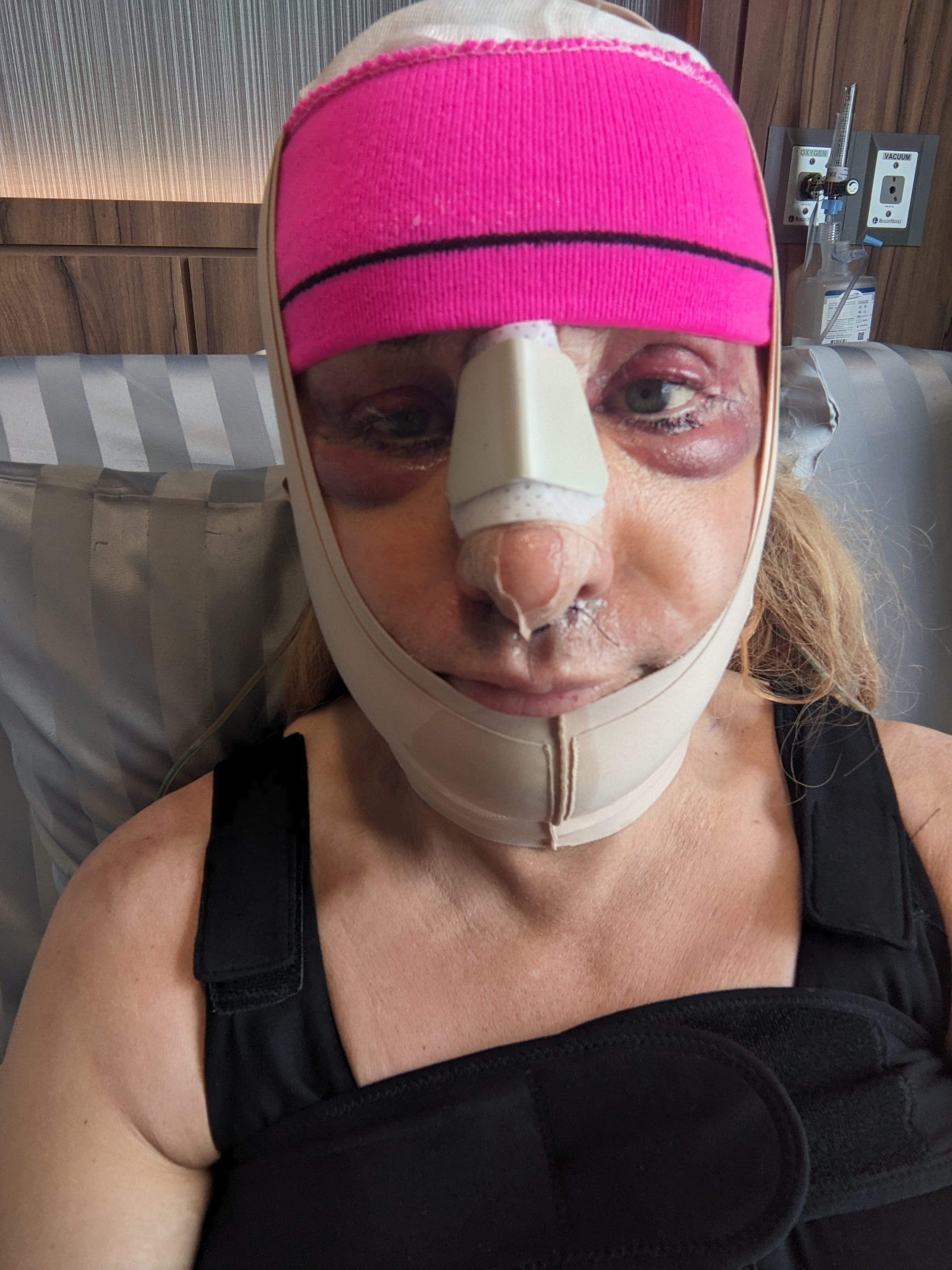
Here, the care is constant. In the UK, you’re left alone for hours. Here, there’s always someone: wiping my mouth, fixing my hair, tending to my eyes. For the first four days, I lived on chicken-flavoured water masquerading as broth. No idea how many calories were in it. Not many.
I drift in and out of sleep, wake up to another stranger touching my face, then slip back into a kind of dazed limbo.
Aftermath and recovery fears
What unsettles me most now isn’t the swelling, or even the bruising. It’s the numbness. Huge parts of my face feel dead. I know from experience — forty years ago when I had shoulder surgery — that nerves don’t always come back. You get used to it. You stop thinking about it. But I still hope it won’t be too bad this time, that I won’t feel alien in my own skin.
I worry about my voice too. My larynx control feels dulled. Will it come back? Will the scars fade? Rationally, I know they should, but there’s always that fear: what if I’m the exception? What if something sticks?
When I first woke up, I heard water running in my ears. A constant stream, like a waterfall next to my head. For twenty-four hours it was there, and I thought: if this never fades, could I live like this forever? Thankfully it’s gone now. But that thought has stayed with me.
Because this is the truth: every decision has already been made. Every cut, every graft, every stitch they’re permanent. There’s no undo button. For better or worse, this is what I’ve done.
Radical change
The strangest thing is knowing how radical this is. Most people never do anything like this to themselves. I’ve reshaped my skull, moved fat around my face, rebuilt my chin, and stitched myself into a new identity.
And my brain, me, the “I” writing this, sits trapped inside it all, millimetres from a titanium plate, staring out of a ballooned, healing head that looks nothing like the man in old photographs.
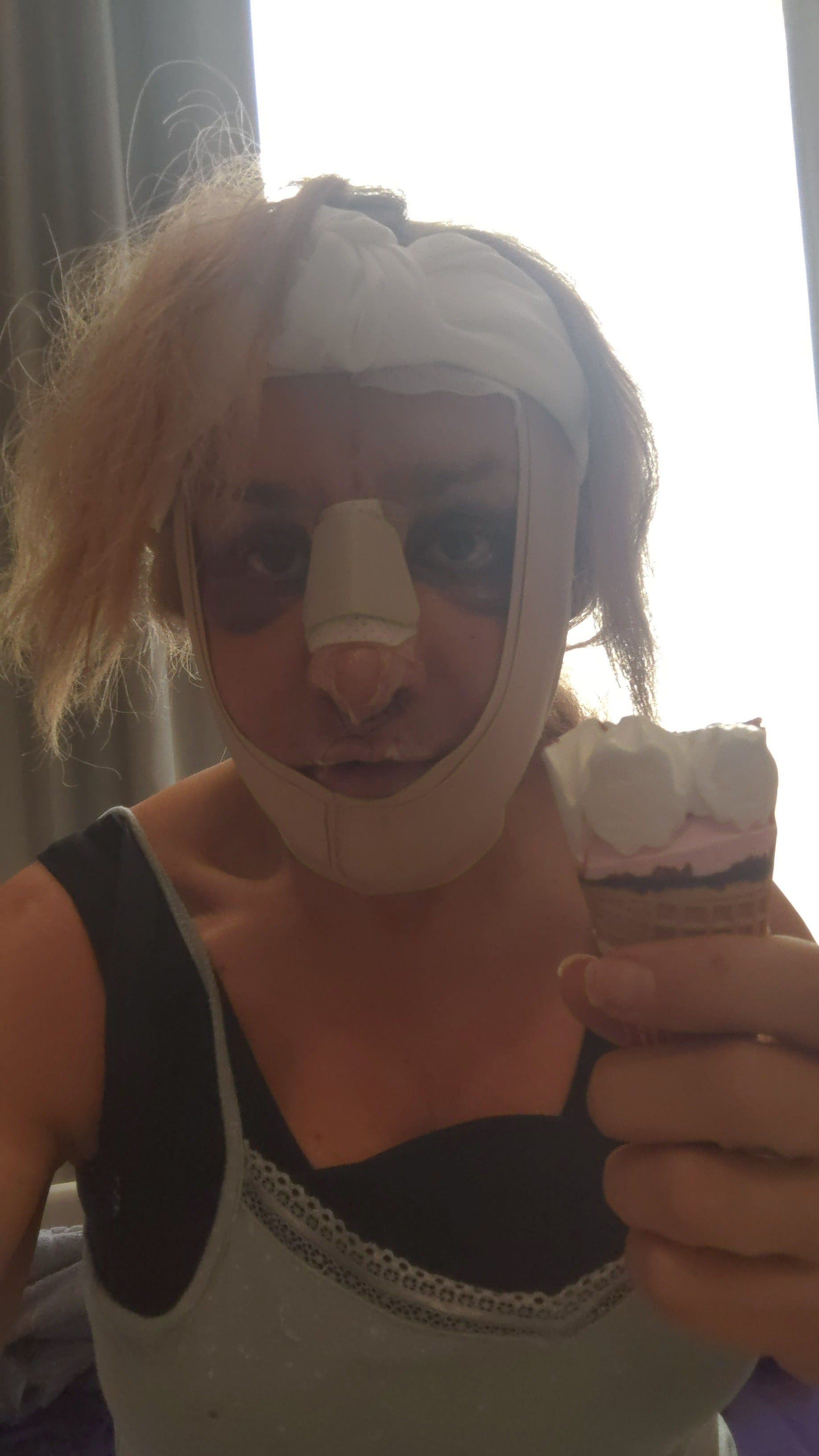
I don’t look like him anymore. He’s gone. And now I wait to see who I’ve become.