I’ve had this article basically finished for a week but have been in way too much pain to edit it down.
Last Friday I looked at my diary and thought, glorious. An empty week. I shall cocoon at home, heal quietly, and finally publish my deep statistical dive into just how rare I am.
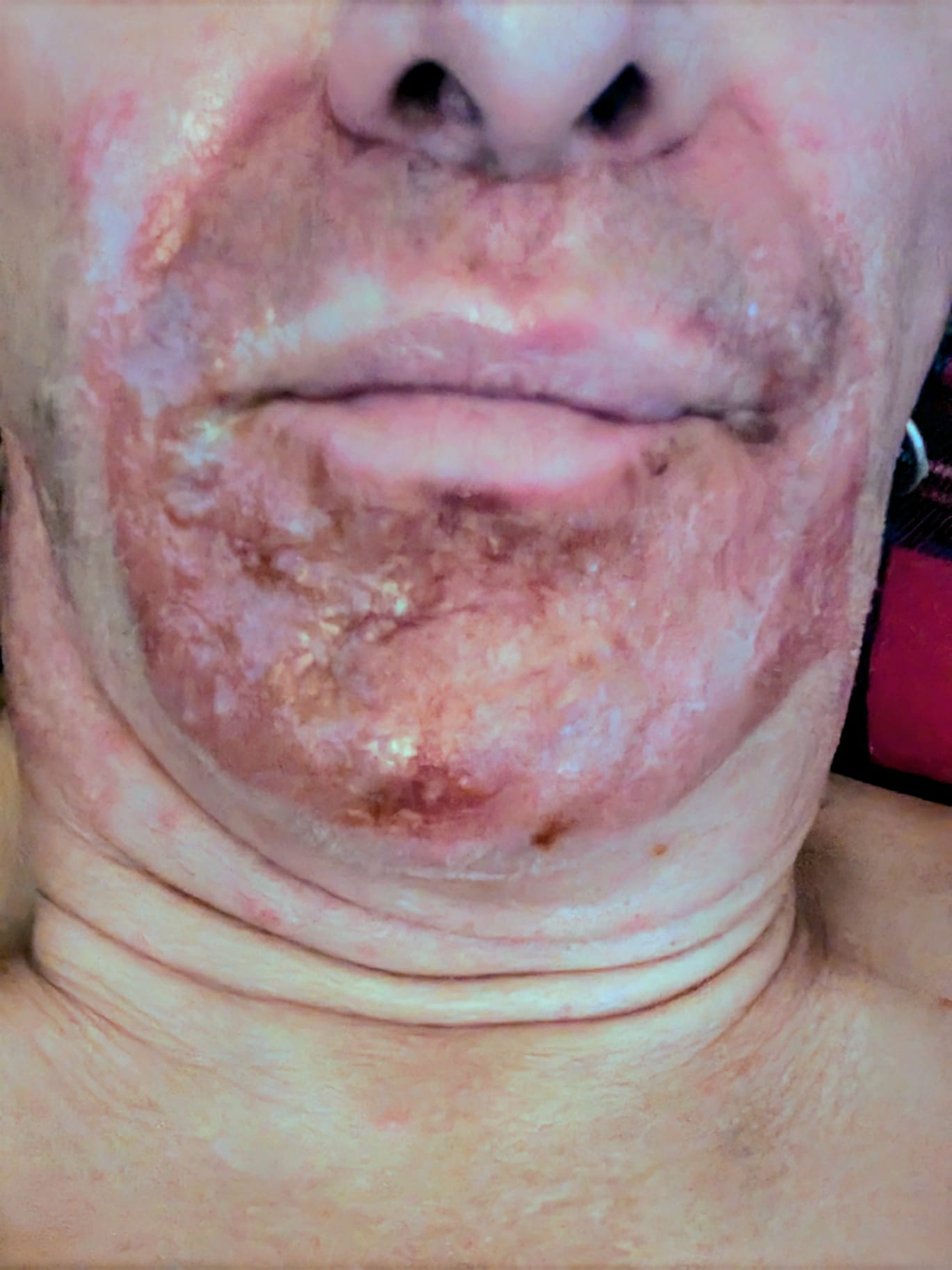
Naturally, I decided this was also the perfect time to have the skin lasered off the strip between my lip and chin. A tasteful cosmetic refresh. A sort of scorched-goatee.
If you’ve done CO₂ laser, you know the drill. They numb you a bit. They hand you two stress balls. You lie down and listen to a tiny dragon sizzling your face while the room smells faintly of toasted human.
Immediately afterwards you think, “That wasn’t so bad.”
Twenty-four hours later you look like you lost a bet with acid.
24 hours later...
Still, that was not the problem.
The problem was that in my commitment to not feeling pain, I was shuddering, bracing, kicking the treatment table and smashing my elbows into it like Frankenstein being brought back to life on a budget. My back was tenser than a piano wire in a thunderstorm. I re-agitated my old C7 nerve issue.
And when I say “re-agitated,” I mean bolts of blinding pain through my shoulder blade, down the back of my arm, into my left hand. My hand was literally quivering. It felt like someone had plugged my spine into a car battery and was occasionally revving the engine for sport.
It was the most agonising pain I have ever experienced.
And Christ almighty, I have “done a few things” to myself!!!
I lay in bed, howling and wailing to myself, why me, why me? I’ll be honest, it’s about as much as I could take. I couldn’t even nip out for ibuprofen because my skin was literally sliding down my neck in a sea of Vaseline.
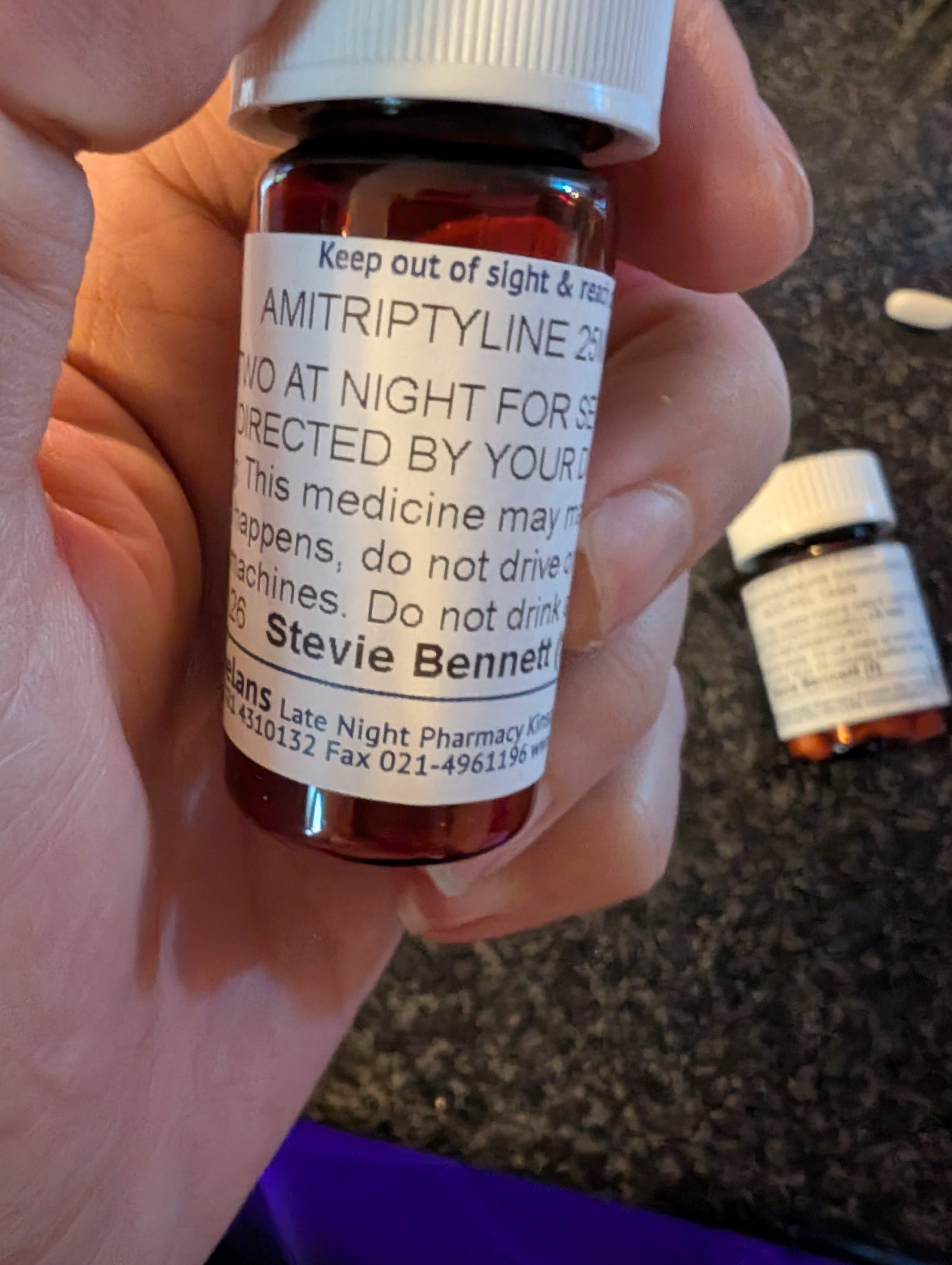
By Tuesday I could plaster on enough makeup to resemble a person and drove to the nice private A&E, where an absolutely lovely doctor prescribed amitriptyline. Which I then took at the wrong time of day and promptly fell into a 20-hour pharmaceutical coma.
The next morning, still partially sedated, I got up at 3am, fell over, twisted my ankle, and spent two days hopping around my house, cursing and yelping.
But it is now Friday evening. I am upright. My arm has stopped impersonating a Tesla coil. And I am finally ready to publish the article I meant to finish in the first place.
Which, improbably, is about how statistically rare it is to have had a vaginoplasty.
Because if you’re going to calculate your own improbability, you might as well do it while slightly singed and freshly electrocuted.
Anyway.
Let’s talk numbers.
How Rare Am I, Exactly?
It is now the 20th of February, nearly five and a half weeks since my surgery, and I have to say, I do not think twenty minutes goes by, no matter what I am doing, when my brain does not flicker and go:
Holy fuck, you have a vagina. Holy fuck, you have a vagina. Jesus Christ, holy fuck.
Thanks for reading Fast Track Femme! Subscribe for free to receive new posts and support my work.
Giving a presentation at work, making my dinner, brushing my teeth, it does not matter. It just keeps happening.
Earlier today I was looking at myself in the mirror and I thought, Christ, you are one of the very few human beings, both alive and who have ever been alive, who will have experienced such a profoundly strange shift in their anatomy.
And then I got curious.
How rare is this?
How rare am I?
So I decided to sit down and make two sets of back of the envelope calculations, as honestly as I could, based on whatever data we actually have, however fuzzy. The questions I wanted to answer were:
What percentage of humans alive today have had a gender affirming vaginoplasty like mine?
What percentage of all humans who have ever lived have gone through what I have just gone through?
In this post I am going to walk through my entire working: every assumption, every fudge factor, every little bit of rationalisation that gets us from “vague idea” to “rough numerical answer”.
Nothing chopped, nothing hidden. This is not meant to be exact, it is meant to be an honest, transparent, best effort estimate.
What I Am Actually Counting
For the purpose of this little experiment, I am using:
“Vaginoplasty” = gender affirming genital surgery for trans women / transfeminine people using penile inversion or related techniques.
I am not counting:
cis women having surgery for prolapse and similar,
or other non gender affirming uses of the word.
Also, I am going to talk about orders of magnitude. I am trying to get to “tens of thousands vs hundreds of thousands vs millions” rather than pretending we know the exact number down to the last person.
Step 0 – A Few Anchor Numbers
Before we can start, we need some basic facts that the rest of the calculation leans on.
0.1 World population today
Current world population is roughly:
8.3 billion people
which I will write as:
𝑃 = 8.3 × 10⁹
That is our “denominator” for the first question.
0.2 How many vaginoplasties happen per year?
Modern papers and hospital summaries used to say things like:
“Vaginoplasty is the most commonly performed gender affirming operation, with more than 3,000 performed annually worldwide.”
But more recent data and a better sense of global capacity suggest that this 3,000 figure is probably on the low side as a global median. Between the United States, Europe, Thailand and other Asian and South American centres, a more realistic current range looks nearer to:
7,000 to 10,000 vaginoplasties per year worldwide
For the sake of having a concrete number to work with, I am going to pick a rounded midpoint:
Current global rate ≈ 8,000 vaginoplasties per year
That is still tiny against 8.3 billion people, but it matters a lot when we integrate over decades.
0.3 How far back do we count?
You can find famous early cases of genital reconstruction for trans women in the early 20th century, but those were rare, experimental one offs.
Routine, somewhat standardised vaginoplasty really only begins to become “a thing” after about 1950.
So I am going to define our “vaginoplasty era” as:
1950 up to 2025
which is 75 years of history.
Within that 75 year window, the numbers start obscure and tiny, then gradually increase until we hit today’s “eight thousand annually” zone.
Step 1 – How Many People Alive Today Have Had Vaginoplasty?
We need to estimate two things:
How many vaginoplasties have been performed in total since about 1950.
Of those people, how many are probably still alive now.
1.1 A toy timeline of surgeries
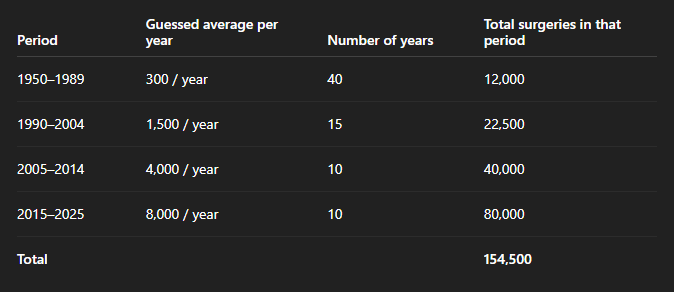
Because the data are patchy, I built myself a simple, plausible timeline and forced it to agree with the idea that recent years are around 8,000 surgeries annually worldwide.
Let me break that down.
1950–1989 At this point it is still rare, very few centres, limited acceptance. I pick a tiny number: roughly 300 per year on average, over 40 years.
300 × 40 = 12,000 surgeries.
1990–2004 Awareness is slowly increasing, but availability is still very limited. I nudge it up to 1,500 per year on average over 15 years.
1,500 × 15 = 22,500 surgeries.
2005–2014 Thailand and other hubs become more established, some Western clinics expand capacity. I jump to 4,000 per year on average over 10 years.
4,000 × 10 = 40,000 surgeries.
2015–2025 We now have multiple centres and many countries seeing steadily increasing numbers. Consistent with the idea that the current global rate is in the high thousands, I pick 8,000 per year as a reasonable average over this decade.
8,000 × 10 = 80,000 surgeries.
Now we add them up:
12,000 + 22,500 + 40,000 + 80,000 = 154,500
So my central estimate is:
Total vaginoplasties ever performed ≈ 155,000
Given the guesswork, I think it is fair to say the plausible range is something like 100,000 to 250,000, but I will stick with 155,000 as the working figure.
1.2 How many of those people are still alive?
Most of those surgeries are quite recent. That matters a lot.
Look at the totals by era:
From 2005 onwards:
40,000 (2005–2014) + 80,000 (2015–2025) = 120,000 surgeries in the last 20 years.
Now we apply a very crude “who is probably still alive” adjustment.
Rough survival assumptions
People who had surgery before 2000 are, on average, older now. Many will still be alive, but not all. I am going to assume about 50% survival.
People who had surgery from 2000 onwards are more likely to still be alive. I will assume 90% survival for that group.
First I need to separate pre 2000 and post 2000.
Pre 2000
1950–1989: 12,000
1990–1999: 10 years out of that 15 year block at 1,500/year = 15,000
So pre 2000 total = 12,000 + 15,000 = 27,000
Post 2000
Total ever ≈ 155,000 Minus pre 2000 = 155,000 – 27,000 = 128,000
Now apply those survival percentages:
Alive from pre 2000 group ≈ 50% of 27,000 = 13,500
Alive from post 2000 group ≈ 90% of 128,000 = 115,200
Add them together:
13,500 + 115,200 = 128,700
I round that to:
About 130,000 living people worldwide who have had a gender affirming vaginoplasty.
Given the uncertainty in every assumption, I am comfortable describing that as a range:
Something like 80,000 to 200,000 living recipients,
with 130,000 as a sensible central guess.
1.3 Percentage of people alive today
Now the fun bit. We divide by the 8.3 billion people on Earth.
Let:
𝑁_live = number of living vaginoplasty recipients ≈ 130,000
𝑃 = current world population ≈ 8.3 × 10⁹
The fraction is:
Fraction = 𝑁_live / 𝑃 = 130,000 ÷ 8,300,000,000
Do the division:
130,000 ÷ 8,300,000,000 ≈ 0.00001566
Turn that into a percentage:
0.00001566 × 100 ≈ 0.0016%
So my central estimate is:
About 0.0016% of people alive today have had a vaginoplasty.
Now flip it around into a “1 in X” figure, which is more intuitive:
𝑋 = 𝑃 / 𝑁_live = 8,300,000,000 ÷ 130,000 ≈ 63,800
Round that:
About 1 in 65,000 people alive today has gone through a gender affirming vaginoplasty.
If we respect the uncertainty in the earlier steps:
If 𝑁_live is only 80,000, then 𝑋 = 8.3 × 10⁹ / 80,000 ≈ 103,750 → about 1 in 100,000
If 𝑁_live is as high as 200,000, then 𝑋 = 8.3 × 10⁹ / 200,000 = 41,500 → about 1 in 40,000
So I would summarise the whole thing like this:
Best guess: about 1 in 65,000
Likely band: somewhere between 1 in 40,000 and 1 in 100,000
In other words, if you put me in a full Croke Park stadium, there is a very decent chance that I am the only person there who has had this operation. In a couple of packed stadiums, maybe there is one more.
Which is still wild.
Step 2 – Percentage Of All Humans Who Have Ever Lived
Now for the second and even weirder question.
Here we want to know:
Of all the human beings who have ever lived, what fraction of them will have experienced a gender affirming vaginoplasty?
For that we need two numbers:
Total vaginoplasties ever performed (we already have a figure).
An estimate of how many humans have ever existed.
2.1 How many humans have ever lived?
Demographers like to estimate “humans ever born” by combining population estimates backwards through time.
A commonly cited figure is:
About 117 billion humans have ever lived.
So I will write:
𝐻 = 117 × 10⁹
2.2 Fraction and percentage
From earlier we have:
Total vaginoplasties ever performed, central estimate 𝑉_total ≈ 155,000
About 1 in 750,000 humans who have ever lived has undergone a gender affirming vaginoplasty.
Now put the range around that.
Lower bound: 𝑉_total = 100,000
100,000 ÷ 117,000,000,000 ≈ 0.000000855
Percentage ≈ 0.000086%
“1 in X” = 117,000,000,000 ÷ 100,000 = 1,170,000
So roughly 1 in 1.2 million
Upper bound: 𝑉_total = 250,000
250,000 ÷ 117,000,000,000 ≈ 0.0000021367
Percentage ≈ 0.00021%
“1 in X” = 117,000,000,000 ÷ 250,000 = 468,000
So roughly 1 in 470,000
So, if you believe my assumptions, you can honestly say:
I am probably somewhere in the band of 1 in 470,000 to 1 in 1.2 million humans who have ever lived.
Again, that is not meant to be precise. It is meant to be the right ballpark.
Step 3 – But I Heard “12% Of Trans Women Have Vaginoplasty”?
If you have spent any time in trans health literature, you may have seen something like:
“About 12% of trans women in survey X report having undergone vaginoplasty, with a larger percentage planning to.”
So why did I not just do:
“People in the world” × “proportion who are trans women” × 12%
and call it a day?
Because if you try that, you end up with a number that completely contradicts the surgical volume data.
Here is why.
3.1 Trans prevalence is messy
Studies that try to estimate “how many people are trans” usually work off surveys that include:
trans women, trans men, non binary people, gender fluid, etc
different definitions and different questions in each study
and mostly Western populations
You can get numbers like “1%” or “2%” of people are somewhere under the trans umbrella, but that is not the same thing as “1–2% are trans women who might want vaginoplasty”.
3.2 Access is wildly unequal
Even if 12% of trans women in a U.S. survey have had vaginoplasty, that says nothing about:
people in countries with no insurance coverage
people in places where it is literally illegal or impossible
long waiting lists
cultural pressures that make surgery unthinkable
If you take a U.S. percentage and apply it to the entire planet, you are implicitly assuming the whole world looks like the U.S., which it obviously does not.
3.3 The million versus thousands problem
If we played with the idea that:
2% of the world were trans in some broad sense, and
12% of those had vaginoplasty,
then you would end up with numbers in the millions.
That completely clashes with:
multiple centres publishing “we did a few thousand over decades”,
global estimates in the low thousands per year even today,
and the entire history of the field.
So instead of starting from “how many trans women exist”, I have started from:
How many surgeries per year do we think are actually being performed,
and then integrated over time.
It is still messy and approximate, but it at least honours the surgical capacity we actually know about.
Step 4 – So What Does That Mean For Me?
Let me pull the main results together.
From the best numbers I can cobble together:
Percentage of people alive today who have had a gender affirming vaginoplasty
Somewhere in the range 0.001% to 0.002%
Central estimate around 0.0016%, which is about 1 in 65,000
Percentage of all humans who have ever lived who have had a gender affirming vaginoplasty
Somewhere between roughly 0.00009% and 0.00021%
Central estimate around 0.00013%, or about 1 in 750,000
So every time I am half way through stirring onions in a pan and my brain screams:
“Holy fuck, you have a vagina.”
I can now calmly reply:
“Yes. And statistically speaking, you are probably one of roughly 1 in 40,000 to 100,000 people alive today, and somewhere around 1 in half a million to a million humans who have ever existed, who have had this exact experience.”
I am not pretending that the numbers are perfectly accurate. They are not. If you replaced my rough guesses with better data, the odds would shift a bit.
But the order of magnitude is right. Whatever the exact odds, this thing that happened to my body is very rare. If you could line up every human who has ever lived in a gigantic cosmic queue, there would now be roughly three quarters of a million people standing between each person like me.
Which is a strange feeling.
Not “better than”. Not “more special than”. Just statistically weird and unusually witnessed, like having your body swapped out for a different configuration mid life, in a way our species only recently invented.
Outro
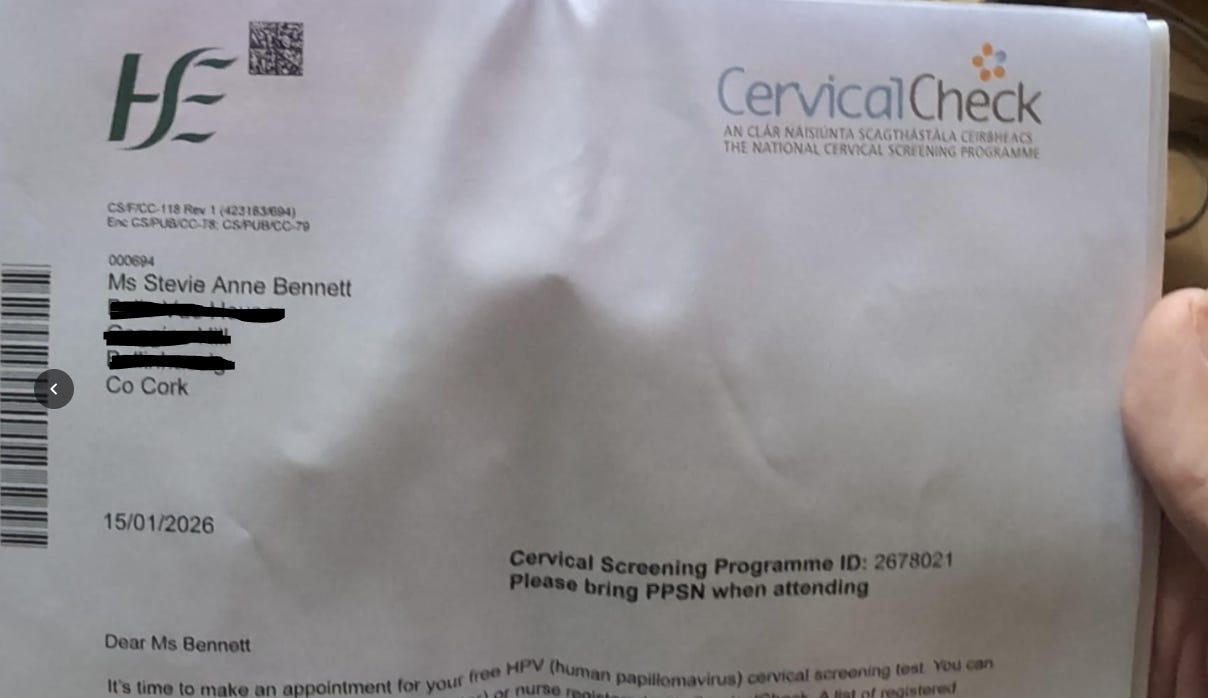
As an aside, today I got some post forwarded on from my old house. I opened it up and, much to my surprise, it was my invitation to go for a cervical smear.
I apparently need to register.
Unfortunately, despite all of the medical advances, and even though I think we are probably now on something like vaginoplasty version 5.2 in terms of sophistication, there is one small snag.
I am going to have to write back and admit, politely, that in my particular case, there is no cervix.
Thanks for reading Fast Track Femme! Subscribe for free to receive new posts and support my work.