

My day started, as it often does, at 6am.
Bing. Bing. Bing.
Alarm.
Right, I thought. We are not scrolling Instagram today.
We are getting up. We are making coffee. We are behaving like a proper adult woman with responsibilities, deadlines, emails, a dog, a publication, and a life that occasionally resembles an exploded stationery cupboard.
Thirty seconds later, obviously, I was scrolling Instagram.
This is how civilisation ends. Not with a bang, but with a 57-year-old transsexual woman lying in bed at dawn thinking, I will just watch one more reel and then I will become productive.
The reel was by Robyn Holdaway, who has been appearing in my feed lately and who is, annoyingly, absurdly eloquent. Ridiculously eloquent. The kind of eloquent that makes me slightly furious. If I could speak to camera with half their gravity, rhythm and consistency, you would see much more of me on video and I would have to write considerably fewer of these bloody essays.
Robyn was talking about the history of anti-trans politics, the TERF movement, and the wider machinery behind what now presents itself as “gender critical” feminism.
And I sat there thinking, with some embarrassment:
Oh God. I know almost nothing about this.
That is one of the slightly awkward truths about me as a trans woman. I am not very good at the syllabus.
I know the names I fixated on growing up, because there were so few of them. I know the women who became little secret landmarks in my head. I know the public figures I watched with that peculiar mixture of longing, fear and recognition.
But the broader history? Queer culture? The roots of Pride? The factions, schisms, arguments, conferences, newsletters, theories, movements and counter-movements?
No. Not really.
I am, in that sense, a bit of an academic failure as a transsexual.
It is a little like when I was a serious cyclist and people used to ask me about the Tour de France. I would have to admit that I barely watched it. I was out cycling. I was not sitting around memorising stage winners from 1987.
Transition has been a bit like that for me. I have been busy doing the thing. Surviving the thing. Rebuilding the thing. Having the thing surgically altered. Explaining the thing to my children. Losing people over the thing. Writing about the thing. Occasionally dancing in a dress because, frankly, after all that, one should be allowed a bit of a boogie.
But as for the intellectual history around the thing?
Patchy. Let us call it patchy.
So when Robyn described anti-trans politics not simply as a British social-media tantrum, but as something connected to wider anti-gender, religious-right and conservative policy networks, I had the reaction I often have when someone says something that sounds both plausible and slightly too neat.
I thought:
Hang on. Is that true?
Because my rough, lazy version of the story had been much simpler.
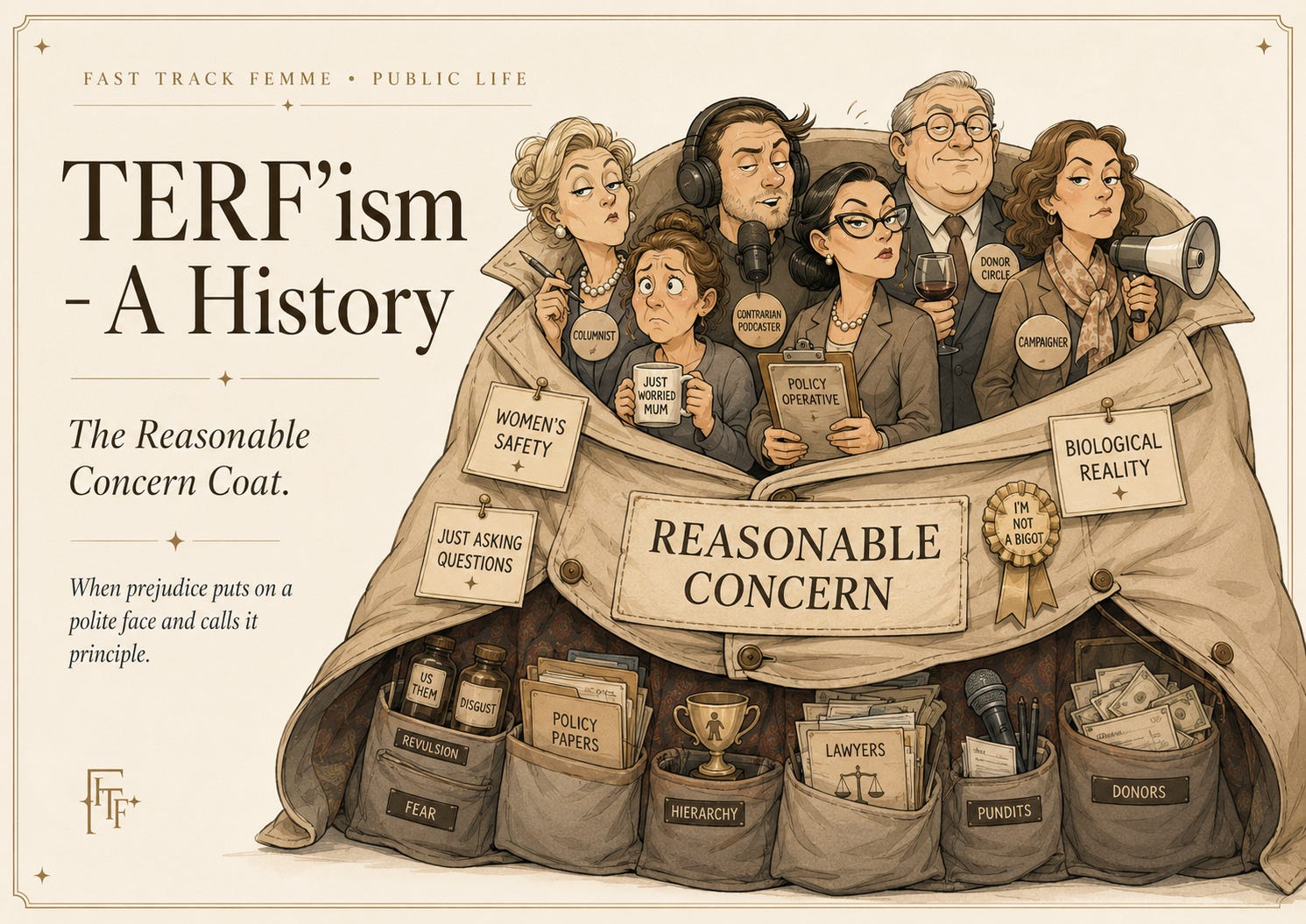
I thought the British TERF thing was mostly Graham Linehan, Mumsnet, newspaper columnists, J.K. Rowling, bathrooms, prisons, sport, a few furious comedians, some dreadful podcasts, and a great deal of disguised revulsion wearing a sensible coat.
You know the coat.
The “reasonable concern” coat.
The “women’s safety” coat.
The “we are only asking questions” coat.
The coat worn by people who insist they are not disgusted by trans women at all, absolutely not, heaven forbid, but who somehow manage to speak about us as though we are a Category B biological incident.
That part I understood immediately.
The bait and switch was obvious enough. The surface language was safety, safeguarding, fairness, children, prisons, changing rooms, toilets. But the emotional voltage never seemed to match the evidence. It always felt too hot. Too thrilled with itself. Too eager. Too intimate. Too bodily.
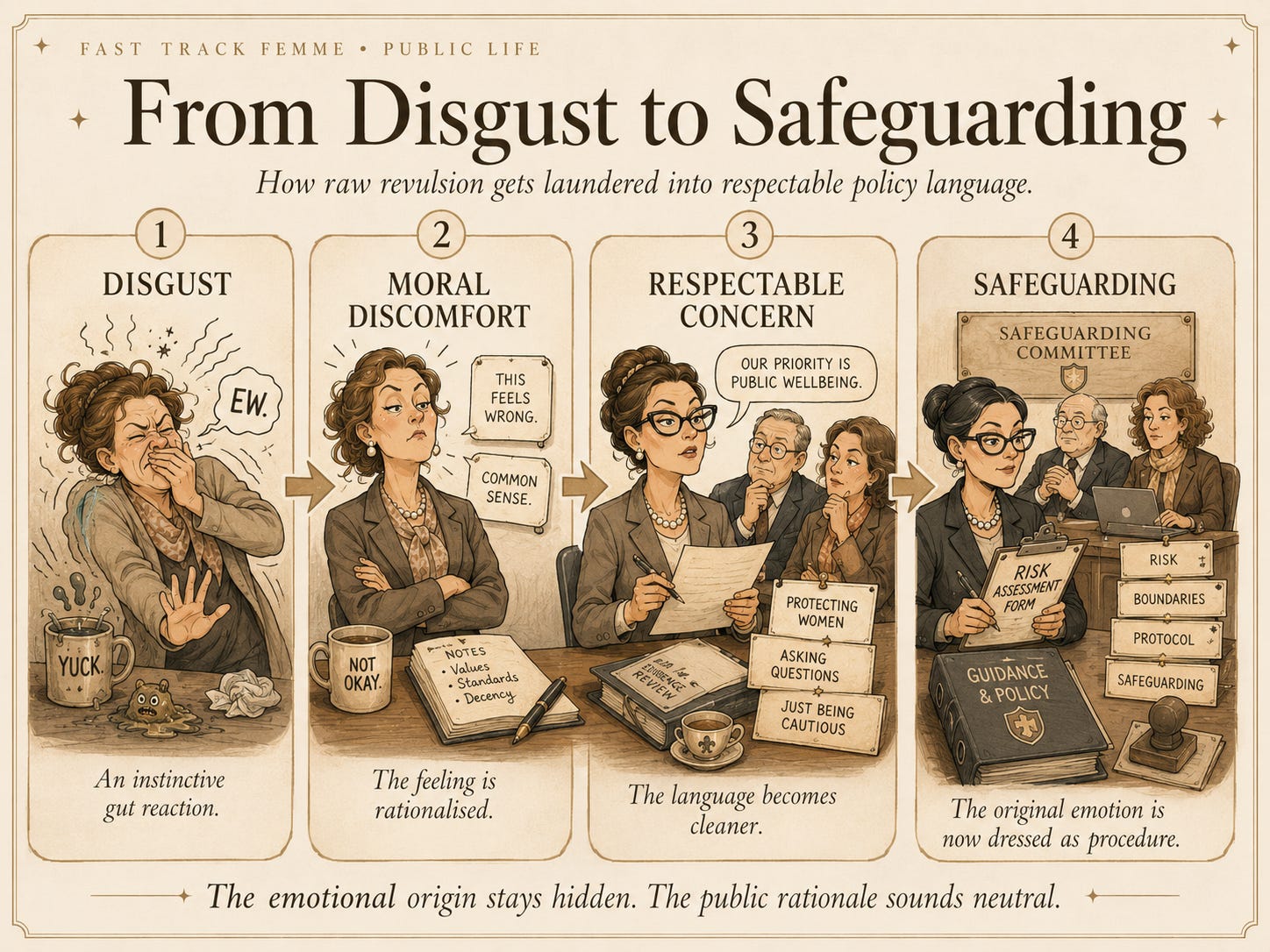
It felt, bluntly, like revulsion that had found a policy department.
But what I had not understood was the larger history.
I had not understood how “gender ideology” became an organising phrase across conservative, religious and anti-LGBT movements.
I had not understood how much of the current anti-trans political architecture sits inside a broader anti-gender movement.
I had not understood the extent to which, after defeats on gay rights and same-sex marriage, trans people became the next available battlefield.
At least, that is the claim.
And because I do not like simply repeating claims, even claims that flatter my existing suspicions, I decided to look.
So what did I find?
The first thing I found was that the cartoon version is too stupid.
There was no single room, no oak table, no Christian billionaire stroking a cat, no secret memo headed Operation Make Everyone Weird About Trans People.
Real life is rarely that kind.
The strongest version of the claim, that American religious conservatives simply invented TERF politics, bought some British feminists, and then marched them around like little wind-up toys, does not survive contact with reality.
But the weaker, more serious version?
That survives very well indeed.
Because what I found was not a conspiracy. It was infrastructure.
That is worse, in a way. Conspiracies require secrecy. Infrastructure just requires money, lawyers, institutions, patience, message discipline and a good supply of frightened politicians.
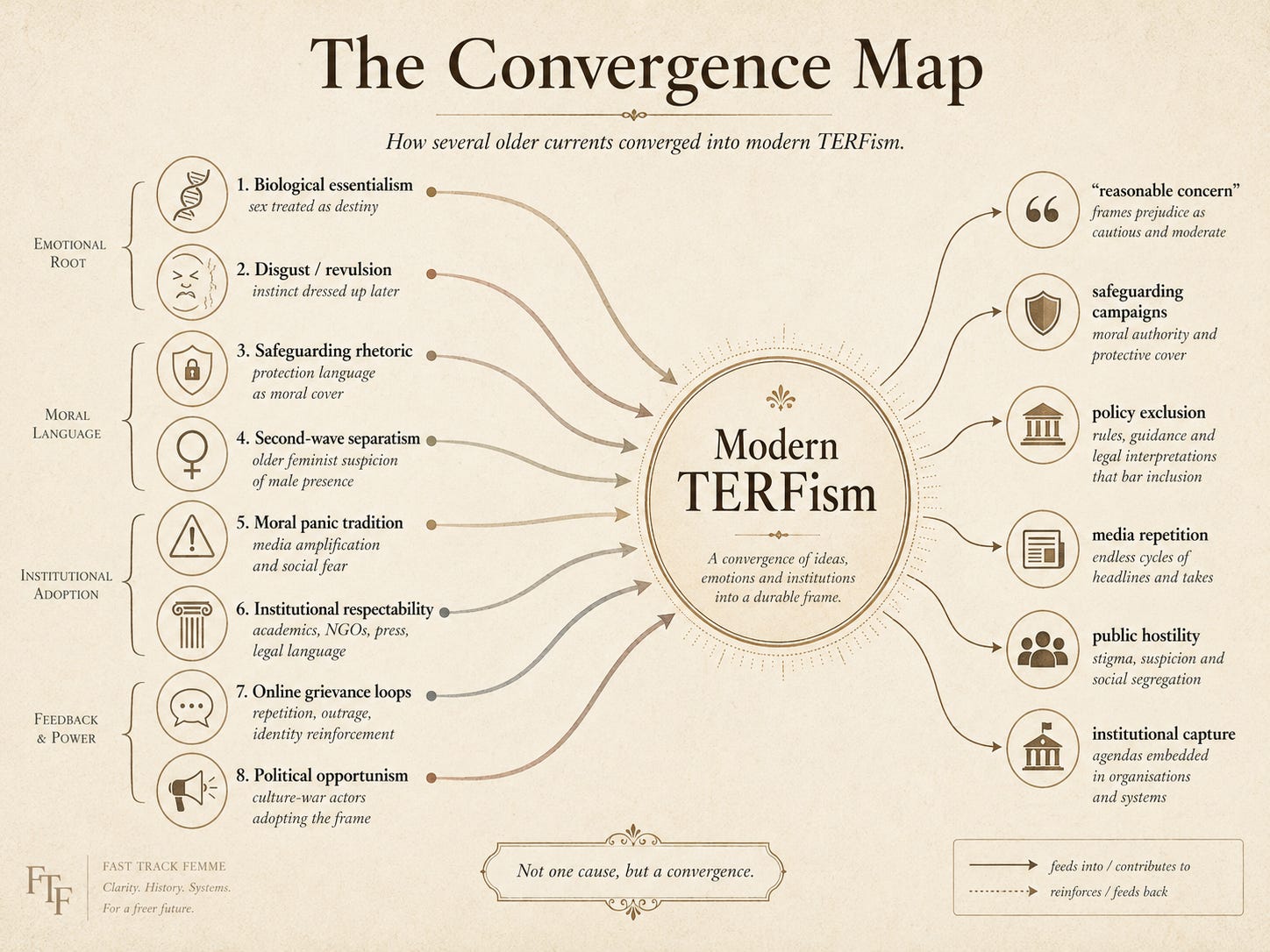
The anti-trans movement, as it now exists, is not one thing. It is a convergence.
There are old-school trans-exclusionary feminists with roots in second-wave arguments about sex, gender and womanhood. There are British newspaper columnists who appear to have mistaken their own revulsion for a legal principle. There are anxious parents, actual bigots, traumatised women, opportunistic politicians, manosphere-adjacent podcasters, professional contrarians, religious conservatives, think-tank people, litigators, donors, YouTubers, and a whole supply chain of people who discovered that “gender ideology” could be made to carry almost any fear they wanted to load onto it.
That phrase matters.
“Gender ideology.”
It is wonderfully useful because it does not sound like an attack on people. It sounds like an attack on a doctrine. Nobody wants to be pro-ideology, do they? Ideology sounds like something that happens in other countries, in badly lit rooms, while humourless people move pins around a map.
So the trans person becomes “gender ideology”.
The gay teacher becomes “sexualisation”.
The trans child becomes “social contagion”.
The supportive parent becomes “captured”.
The doctor becomes “mutilator”.
The school becomes “indoctrination”.
And the whole thing moves, very smoothly, from disgust to safeguarding.
That, I think, is the genius of it.
Not moral genius, obviously. Strategic genius.
The emotional engine is revulsion, fear and hierarchy. But the public language is children, women, safety, fairness, privacy, parents and biological reality.
This is how you launder disgust into policy.
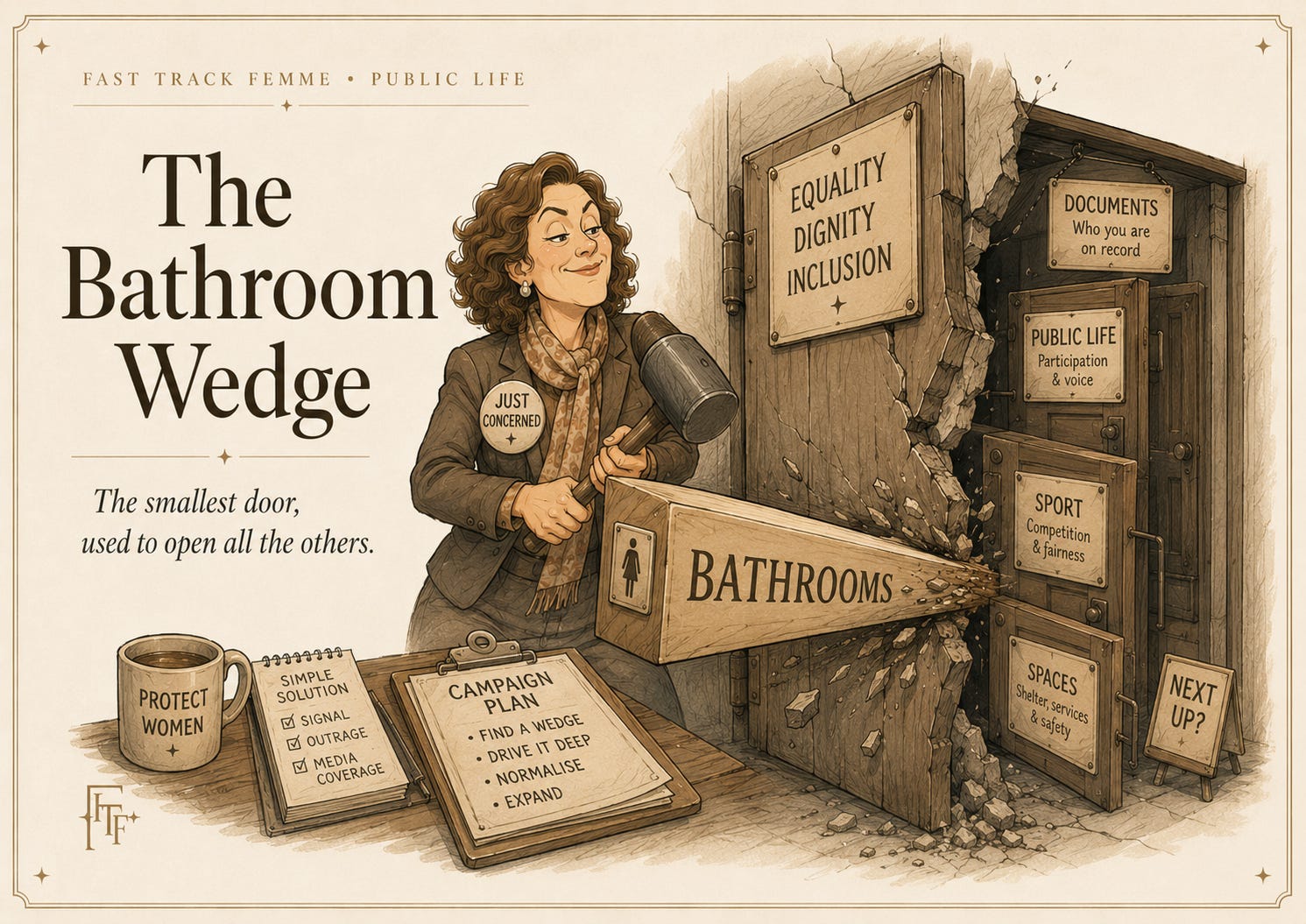
The early wedge was bathrooms. That was the point at which I started recognising the shape of it, even before I understood the machinery. The argument was never really, “We have evidence that trans women are causing danger in toilets.” The argument was much more primal than that. It was, “Imagine a man in there.”
That was enough.
Once you can make people picture “a man in there”, you no longer need the actual trans woman. She has been replaced by a threat image.
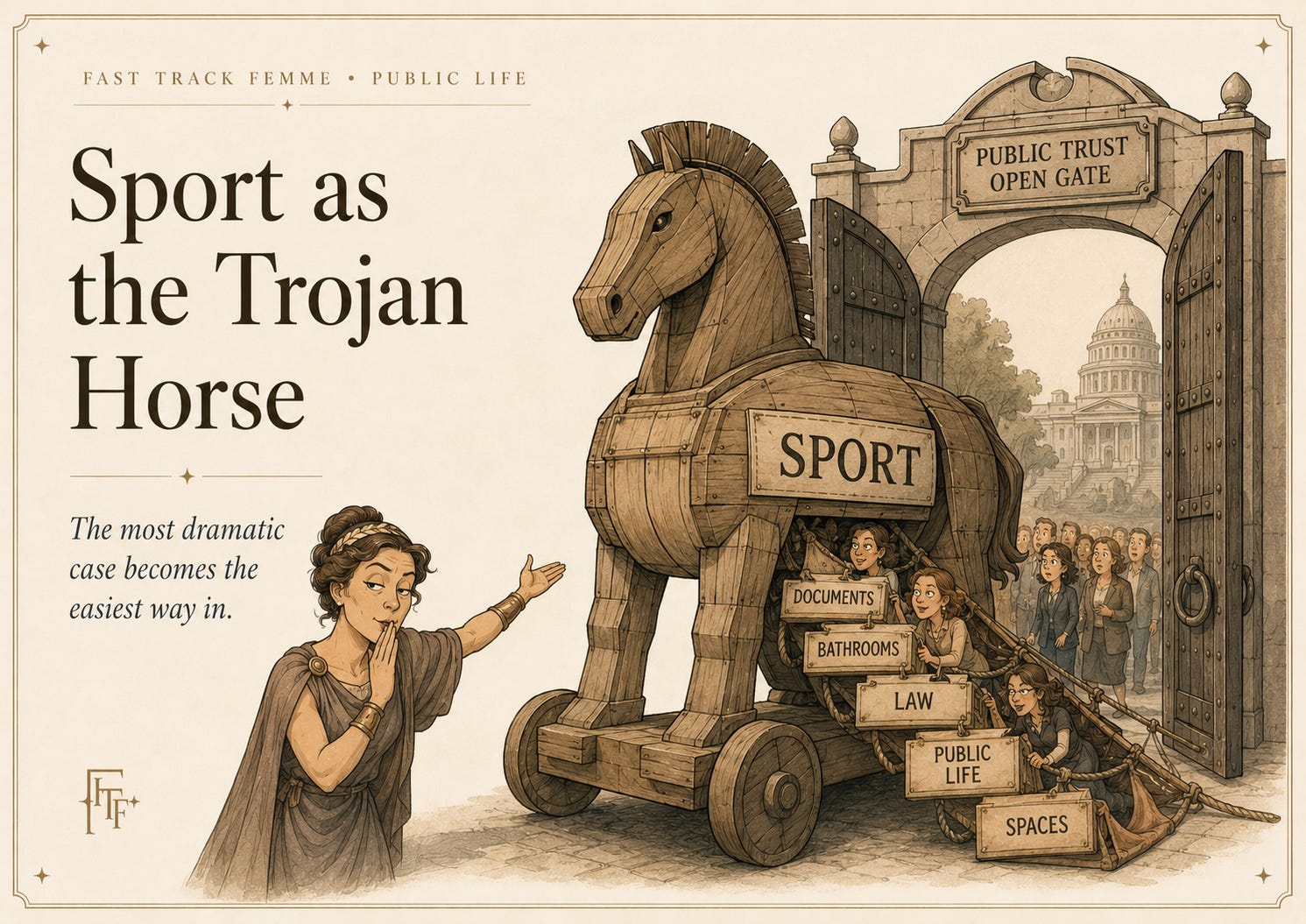
Then came sport, which was even more useful.
Sport gave the movement something bathrooms did not quite give it: a plausible secular fairness argument. You did not have to talk about sin. You did not have to admit disgust. You did not even have to say you disliked trans people. You could say, with a serious face, that you were defending girls.
That is a very hard frame to fight.
Not because every version of the sports debate is automatically illegitimate. It is not. Sport does involve bodies, puberty, competition categories and material differences. Any honest person can see that.
But that is precisely why it was useful. It gave anti-trans politics a point of entry through a real-world complexity. Once inside, the argument could expand. From elite sport to school sport. From school sport to bathrooms. From bathrooms to pronouns. From pronouns to medical care. From medical care to child protection. From child protection to parental rights. From parental rights to the idea that any institution which recognises trans existence is engaged in ideological capture.
Then healthcare became the big one.
This is where the machinery becomes easiest to see, because the same phrases, structures and legal ideas begin appearing in different states. Model bills. Similar wording. Similar testimony. Similar “findings”. Similar claims about social contagion, regret, Europe, puberty blockers, parental rights, and doctors supposedly rushing children into irreversible procedures.
That is not an organic village panic.
That is a production line.
A national organisation writes the argument. A state lawmaker introduces it. A local witness gives it a human face. A friendly media ecosystem amplifies it. Lawyers defend it. Another group brings the next case. The bill fails in one state and passes in another. The passed law creates litigation. The litigation creates headlines. The headlines create fear. The fear creates more political demand.
And so the machine feeds itself.
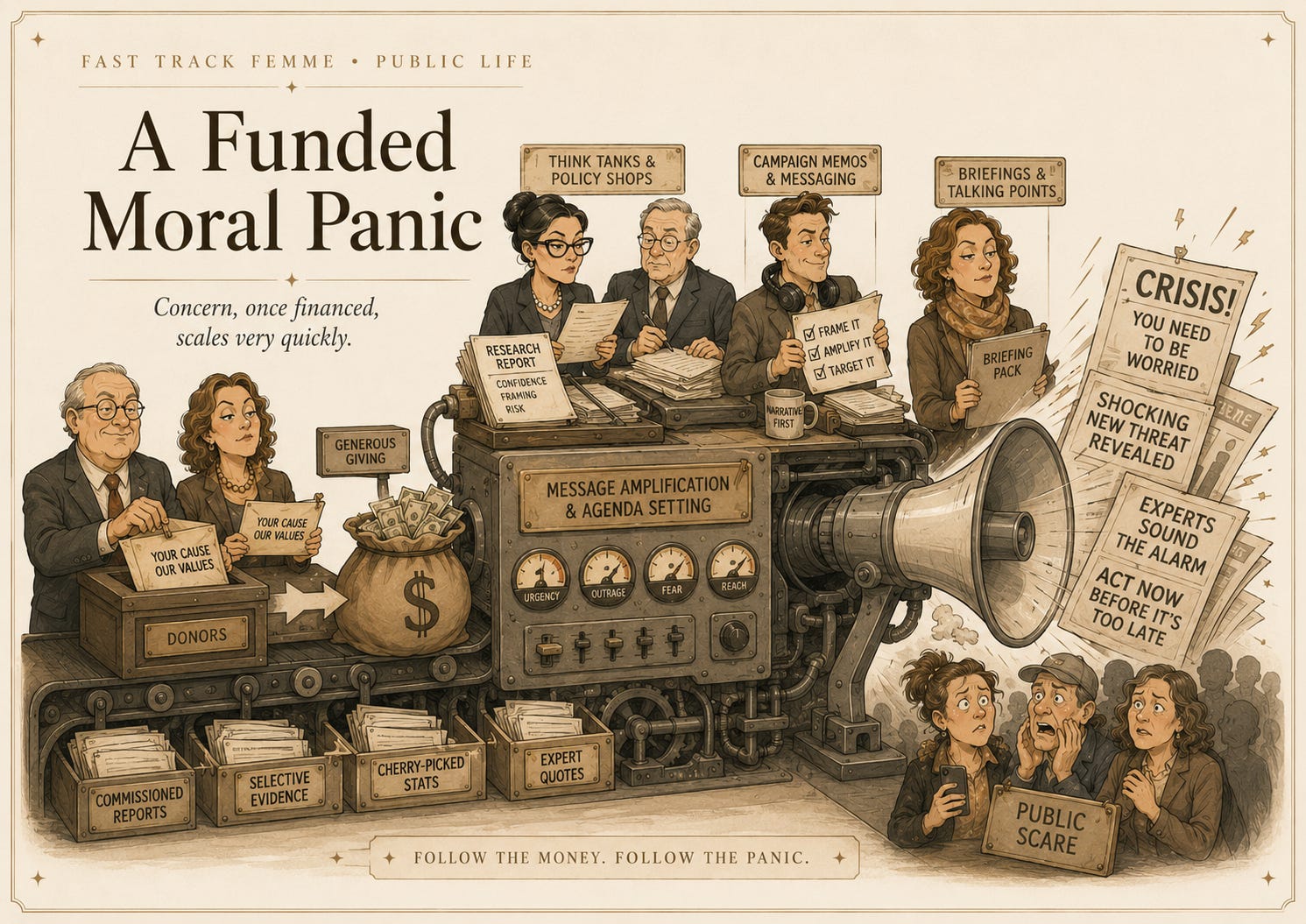
This is where the money matters.
Not because money explains everything. It does not. Lots of ordinary people believe stupid and cruel things for free.
But money buys continuity.
Money buys lawyers who can spend years on cases. Money buys policy papers. Money buys staff. Money buys polling. Money buys media operations. Money buys conferences. Money buys fellowships. Money buys relationships with lawmakers. Money buys state-by-state legislative tracking. Money buys the ability to lose one battle and simply move to the next jurisdiction.
A broke moral panic burns hot and dies.
A funded moral panic becomes a career path.
And that, I think, is what happened.
The anti-trans movement became professionalised.
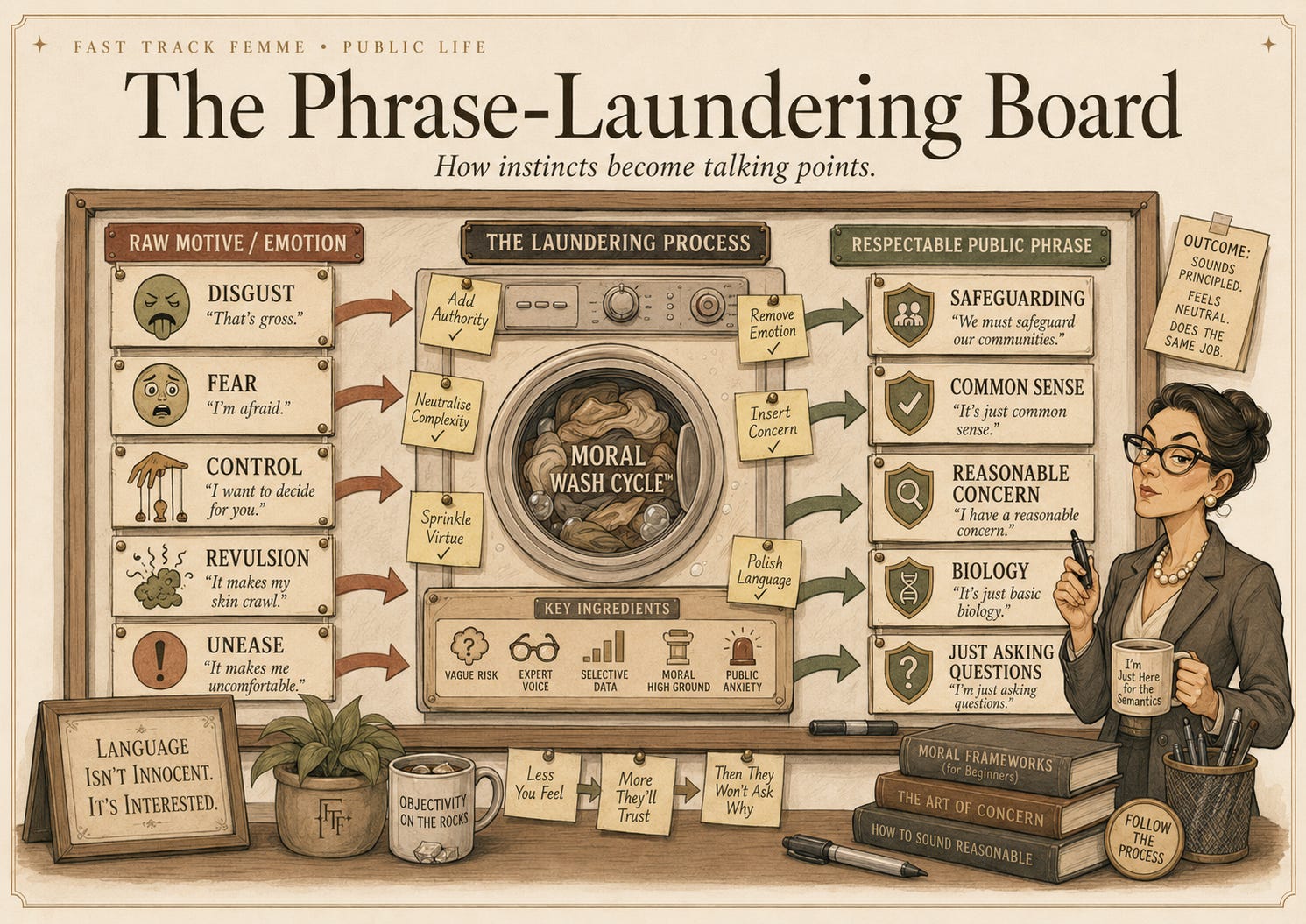
It learned to stop sounding like “we find these people disgusting” and start sounding like “we have grave concerns about safeguarding.”
It learned to stop saying “we oppose LGBT rights” and start saying “we support parental rights.”
It learned to stop saying “our religion requires sex hierarchy” and start saying “biological reality.”
It learned to stop saying “we do not want trans people in public life” and start saying “women and children deserve protection.”
And crucially, it learned where the liberal mind is weakest.
Children. Sport. Prisons. Bathrooms. Schools.
Pick the place where the public is uncertain, where even sympathetic people feel a little awkward, where the facts are complicated, where nobody wants to sound heartless, where the most extreme example can be made to stand in for the whole group.
Then push there.
Again and again and again.
This is why the UK version interests me so much, because Britain has its own strange pathology. The British gender-critical movement is not simply a branch office of the American Christian right. That would be too easy. It has roots in British feminism, British media, British class politics, British institutional caution, British politeness, British cruelty, and that peculiar national habit of making repression sound reasonable if you say it in the right accent.
But it also does not sit apart from the wider movement.
There are overlaps. Alliances. Shared phrases. Shared enemies. Shared platforms. Shared legal concepts. Shared think-tank worlds. Shared moral panic structures.
The British version may wear a different coat, but it is standing in the same weather.
So, no, I do not think the correct conclusion is:
“TERFs are all secretly funded by American Christians.”
That is not serious enough.
The better conclusion is this:
Anti-trans politics became the place where several different movements found each other.
Radical feminist sex essentialism found Christian-right family politics.
Christian-right family politics found conservative legal strategy.
Conservative legal strategy found Republican statehouses.
Republican statehouses found media outrage.
Media outrage found social media.
Social media found frightened parents.
Frightened parents found campaigners.
Campaigners found donors.
Donors found lawyers.
Lawyers found cases.
Cases found courts.
Courts found policy.
Policy found my life.
And that is the part people forget.
This is not abstract. It does not stay in think-tank PDFs. It does not remain in American statehouses. It does not sit politely inside an Instagram reel.
It travels.
It travels into newspapers, hospitals, schools, families, airports, toilets, changing rooms, courtrooms, dinner tables, comment sections and the eyes of strangers.
It arrives at the front door.
Which is why I wanted to know where it came from.
Source anchors
A few pieces of evidence are worth separating from the general noise.
Bathroom bills as a post-marriage-equality wedge
Type Investigations traces the rise of bathroom bills after Obergefell and describes how bathroom panic became an early post-marriage-equality strategy.
Read: The Secret History of Bathroom Bills
The coalition strategy
Political Research Associates documents Promise to America’s Children, a programme backed by Family Policy Alliance, the Heritage Foundation, Alliance Defending Freedom and other groups, covering trans healthcare, trans athletes, sex education, conversion therapy, adoption, schools and parental control.
Read: The New Anti-Trans Promise
Copy-and-paste state legislation
The Associated Press analysed more than 130 bills across 40 US state legislatures and found many were identical or similar to model legislation promoted by conservative groups.
Read: Many anti-trans bills came from a handful of far-right interest groups
Model legislation in plain sight
Do No Harm published model legislation covering schools, government funding, medical procedures for minors, private legal action, insurance coverage and enforcement routes.
Read: Do No Harm model legislation, The JUST FACTs Act
Scale of institutional money, Alliance Defending Freedom
ProPublica’s nonprofit records show Alliance Defending Freedom operating at a very large institutional scale. This does not mean every dollar is anti-trans money, but it does show that this is not a fringe operation with a few angry people and a podcast.
Read: ProPublica nonprofit profile, Alliance Defending Freedom
Scale of institutional money, Heritage Foundation
ProPublica’s nonprofit records also show the Heritage Foundation operating at a very large institutional scale, with major revenue, expenses and assets. Again, this is not the same as saying every dollar is spent on anti-trans politics, but it matters when assessing infrastructure.
Read: ProPublica nonprofit profile, Heritage Foundation
Project 2025 in its own words
Project 2025 is not just a name people throw around for dramatic effect. Its own text contains explicit language about “gender ideology”, schools, federal funding, sexual orientation, gender identity, and policy rollback.
Read: Project 2025, Mandate for Leadership
European anti-gender funding
The European Parliamentary Forum reports significant anti-rights and anti-gender funding in Europe between 2019 and 2023. This is broader than anti-trans campaigning alone, but it helps show the wider anti-gender infrastructure.
Read: EPF report on anti-gender funding in Europe
UK gender-critical feminism and right-wing alliances
Sally Hines examines the relationship between UK gender-critical feminism and right-wing, far-right, Christian fundamentalist and conservative media networks, while also recognising the older feminist roots of trans-exclusionary thought.
Read: Hands towards the right? UK gender critical feminism and right-wing coalitions
Campaign advertising and the electoral machine
The Guardian reported on major Republican spending on anti-trans advertising during the 2024 US election cycle, including figures cited from ad-tracking analysis.
Read: Trump and Republicans bet big on anti-trans ads