



It's Saturday morning. I'm sitting at my breakfast bar in Cork. My empty bowl of Greek yoghurt and blueberries is in front of me, I've finished my coffee, and Chester is beating the living shit out of his teddy bear.
I have absolutely no idea what the teddy has done to deserve this. Judging by the ferocity of the assault, it must have been something fairly serious.
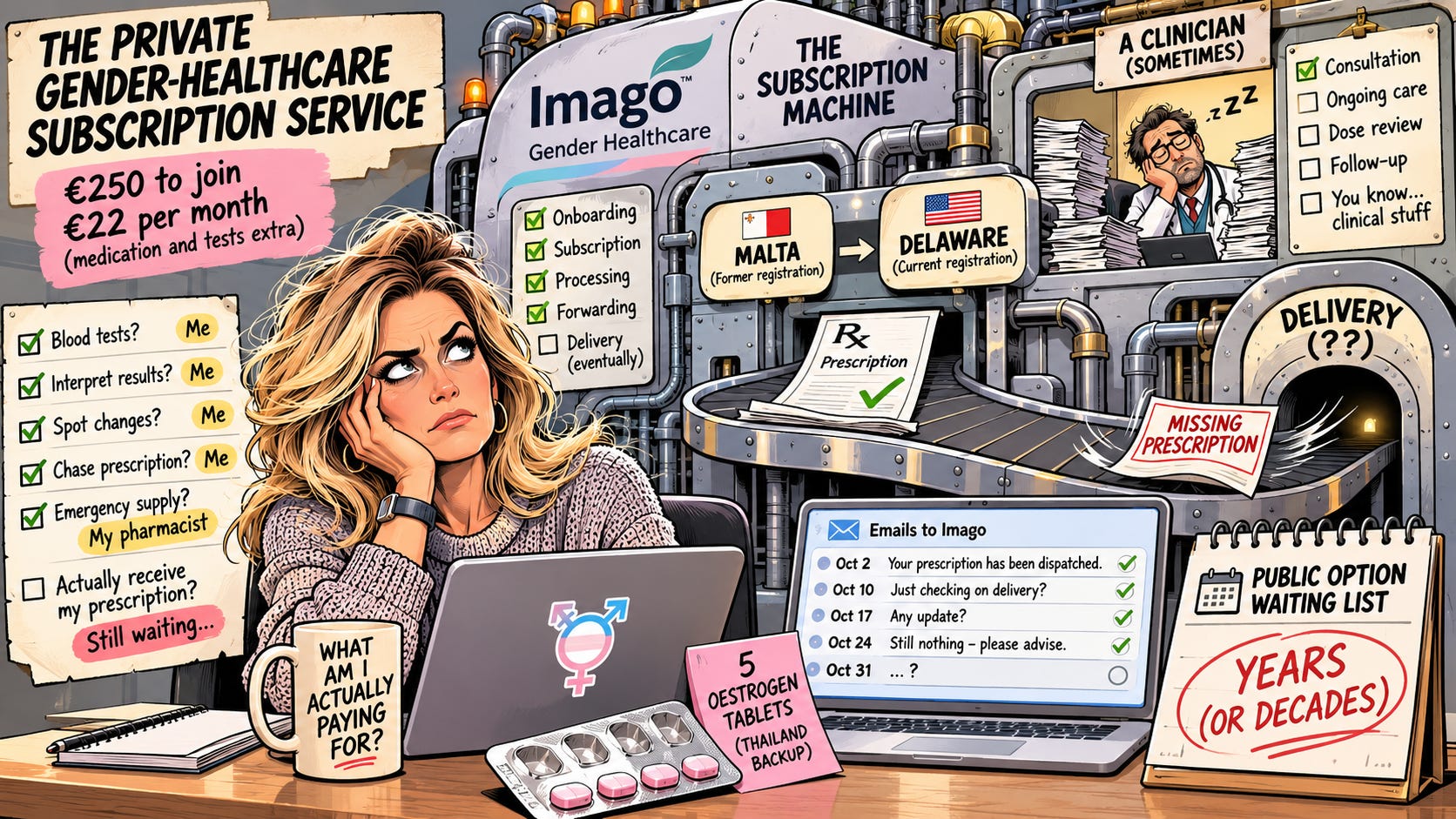
Meanwhile, just to my right, is a rather sorry-looking blister pack containing five little estrogen tablets.
Five.
They're leftovers I picked up in Thailand as a backup. I don't normally take tablets. I use patches, prescribed through a private transgender healthcare provider called Imago. Except my prescription hasn't arrived. It was supposedly dispatched on 2 October, and despite four emails chasing the bloody thing, here I am, over a month later, looking at five little tablets.
And I'm angry. Really fucking angry.

Not because I'm terrified of going without estrogen for a few days. I've had medically supervised breaks of several weeks around surgery. I'm angry because the more I think about it, the more absurd the entire arrangement becomes.
I'm paying a private company to facilitate access to medication, and it cannot reliably deliver the prescription. That company has moved its registration from Malta to the United States, which hardly fills me with confidence. The public alternatives in Ireland and Britain involve waiting lists measured in years, and in some cases decades. My own GP doesn't feel qualified to prescribe the medication, despite ordinary doctors managing endocrine conditions every day. And I've become so frustrated by the whole business that I've seriously investigated setting up a competing service myself.
That, ladies and gentlemen, is the state of gender-affirming healthcare in 2026: a public system that makes access extraordinarily difficult, and a private market that profits from providing a way around it.
The more interesting question is why that private market has so little incentive to be any bloody good.
What exactly am I paying for?
I've been using Imago for nearly two years. I paid an initial joining fee and have been paying a subscription ever since. Their currently advertised price is €250 for onboarding and €22 a month, with medication and blood tests charged separately.
At the beginning, I spoke to a doctor. We discussed my medical history, the proposed treatment and the usual considerations. All perfectly sensible. Then they sent me a photocopy prescription, which my original pharmacy wouldn't accept, and eventually I found another pharmacy prepared to honour it.
Fine. Teething troubles.
Except that first conversation was also the last time I spoke to an Imago medical professional.
In nearly two years.
Now, I'm the sort of person who is acutely interested in the value proposition of almost anything I buy. Whether it's a toaster from Currys, something from Alibaba, a hair appointment or a software subscription, I want to understand precisely what I'm receiving for my money. So let's dismantle this particular service and see what I'm actually buying.
Blood tests? I arrange those myself through my GP. I have Graves' disease and occasionally elevated iron levels, so blood testing is already part of my life, and the surgery very kindly adds the hormone tests when required.
Interpreting the results? Me again. I have a reasonable understanding of my treatment by now. I look at the numbers, identify unexpected changes and occasionally feed the results into ChatGPT for a second opinion. A useful tool, but not a prescribing physician.
Spotting when something needs changing? Apparently me.
Nine weeks ago, my latest results showed that my estrogen levels had fallen considerably. Imago issued another prescription, apparently repeating my previous treatment.
Including spironolactone.
There's a rather obvious problem with that.
I've had vaginoplasty. I no longer have testes. And I'd already told Imago I no longer needed spironolactone for testosterone suppression.
I contacted them, pointed out the oversight and asked whether anyone had noticed that my estrogen had fallen off a cliff. The response was an agreement to increase my dose and issue a replacement prescription. No discussion with a doctor. No consultation about what had changed.
The replacement prescription never arrived. I chased it. On 2 October I was told it had been dispatched. Still nothing. More emails followed, culminating in my fourth attempt this week.
Chasing the prescription? Me, naturally.
Providing emergency medication? My pharmacist, who kindly supplied a week's worth when it became clear I was running out. That's gone too.
Which brings us back to the five little tablets on my breakfast bar.
I don't expect somebody to hold my hand every month, measure my cup size and tell me how beautifully my transition is progressing. I need somebody qualified to review my blood results, make appropriate prescribing decisions and ensure the bloody prescription arrives before I run out of medication. That's the service.
Strip away the website, the subscription, the reassuring language, and what am I actually receiving? Access to a piece of paper that certain Irish pharmacies will honour, allowing me to buy genuine, regulated estrogen.
It's a prescription-rental service with a €22 monthly subscription.
And right now, the fucking paper isn't even arriving.
And I don't trust where the paper comes from
My confidence isn't helped by Imago's corporate arrangements.
When I joined, the business operated from Malta. Earlier this year, I received an email informing me that it was moving to Delaware. Its current terms state that Imago itself isn't the healthcare provider. It facilitates access to independent clinicians, and it doesn't guarantee that their prescriptions will be accepted by pharmacies in every jurisdiction.
So here I am, a woman in her mid-fifties, post-vaginoplasty, requiring hormone replacement for the rest of her life, relying on a service whose registration can move from one country to another by email, in which the platform, the prescribing clinician and the dispensing pharmacy may all sit in different jurisdictions.
This is my health. My medication. For the next thirty years.
I feel as though I'm one administrative change away from having to find another way to obtain my hormones.
So why not use the public system?
Oh, my sweet summer child.
Ireland has something called the National Gender Service. Its own website says it is currently assessing people referred approximately four and a half years ago. Already rather breathtaking. But an independent analysis published by The Beacon in February 2026 estimated that approximately 2,583 people remained on the list at the end of 2025, and that approximately 144 people had been removed from it during the year.

Now, I spent years working in software engineering, so I can just about manage dividing one number by another.
2,583 divided by 144.
17.9 years.
Almost eighteen fucking years. That's an extrapolation from estimated throughput rather than an official forecast, but it illustrates the scale of the problem rather magnificently. You could join the queue as a young adult and find yourself approaching middle age before receiving an assessment. At some point it stops resembling a waiting list and starts resembling a hereditary obligation. Perhaps your grandchildren could inherit your place when you die.
And after all that, there's the assessment itself. I sometimes imagine what might be required. Five psychiatrists, a signed letter from Jesus Christ, two supplementary references from the Lord and the Holy Ghost, and a sworn affidavit confirming that you have never enjoyed watching Match of the Day. Presumably the Holy Ghost's reference would also need to be notarised.
All before somebody will contemplate giving you a couple of fucking estrogen patches.
I was never going to use this route. I wasn't prepared to wait years, and I certainly wasn't prepared to hand control of my body and my future to a state queue. I'm not quite a libertarian, but I'm a damn sight closer to one than most alternatives. I'll do it myself, thank you very much. I could afford to make that choice, and I recognise that many people cannot.
Across the Irish Sea, the situation is hardly more inspiring. NHS England's own review of adult gender services, published in December 2025, found that patients attending their first appointments in October 2024 had waited an average of 296 weeks. More than five and a half years. And the majority of clinics were projecting waits of fifteen years or longer for newly referred patients if capacity didn't improve.
Britain also has a history of peculiar expectations around real-life experience, the old notion of demonstrating that you could live in your affirmed gender before progressing through certain parts of treatment. I've always found that philosophy wonderfully antiquated. I spent approximately nine months on hormones while still presenting publicly as male, entirely deliberately, because I wanted the physical changes to develop before I went full-time. Towards the end I looked like the campest man in Christendom, but I had absolutely no intention of wandering around Tesco looking like Barney Rubble in a bloody dress to satisfy somebody else's timetable.
I transitioned in my own order, at my own pace. Admittedly, my pace was that of a complete bloody nutcase, but it worked for me. Different people transition differently.
Meanwhile, the official waiting times are so enormous that people are left seeking alternatives. Which brings us to the really interesting part.
The extraordinary economics of a captive market
If Britain and Ireland had properly functioning public gender healthcare, much of this private subscription industry would barely exist. Why would anybody pay a company registered halfway round the world to facilitate a prescription when they could walk into their own GP's surgery? These businesses aren't selling a medical innovation. They're selling a way around a problem that shouldn't exist.
And look at the contrast between the two routes. In the public system, you can spend years waiting for clinicians to examine your history, your mental health, your identity and your suitability for treatment.
Then you go private.
"So, you think you're transgender?"
"Yep."
"Excellent. Here's some estrogen. Crack on. Grow some boobs."
I'm exaggerating slightly, but only slightly. I had one initial consultation, started treatment, and nearly two years later I haven't spoken to another medical professional. We've created two wildly different approaches to precisely the same medication: one involves years of assessment, the other involves a subscription and remarkably little contact thereafter.
Here's the economic perversity. When the public service is catastrophically inadequate, it doesn't merely create an opportunity for private companies. It creates a captive market. And when the barriers to entering that market are high, which they are, you end up with a handful of established providers facing very little competition.
So once you've established a business in this market, what commercial pressure is there to be any good? Very bloody little. You don't have to be magnificent. You simply have to provide something your customers desperately need and cannot obtain elsewhere.
It's rather like opening a second-hand American car dealership in the former Soviet Union. The cars could be ten years old, covered in rust, with one headlight missing and a gearbox that sounded like a cement mixer full of cutlery. They'd still do a roaring trade. Not because they were good cars, but because the alternative was whatever the state happened to make available, assuming you could get one at all.
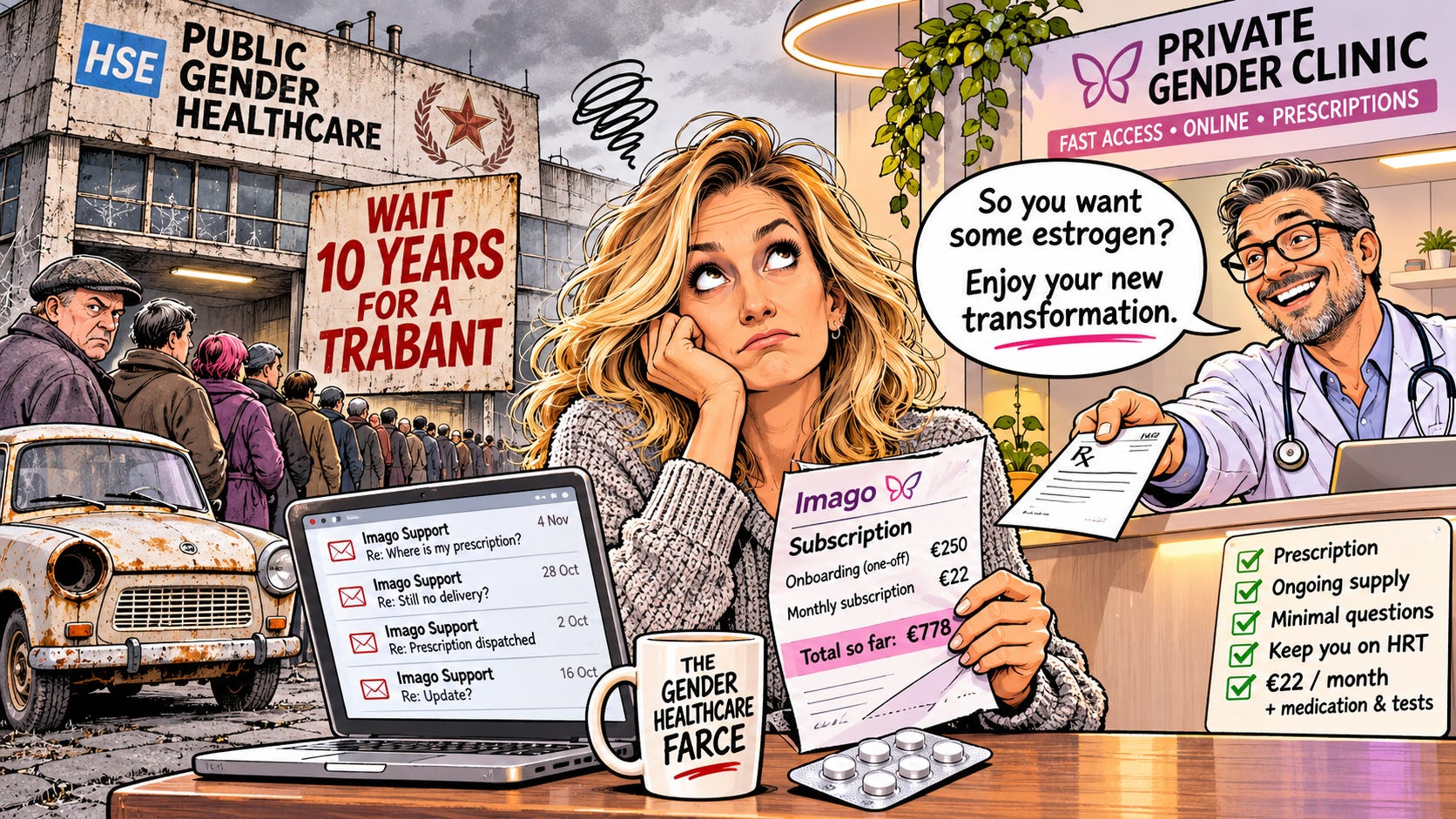
That's the position these providers enjoy. And when the service is crap, what are you supposed to do? Cancel your subscription and join an NHS waiting list? Spend five years waiting for somebody to assess whether you qualify for the medication you've already been taking? Of course not. You grit your teeth, pay your subscription, send another fucking email, and hope that somebody in Malta, Delaware or wherever the paperwork originates this month will eventually arrange your prescription.
The business doesn't have to earn your loyalty through excellence. Your lack of alternatives does that work for it.
In one system, you can't get through the door. In the other, you can't find anybody once you're inside. And somewhere between the two, we've completely misplaced the rather straightforward concept of ordinary, competent medical care.
Why can't an ordinary doctor do this?
I have Graves' disease, an autoimmune thyroid condition. I see a private endocrinologist who manages it. She reviews my blood tests, recommends medication changes and considers how my wider health affects treatment. At one point she even recommended that I stop the mild blood-pressure medication I'd been on for years. Specialist provides expertise, GP handles ongoing care, treatment gets adjusted. Nobody considers this arrangement remotely remarkable.
So I once asked my GP why she couldn't manage my estrogen replacement. She was perfectly candid. She wouldn't know what levels to aim for and didn't feel qualified to prescribe it.
I don't blame her. But this isn't exactly beyond the limits of human knowledge. There are published clinical guidelines, established monitoring practices and endocrinologists who understand hormone replacement. I'm not suggesting a GP should qualify as an endocrinologist after ten minutes on Google. I'm asking why she can't acquire the competence and specialist support in the same way she does for countless other conditions.
And it matters more after surgery. My testes are gone. I require ongoing sex-hormone replacement for my long-term health, including my bones. This is no longer about physical feminisation. It's continuing endocrine care, exactly the kind of boring, long-term medical maintenance that GPs and specialists manage all day.
What I want is remarkably uncontroversial.
I want transgender healthcare to work like ordinary healthcare. The way my Graves' disease does. A GP, an appropriate specialist when necessary, blood tests, medication, and medical professionals who actually talk to one another.
That really is the extent of my revolutionary proposal.
So I looked at doing it myself
Because apparently nobody can organise this in a straightforward fashion, I started investigating whether I could build something better. And I mean seriously investigating it.
I've spent nearly thirty years designing software systems and businesses, and when I encounter an inefficient service, my natural instinct is to take it apart and work out how I'd rebuild it. I researched the legal jurisdictions, the subscription model, potential clinical networks, and how to distribute prescribing work between independent doctors.
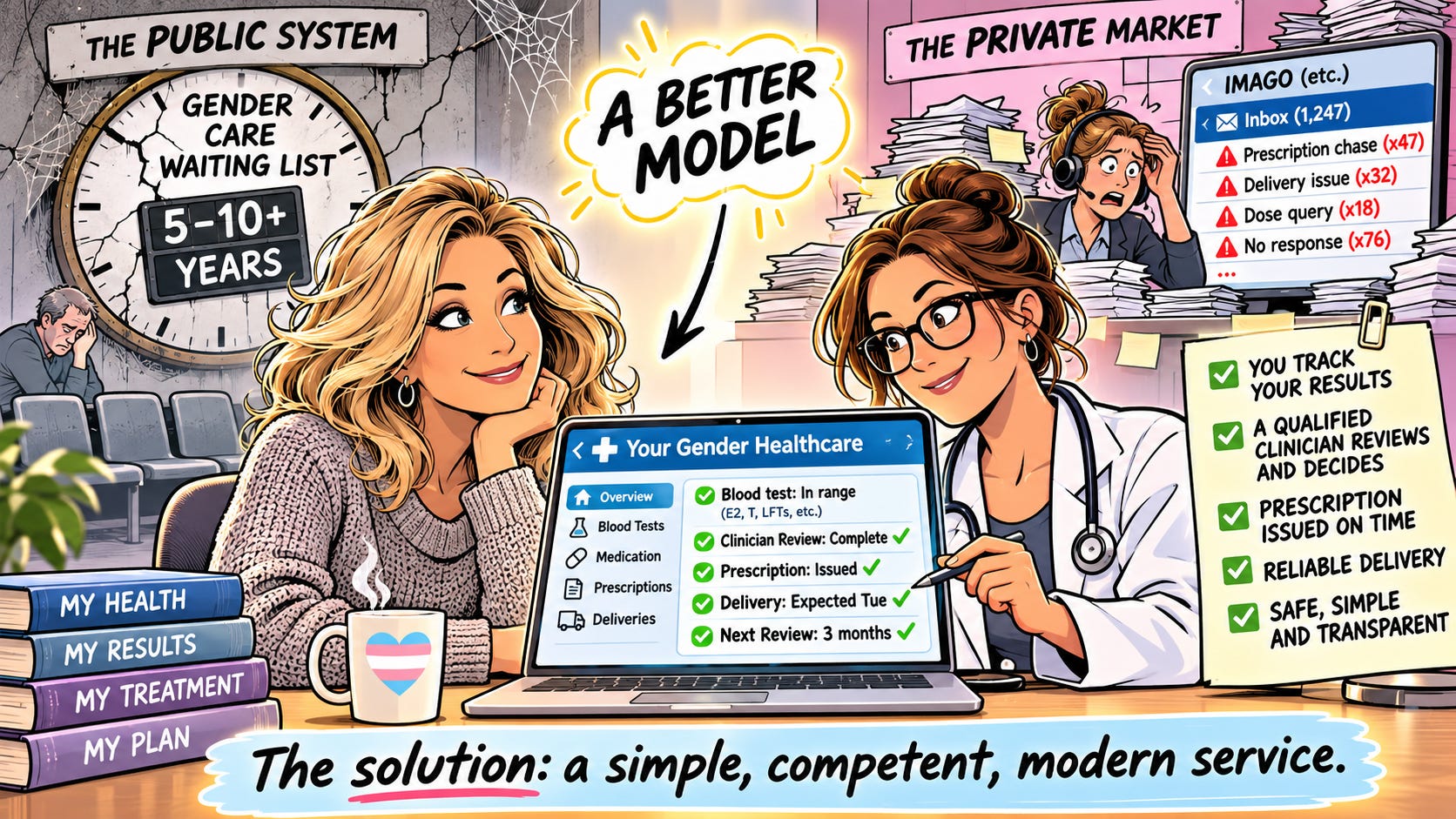
The concept wasn't terribly complicated. Let software do the administration and monitoring. Let qualified clinicians make the medical decisions. Blood tests arrive. The system checks them against the patient's treatment plan, identifies unexpected changes and flags anything requiring clinical review. A doctor reviews the information and authorises treatment. The system tracks renewal dates and alerts everybody concerned well before the patient runs out. Nobody should be sitting at a breakfast bar wondering where a prescription disappeared to nine weeks after requesting it. Modern software does vastly more complicated things than this before lunch.
Even the revenue arithmetic looked interesting. A thousand customers paying €22 a month is €264,000 a year in recurring subscriptions.
What disheartened me was the difficulty of establishing a sufficiently large network of qualified prescribers. In the UK, one specialist training pathway I examined required access to an existing NHS gender service to complete its core training. So you're trying to increase the number of professionals capable of providing care, and the route to certification runs through the very NHS infrastructure you're trying to supplement. It's the kind of circular arrangement that would make Joseph Heller proud.
I spent a considerable amount of time on all this, considered some potential clinical arrangements, and then ADHD Stevie remembered she already had approximately seventeen other projects demanding her attention.
I haven't built it.
Yet.
But if one thoroughly irritated woman with a laptop can see how to build a more reliable service than the company she's currently paying, that tells you something about the state of the market.
Five little tablets
Chester has finished with the teddy bear. My breakfast bowl is still empty. And those five little estrogen tablets are still sitting beside me.
I've had an extraordinarily fortunate transition. I was able to plan it, finance it and proceed at my own pace, and I'm not about to let a missing prescription undo that. But we deserve competent, reliable medical care without having to choose between an interminable public waiting list and a private company whose customers have so few alternatives that basic reliability has become optional.
Now, if you'll excuse me, I've got another email to write.
Apparently, I'm still waiting for my fucking prescription.
This is my first article my you. Following now. XOXO 🍒
I really feel for you sweetie, the whole system is absurd and is something that has really put me off exploring my future seriously. On the one hand, the NHS would leave me waiting a lifetime. On the other hand, private providers are happy to take your money and run. There must be a good middle ground somewhere….