

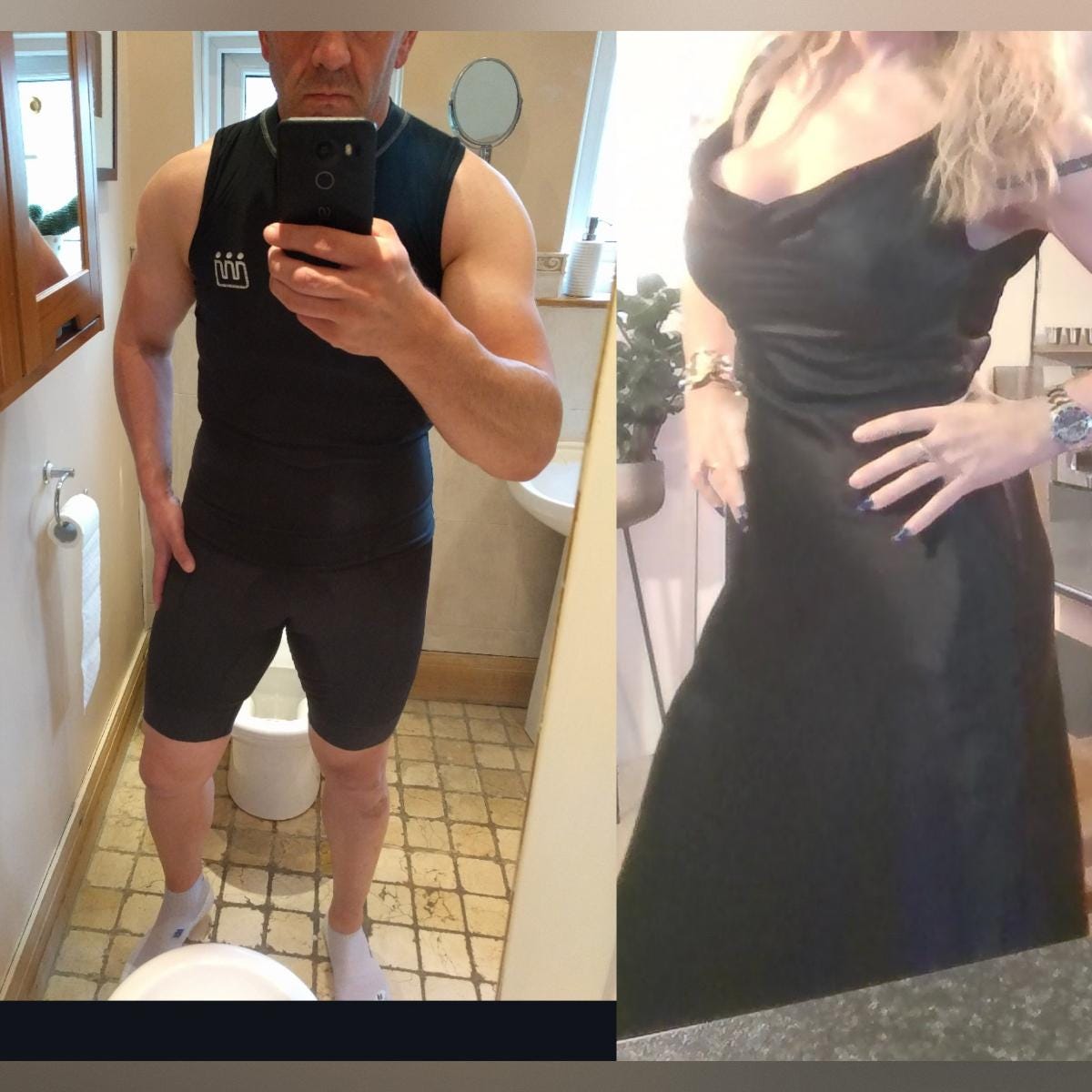
I woke up at 6.15 this morning in a house that is finally behaving itself again. After several rounds of battling leaking pipes, exploding Y-splitters, and water cheerfully cascading across the kitchen floor at random intervals, I think the plumbing might actually be under control.
The plan for today was wholesome and disciplined.
A quick 20-km indoor ride on the bike. I’ve actually been very good this week, back to something resembling training, though nowhere near the distances and effort I used to manage. Followed by a shower, coffee, and a normal start to the day.


Instead, fatally, I opened X.
And there was a tweet I’d written the day before, a reply to one of Helen Webberley’s latest blasts. You know the genre: the absolutist, non-negotiable declarations that trans women are literally biological women in every conceivable sense, and if you disagree you’re a hateful TERF condemned to the bowels of hell. That sort of thing.
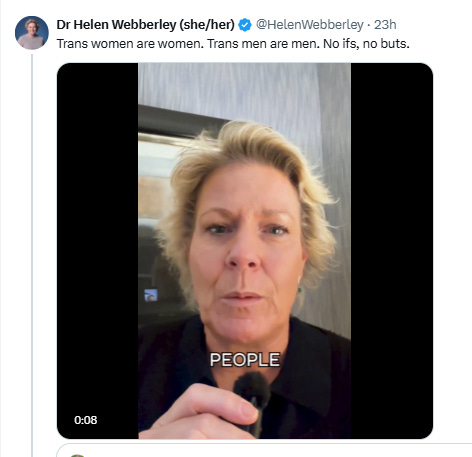
My response to her had been sitting there overnight, and by morning it had gathered hundreds of likes from people who, under normal circumstances, would never, ever agree with someone like me. Not that the tweet had “gone viral,” just that it had landed squarely with a demographic that usually rejects, mocks, or dismisses me out of hand.
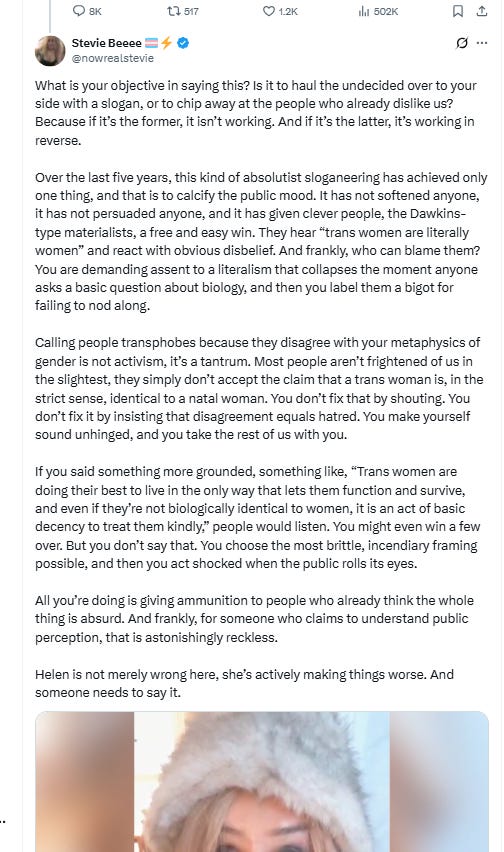
What is your objective in saying this? Is it to haul the undecided over to your side with a slogan, or to chip away at the people who already dislike us? Because if it’s the former, it isn’t working. And if it’s the latter, it’s working in reverse.
Over the last five years, this kind of absolutist sloganeering has achieved only one thing, and that is to calcify the public mood. It has not softened anyone, it has not persuaded anyone, and it has given clever people, the Dawkins-type materialists, a free and easy win. They hear “trans women are literally women” and react with obvious disbelief. And frankly, who can blame them? You are demanding assent to a literalism that collapses the moment anyone asks a basic question about biology, and then you label them a bigot for failing to nod along.
Calling people transphobes because they disagree with your metaphysics of gender is not activism, it’s a tantrum. Most people aren’t frightened of us in the slightest, they simply don’t accept the claim that a trans woman is, in the strict sense, identical to a natal woman. You don’t fix that by shouting. You don’t fix it by insisting that disagreement equals hatred. You make yourself sound unhinged, and you take the rest of us with you.
If you said something more grounded, something like, “Trans women are doing their best to live in the only way that lets them function and survive, and even if they’re not biologically identical to women, it is an act of basic decency to treat them kindly,” people would listen. You might even win a few over. But you don’t say that. You choose the most brittle, incendiary framing possible, and then you act shocked when the public rolls its eyes.
All you’re doing is giving ammunition to people who already think the whole thing is absurd. And frankly, for someone who claims to understand public perception, that is astonishingly reckless.
Helen is not merely wrong here, she’s actively making things worse. And someone needs to say it.https://x.com/nowrealstevie/status/1991525257170100350
That caught my attention.
So, naturally, I abandoned the ride until lunchtime.
The Bell Curve Problem
I’ve always thought that public opinion about trans issues follows a bell curve — a normal distribution.
At one end you have the absolutists:
people who insist that language, biology, and social categories can be redefined by sheer ideological force.
At the other end you have the zealots:
people who think trans people are delusional, dangerous, or in need of confinement.
But the vast majority sit in the middle of that curve normal people who aren’t hateful and aren’t ideological. People who remember GCSE biology. People who are fully capable of kindness, but who don’t appreciate being told to deny reality in order to prove that they’re “good allies.”
So when someone says:
“Trans women are literally women in every sense, full stop.”
…they don’t hear compassion or inclusion.
They hear a demand:
“Say something untrue. Perform compliance.”
And that’s where trust breaks.
Not because they’re bigoted but because they’re not stupid.
Once the middle of the bell curve feels they’re being manipulated, they start drifting away.
Not towards understanding.
Not towards compassion.
But towards the people who at least speak in plain, grounded language, even if that language is hostile.
My intention yesterday was simple:
reach the middle before they slide off the edge.
If the ultra-absolutist approach pushes them outwards, perhaps a little nuance could bring them back in.
The Action Man Replies

Of course, a few hostile replies arrived, tiny in number but they made me laugh.
Not because they were vicious, or even personal.
But because they weren’t replies at all.
They were Action Man moments.
For anyone outside the UK:
Action Man was a British action figure from the sixties through the eighties — the local answer to G.I. Joe. Certain versions had a little pull-string on their backs. You tugged the cord, released it, and Action Man would belt out one of about ten pre-recorded phrases. Completely context-free. Completely automated.
(And yes, in the seventies you could genuinely buy him an SS officer’s uniform. It was a different time.)
These commenters behaved exactly the same.
Pull the imaginary string, and you get:
“You’re a man.”
“Stop lying.”
“Use the men’s toilets.”
“See a psychiatrist.”
“Facts don’t care about your feelings.”
“End of discussion.”
It didn’t matter what I’d actually written.
It didn’t matter how measured, honest, or grounded the thread was.
You could tweet about baking soda bread and they’d still yank the cord and out would pop the same stock phrases.
They’re not engaging.
They’re not listening.
They’re not thinking.
They’re just Action Man on autoplay.
And that’s fine, they’re not the audience. The centre of the bell curve is.
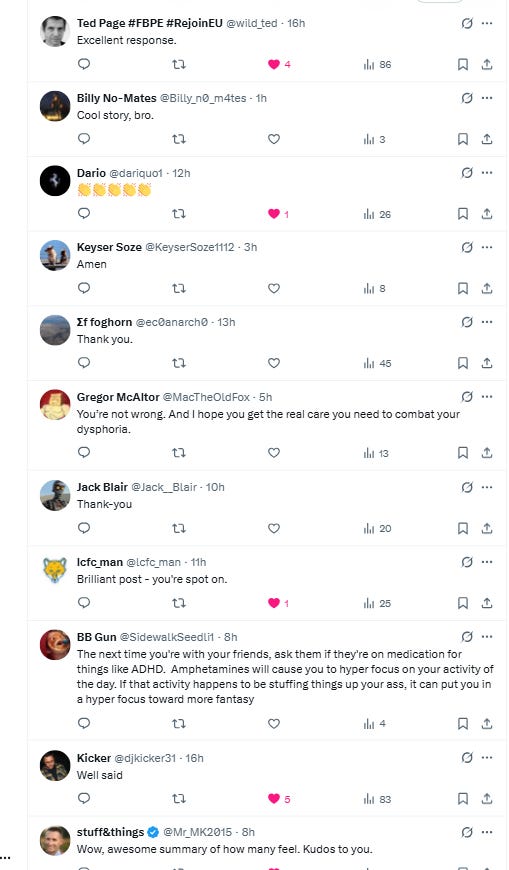
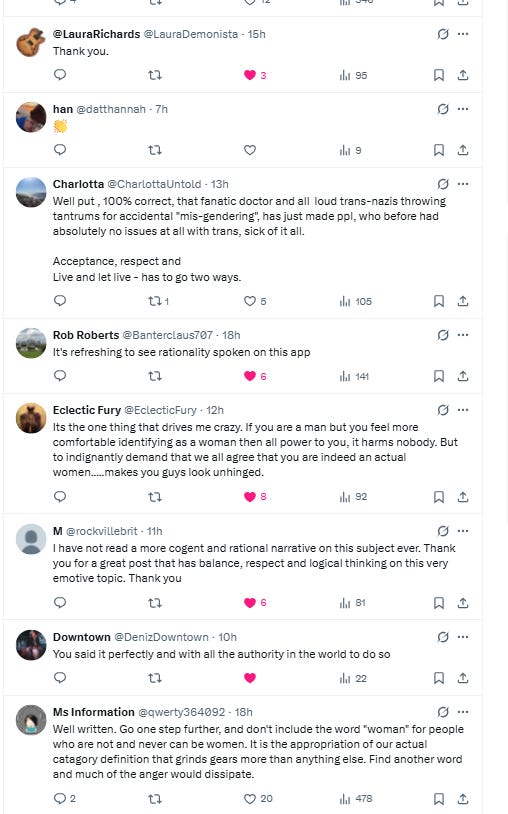
“You’re the first trans person who’s made sense to me.”
What astonished me and what made me stop, stare, and then postpone my bike ride was the other replies.
The replies from people I never expected to reach.
People who normally recoil from trans discussions altogether.
People who instinctively distrust activists.
People who feel alienated by absolutism.
People whose patience with the entire conversation has long since evaporated.
And yet:
“Thank you — this makes sense.”
“I’ve never heard a trans person put it like this.”
“This I can agree with.”
“You’re the reasonable one in the room.”
“If more trans people spoke like this, we wouldn’t be fighting.”
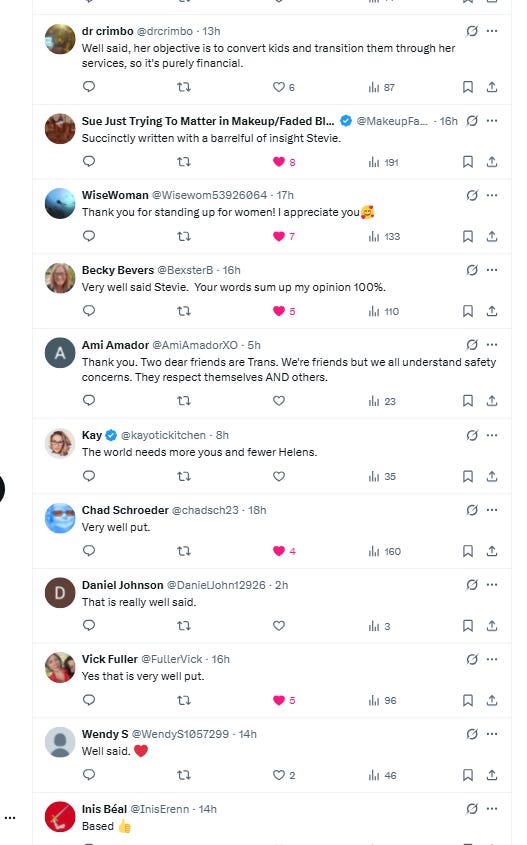
They weren’t praising me for mocking other trans people — I didn’t do that.
They weren’t cheering a self-hating performance — there wasn’t one.
They were responding to something much simpler:
I told the truth.
No slogans.
No moral guilt.
No reality-warping.
No demands that they deny what they know.
Just:
Here is my experience.
Here is how I see it.
Here is where my limits are.
Here is where yours are.
We can work from there.
And that was enough.
The Hive-Mind Myth
A theme cropped up repeatedly in the replies, even the supportive ones, that reveals just how distorted the public picture has become.
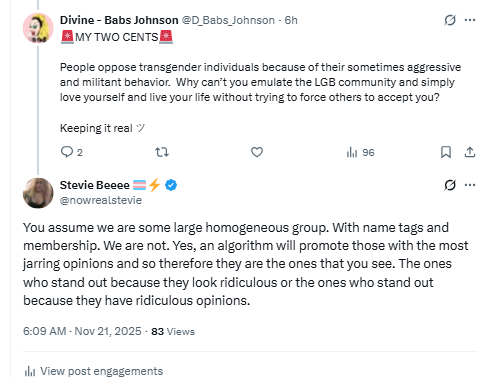
The idea that “trans people” are a unified block.
A hive-mind.
A single coordinated organism.
People said things like:
“Why can’t you lot all be like this?”
“If you people stopped saying X, we’d support you.”
“Why do you all insist on Y?”
As if somewhere there’s a central command centre issuing bulletins about vocabulary and bathroom protocol.
There isn’t.
We are not the Borg.
We are not a monolith.
We are not unified.
We are, at best, a loosely-related cluster of individuals with wildly different politics, beliefs, boundaries, and temperaments.
The problem is not that trans people all say the same thing.
The problem is that algorithms amplify the loudest caricatures and drown out everyone else.
What Yesterday Proved
Yesterday confirmed something I’ve long suspected:
If you stop lying, people stop hardening against you.
If you acknowledge biology, they exhale.
If you acknowledge limits, they relax.
If you stop insisting they deny reality to affirm your humanity, they suddenly become willing to affirm your humanity.
Trust is not built through slogans.
It’s built through honesty.
This shouldn’t be revolutionary.
But in the climate we all live in, it practically is.
My Little Outro
So yes the bike ride was postponed.
Lunchtime it is I promise.
But I wanted to capture this moment while it was still fresh, because for a few hours yesterday, something unusual happened on X:
The noise dropped.
The centre of the bell curve blinked.
People listened.
People responded.
People softened.
And I thought:
Maybe we’re not doomed after all.
I've thought for a while now that with all the high profile coverage of trans issues in the US and UK and the hostility towards us harbored by the current administrations that at some point the pendulum is gonna swing the other way and all this exposure, good, bad or otherwise, that that big middle of the bell curve is getting to us will lead to greater acceptance of trans people in the West, similarly to how increased exposure to gay and lesbian people led to more acceptance, which led to more LGB people coming out etc in a virtuous circle.
When almost all gay men and lesbians were closeted most people didn't think they knew any!! Think back if year old enough to remember those days!!
Before VERY recently transitioning was so expensive and so heavily gatekept that NOBODY knew any trans people it seems and now I'm living somewhere with 300 people in the building and 4 of us are out trans women, only two of who "pass" at all... My close trans friends think I'm wrong but I really hope I'm right on this one!!