


This week: the Nobel-winning psychology of why you've never once won an argument about trans people, and never will. Featuring Daniel Kahneman, Richard Dawkins, and the man down the flat-roof pub
For fifty years I said nothing. You learn a particular silence in the closet. Not just not speaking, but not letting yourself form the sentence in case it showed on your face.
So when I finally came out, I came out of that silence like a greyhound out of a trap.
I went straight onto X, and for the first time in my life I could say the thing. Every argument I’d swallowed for half a century, suddenly out under my own name. I argued with everyone. The gender-critical names with the blue ticks and the book deals, their followers, the trolls who’d wandered in for sport. Daily, for hours, with the manic energy of someone who’d just discovered the gag was off.
I wasn’t naive. I had a strategy. I knew I couldn’t change the minds of the people I was arguing with, so the point was the audience. The silent onlookers, the undecided, the people scrolling past. You don’t win by converting your opponent; you win in the minds of the people watching.
What I hadn’t costed in was what it would do to me. It is a specific kind of exhausting, building a careful, evidence-based argument while a thousand voices shout you’re a fucking man in a dress. Not because the insult stings, though sometimes it does, but because of the asymmetry. The insult is free: five words, no thought, fired and forgotten. My argument was expensive: evidence, structure, patience, nuance. I was running an engine that drank fuel by the gallon against people running one that ran on air. They could keep it up forever. I couldn’t. One day I understood that, and walked away from the spectacle.
But I didn’t leave empty-handed. Across all those bruising months, and in the harder encounters, with real people in real rooms, family among them, I’d started to see the machinery behind the faces. I’d gone in to persuade, failed, got hurt, and come out with something better than a win. I’d worked out how the thinking actually works.
And here is what it is.
The whole thing runs on one move, and once you’ve seen it you can’t unsee it.
Attribute Substitution
There’s a thing the psychologist Daniel Kahneman calls attribute substitution. When the mind meets a hard question, it quietly swaps it for an easier one and answers that instead, without noticing the swap. Ask someone “how satisfied are you with your life?”, a genuinely hard question, and what they actually answer, without knowing it, is “what mood am I in right now?” The substitution is invisible from the inside. They’re certain they answered the hard question.
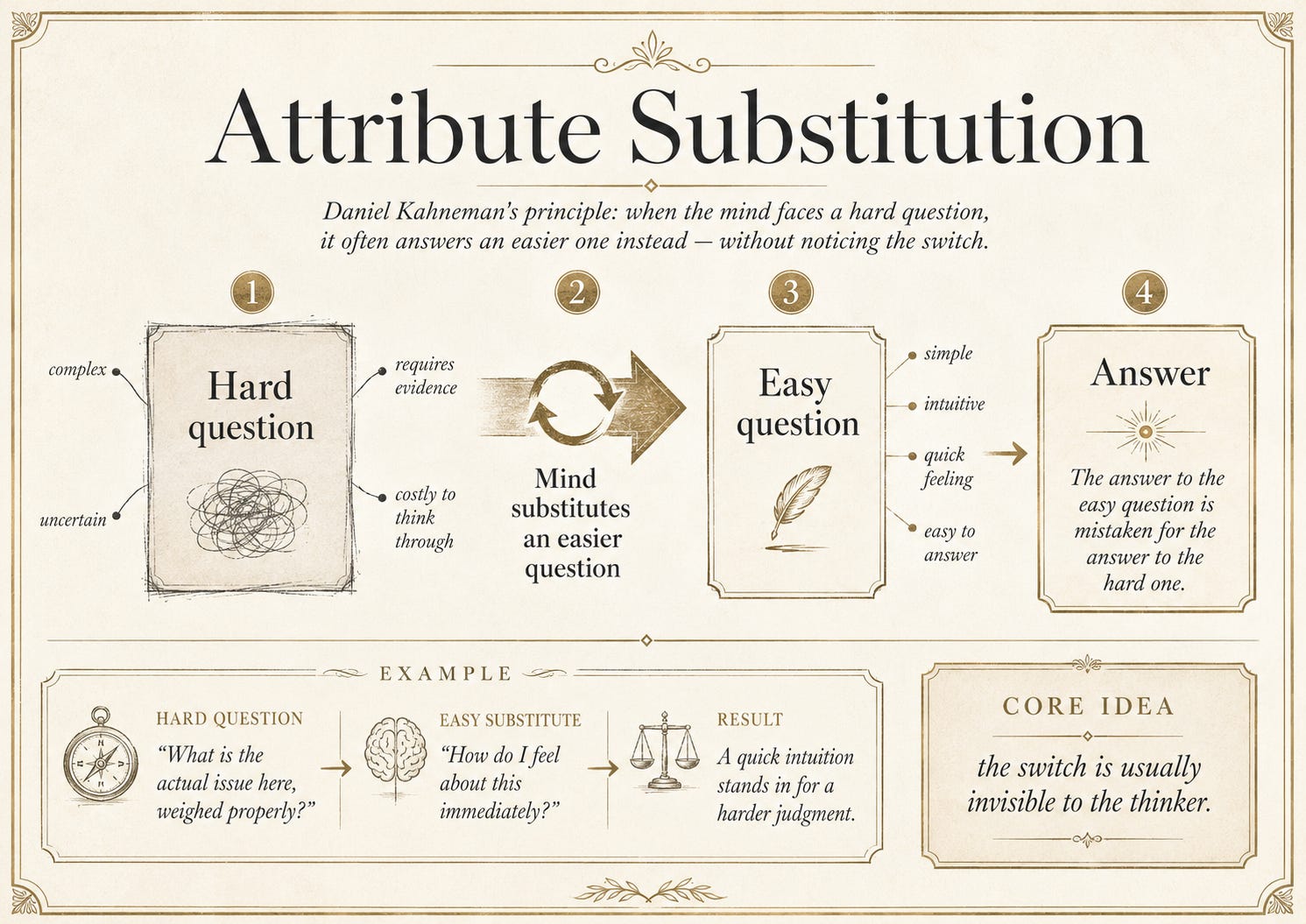
Here’s how it runs with people like me.
The hard question is this: what is the actual risk of allowing trans women into women’s spaces, weighed against the actual cost of excluding them, in light of the actual evidence? That needs base rates, proportion, some moral seriousness. What harm has actually occurred, how often, compared against the harm exclusion causes.
Think about how we drive. Two cars approach each other on an ordinary road at sixty miles an hour, a combined hundred and twenty, with nothing between them but a painted line and a shared agreement not to cross it. Any driver could swerve across and kill everyone. We know this. We accept it. We don’t ban driving, because we weigh the real risk against the real cost and make our peace with the painted line. That’s what grown-up risk reasoning looks like. It’s never “could harm ever occur?” It’s always “how much, how likely, against what cost?”
So you make that argument. You bring the base rates, the proportion, the painted line. And the answer comes back:
But you’re not a woman.
There it is. The switcheroo. You asked about risk; they answered about definitions. And this is the maddening part, the part that took me a thousand arguments to see: they experience it as having answered you. They’ve swapped the hard question for an easy one, knocked the easy one over, felt the satisfying crunch of something falling, and assumed it was your point. You hand them an actuarial table; they think the conversation was about the meaning of a word.
The switcheroo
Now, I want to be careful here, because there’s a version of me that wastes the rest of her life disputing whether a man can become a woman, and I’m not her.
In one narrow biological sense, the sentence is true. I wasn’t born female. I don’t produce ova. I can’t become the kind of woman my mother is. Fine. Granted. I don’t need metaphysical perfection from the universe before I’m allowed to exist with dignity.
The problem isn’t the sentence. The problem is what they make the sentence do.
The whole model is just three rungs:
A man cannot become a woman.
Therefore a trans woman is a man.
Therefore a trans woman must be kept out of women’s spaces. And out of the sport, the prison, the changing room, the documents, the pronouns, the basic kindness.
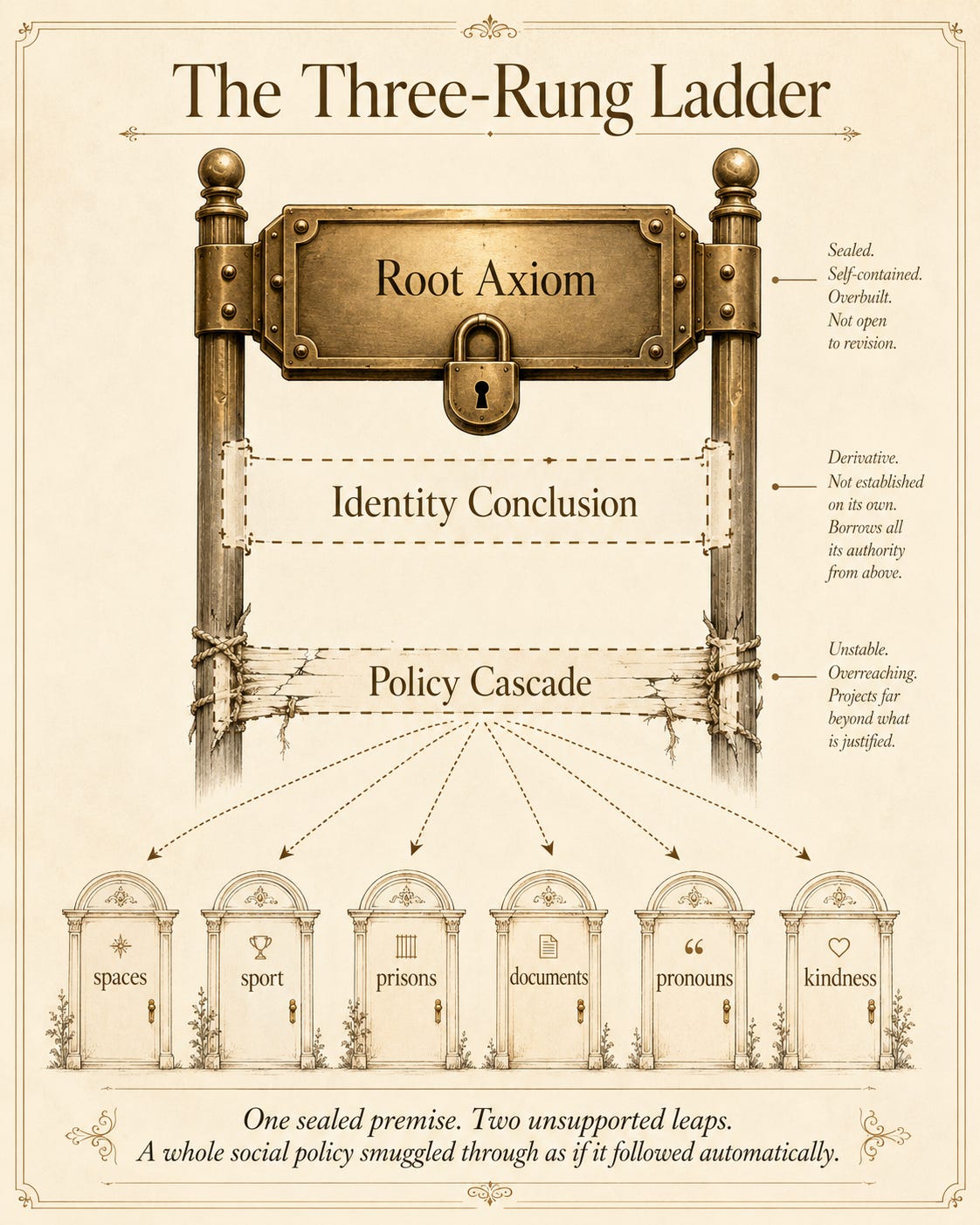
Only the first rung does any work. The rest is supposed to cascade out of it automatically. And that’s the fraud. Not the biological claim, but the pretence that every social, legal and moral conclusion falls out of it for free. A person can be male-born without that single fact settling what risks she poses, what exclusion costs, or how a decent society should weigh competing needs. But the model doesn’t want to do that work. It wants the clean cascade. Grant the root and everything else is meant to follow.
I understand the pull of this better than most, because building abstractions is my day job. I write software. My whole craft is climbing to the clean rule at the top of the tree and letting everything follow from it. I feel the seduction of the parsimonious model in my bones. There is something that feels rigorous about a world you can capture in three statements; the fewer the axioms, the more serious it feels. But any engineer who’s been at it long enough knows the discipline that makes abstraction honest: the model has to answer to reality. When the runtime behaviour contradicts your beautiful invariant, the invariant is wrong, and you climb back up and fix it. Evidence flows upward. The day you stop letting the world revise your model is the day you stop being an engineer and start being a priest.
That’s what this is. The root axiom was never derived; it was asserted, then sealed. No fact is permitted to climb back up and touch it. So when you argue rung three, the risk and the evidence, and they answer with rung one, the slogan, that’s the switcheroo in its native habitat. They retreat to the top of the tree because it’s the only rung that feels safe. The lower rungs wobble the instant you ask them to justify themselves.
A man can’t be a woman. Yes, in one sense. Fine. Now explain why that settles whether a harmless, transitioned, middle-aged woman buying a lipstick in Boots is a threat to public order. They rarely do, because explaining was never the point. Returning to the slogan is the point.
Three intellectual levels of TERF, same swictheroo.
You meet three kinds of person doing this, and they’re worth telling apart.
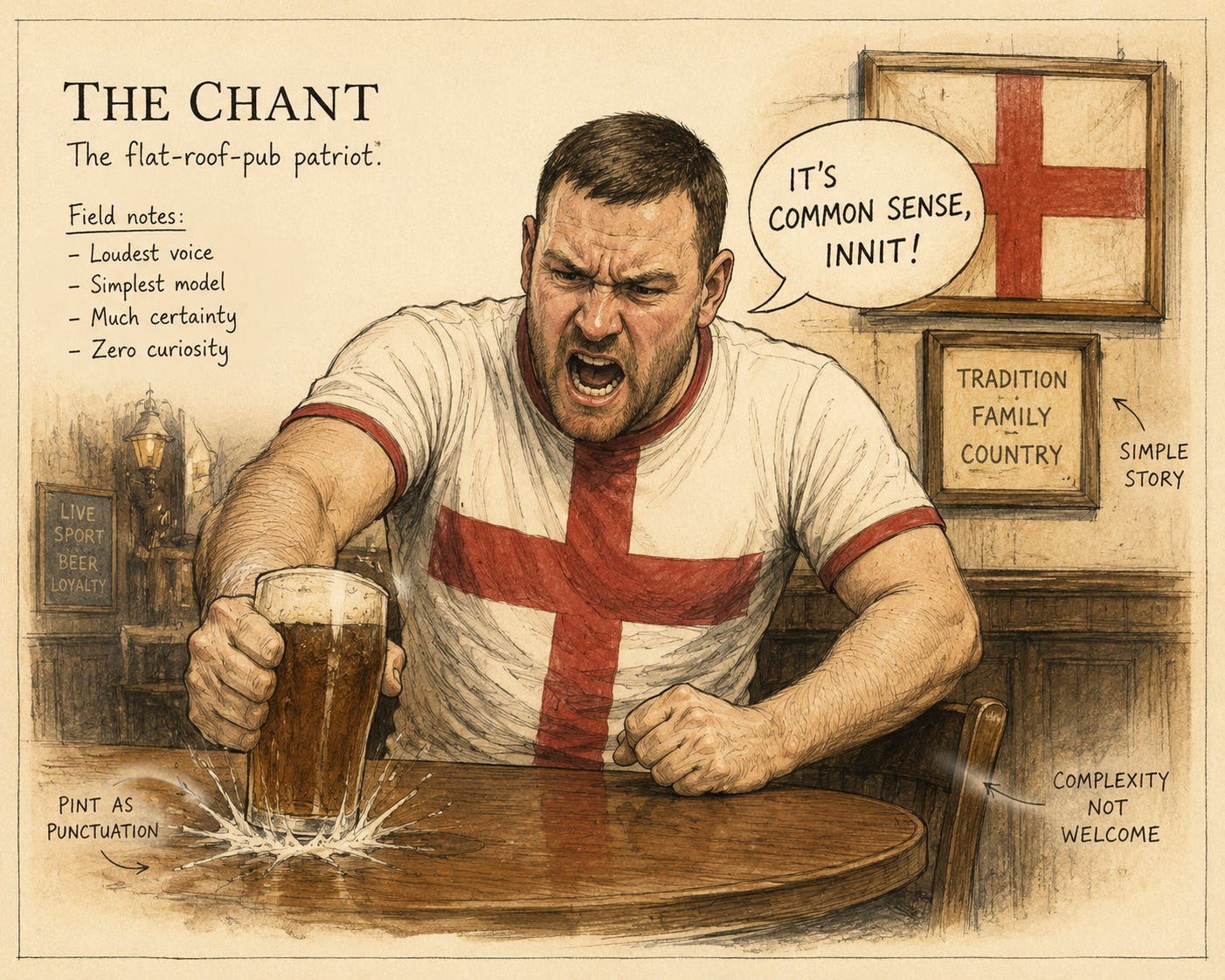
At the bottom of the tree is the flat-roof-pub patriot. “England till I die”, knows what a woman is, said it down the boozer and got a laugh. He doesn’t argue the axiom, he shouts it. There’s no machinery and no disguise. You say anything at all and back comes the slogan like a football chant. He’s at rung one before you’ve finished your sentence, because rung one is the only rung he owns.
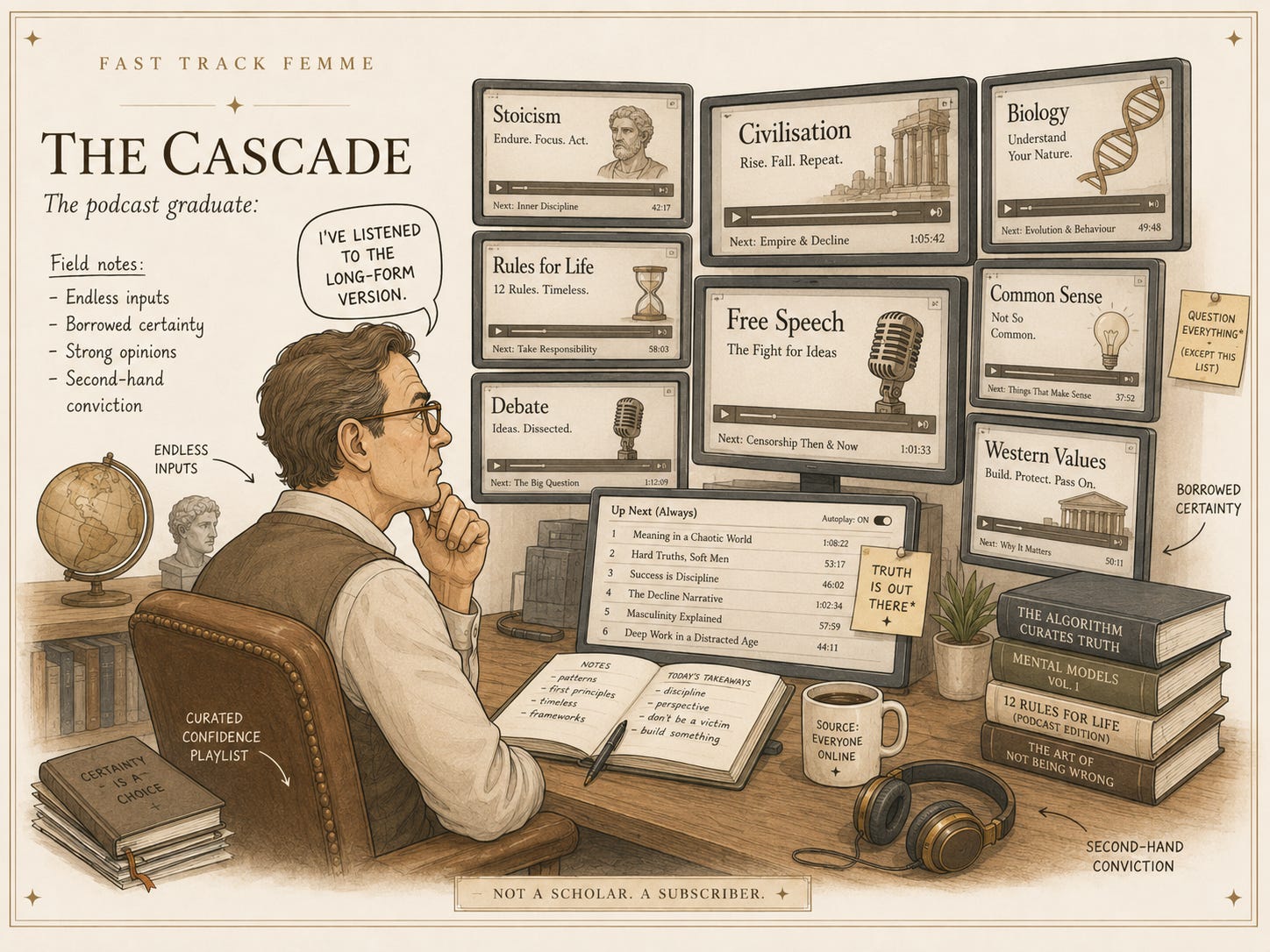
In the middle is the podcast graduate. He’s done the reading, by which I mean he’s consumed four hundred hours of Jordan Peterson, Helen Joyce and the rest of the brigade, and he has mistaken agreeing with a confident presenter for having thought something through. This is the one who flatters himself on his intellect. He can cascade the model down with real fluency: man can’t be a woman, therefore men, therefore no spaces, therefore no pronouns. Because it has the shape of reasoning, he believes it is reasoning. But he didn’t derive the root; he absorbed it, pre-loaded, from someone with a microphone, and he’s never once let a fact climb back up and revise it. He has cut the feedback wire and called the silence rigour.
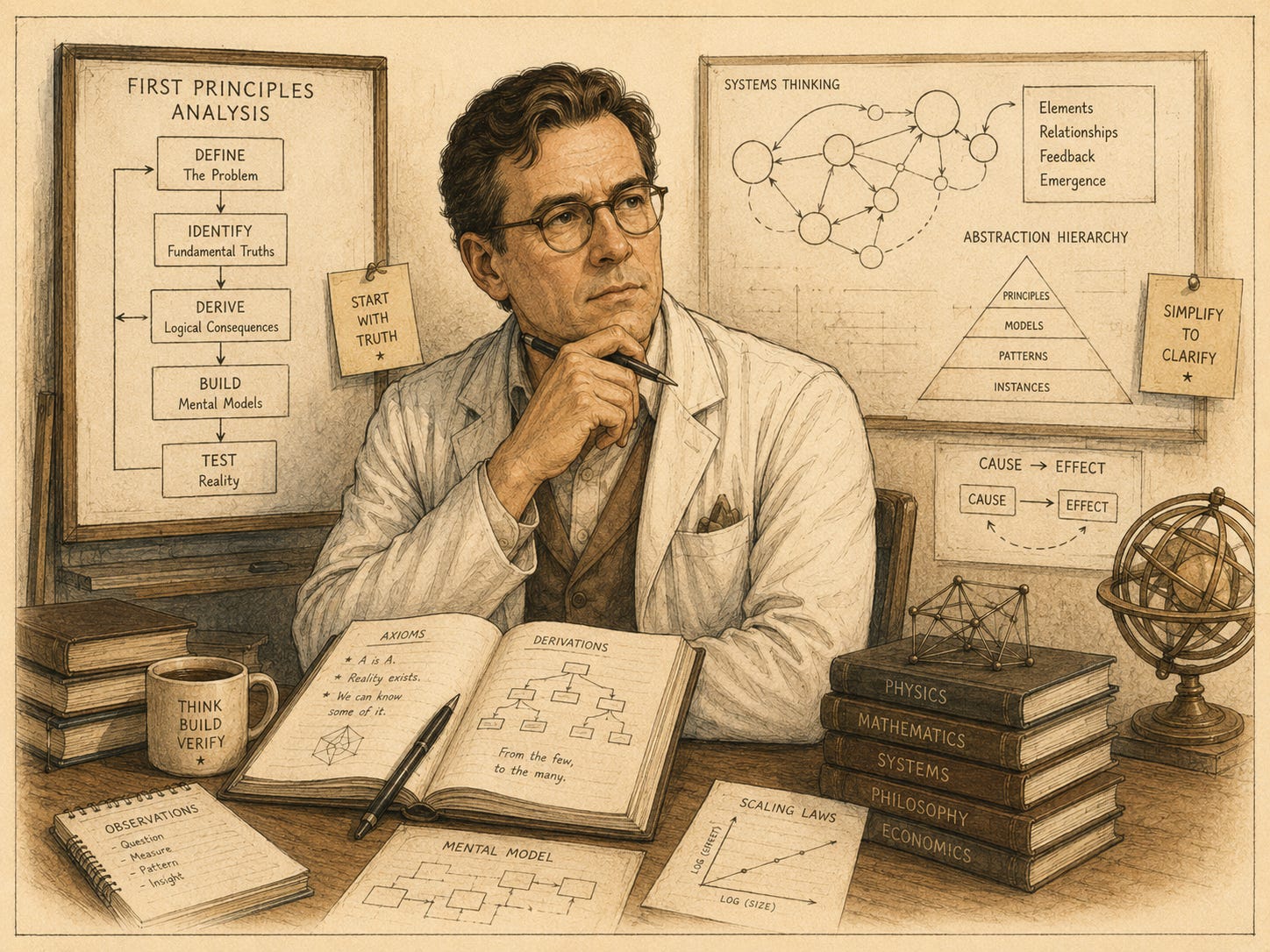
And at the top is ‘the scientist’, or real thinker. For our example, we will cite Richard Dawkins. The man who taught a generation to think in fine gradients about evolution, to distrust the easy story, to follow the evidence into the mess, reaches, on this one subject, for the hardest binary he can find. Sex is binary. Gametes. Chromosomes. True enough, in the context he means them. And deployed, with enormous authority, as an answer to the top of the tree dressed up as a verdict on the bottom of it. I have seen him do this on endless podcasts with Helen Joyce and the gang. The erudition isn’t the reasoning. The erudition is the disguise. And it’s worse from him than from the man down the pub, not better, because the credentials lend the swap a borrowed authority. The onlookers I was trying to reach see a famous scientist and assume the science has spoken. It hasn’t. He’s done exactly what the pub did. He’s just done it in a lab coat.
A chant, a cascade, a lab coat. Underneath all three, the same climb back to the top of the tree.
The deeper failure isn’t stupidity. It’s a kind of corrupted cleverness. The clever ones fall for it precisely because they’ve been trained to admire elegance: the clean model, the hard line, the feeling of stripping away fashionable nonsense to reveal the underlying truth. They mistake the satisfaction of a simple model for the validity of it.
But a model’s only job is to fit the territory. And the territory here is people.
A model of sex and gender that resolves to three rules got that clean the only way it could: by throwing away the data that didn’t fit. And the data it threw away has a face, and a name. It’s me, and the others like me. The elegance was bought with amputation. The model compressed the world by deleting the inconvenient parts, and the inconvenient parts were human beings.
Real life is the messy model. It always was, because real life is made of people, and people have never once resolved to three clean statements. Anyone selling you a tidier map has tidied it by leaving people off it.
I don’t argue on X anymore. I’d taken everything the arena had to give, and what it gave me was this: you cannot feed evidence into a mind that has swapped your question for a different one. So I stopped offering, and I spend my breath where the wire is still connected. There are such people. The ones for whom this is a real person, and she’s harmless, and she’s happy is allowed to edit the model. I’ve found them. Some of them surprised me.
The switcheroo is the tell. Make an argument about anything in the real and messy world, and if the answer comes back as a statement about what a word means, they didn’t answer you. They climbed back to the top of the tree, and they probably don’t even know they did it.
Once you can see the climb, you’re free. Not because you can win. Because you finally understand why you never could, and you can stop setting yourself on fire to keep a severed wire warm.
I'm not the fragile sort!! Not remotely.