



For a stretch of my life, roughly eighteen to thirty, I was reckless.
Not charmingly reckless. Not the memoir sort, soft-focus photograph and a lesson at the end. Actually reckless. Drink, drugs at points, weight going all over the place, impulsive decisions, fast decisions, and a general sense that I was living in a body wired up by a bored electrician on a Friday afternoon.
The part people misunderstand about chaos is that it often coexists with ambition. I always wanted to be better. I wanted to drink less, stop smoking, get my weight under control, become the person I kept imagining in those bleak little moments after the damage was done, when the energy had gone out of the room and all that remained was the bill.
And every time, I did the same thing. I made a vow. *This time I mean it. This time I have learned.* Then I relied on the raw force of that vow to carry me through the next temptation, which is a beautiful system provided the temptation lasts about nine minutes and you are never tired, bored, lonely, ashamed, hungry, frightened, drunk, or alive.
So the pattern repeated. Decision, effort, collapse, shame, decision again. And I spent years thinking it was a character problem, that discipline was a thing other people had and I’d been issued the Poundland version. Some people had the proper moral engine. Mine had a warning light on and made a funny noise when cornering.
I now think I was wrong about almost all of it.
Not completely. Willpower is real. It can get you through the immediate moment, shove you back from the edge, survive the first exposed hour. But it is not a life system. It is sprint fuel.
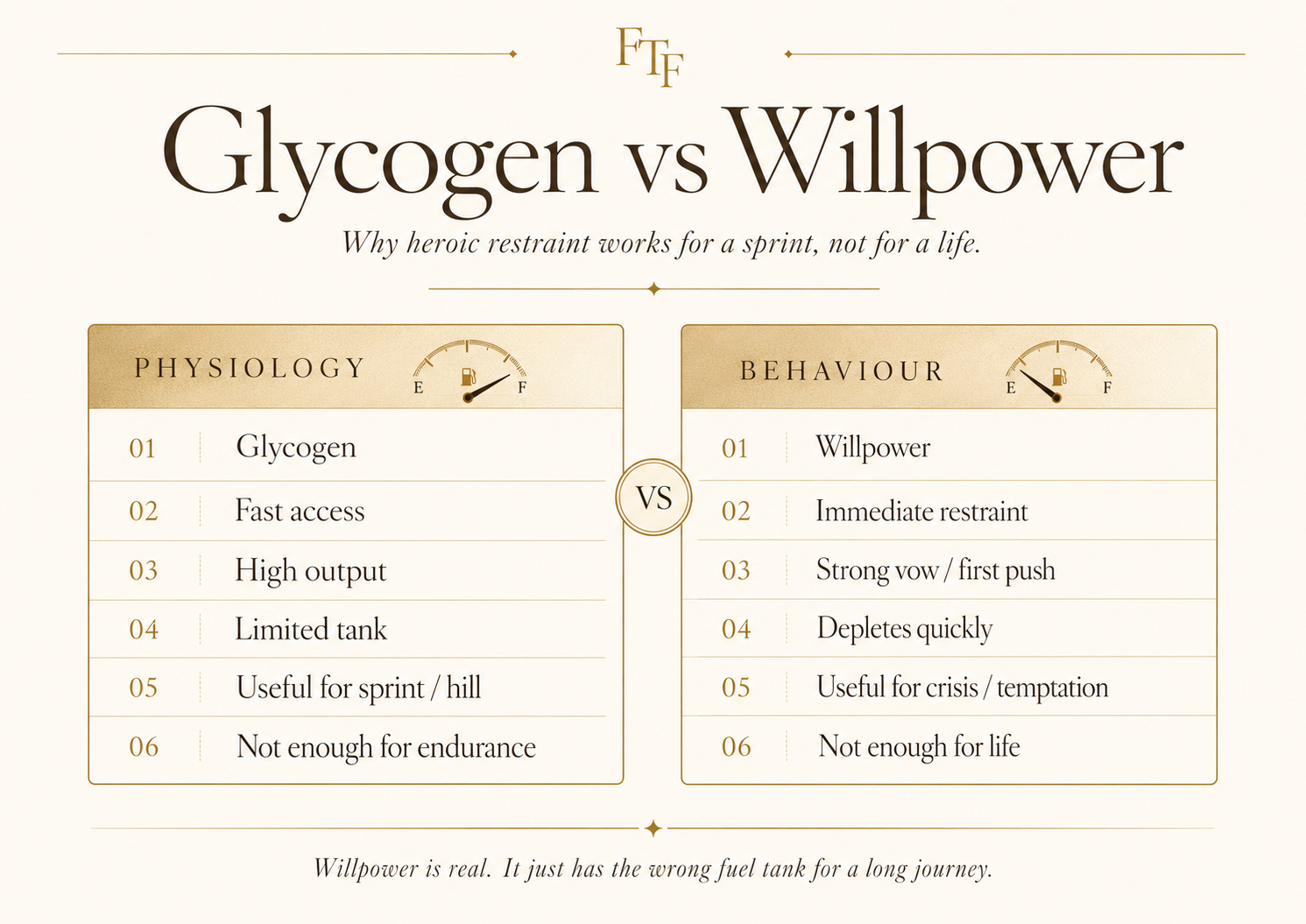
Willpower runs on glycogen.
Forgive me. I came up with this at midnight and it involves exercise physiology.
Glycogen is the fast fuel: immediate access, high output, limited tank. It powers a sprint, a hard climb, the ridiculous decision to chase someone up a hill because your ego has briefly overruled your cardiovascular system. It’s brilliant and essential and it depletes hard. Burn through it and you hit the wall. You bonk. Your legs become two bags of wet sand and no amount of moral conviction will persuade them otherwise.
That is willpower exactly. It works beautifully for a while and then it empties, and once it’s gone you cannot motivational-quote your way around human biology. You cannot grit your teeth into a second liver.
And yet this is how most people try to change their lives, stop drinking, diet, get fit, fix their finances, their sleep, their phone, their entire personality, all on the same tiny emergency fuel source designed to get them through a short, sharp crisis. Then when the tank empties, they conclude they’re weak. They’re not weak. They’re running a marathon on sprint fuel. That was me for years. I wasn’t short of desire. If anything I had too much, which is why I kept designing transformation as a heroic event, the big decision, the clean line in the diary, the new version of me arriving with lighting, music and possibly a small brass section.
But human beings are not changed by speeches. We’re changed by systems.
The thing that made me think about all this again was drinking. Three weeks ago I stopped, after a year on and off the booze that followed about fifteen years of not drinking at all. And the strange thing is that it has been easy. Not white-knuckle easy, not “bravely staring into the middle distance” easy. Genuinely, boringly easy, not constitutionally easy, but system-easy, which is a different thing. I sit in the garden with cranberry and ginger in a wine glass, watch a documentary with tonic and berries, and fall asleep before I finish the second glass, like a deeply wholesome woodland creature with excellent glassware. A few weeks ago the same evenings would have ended in gin.
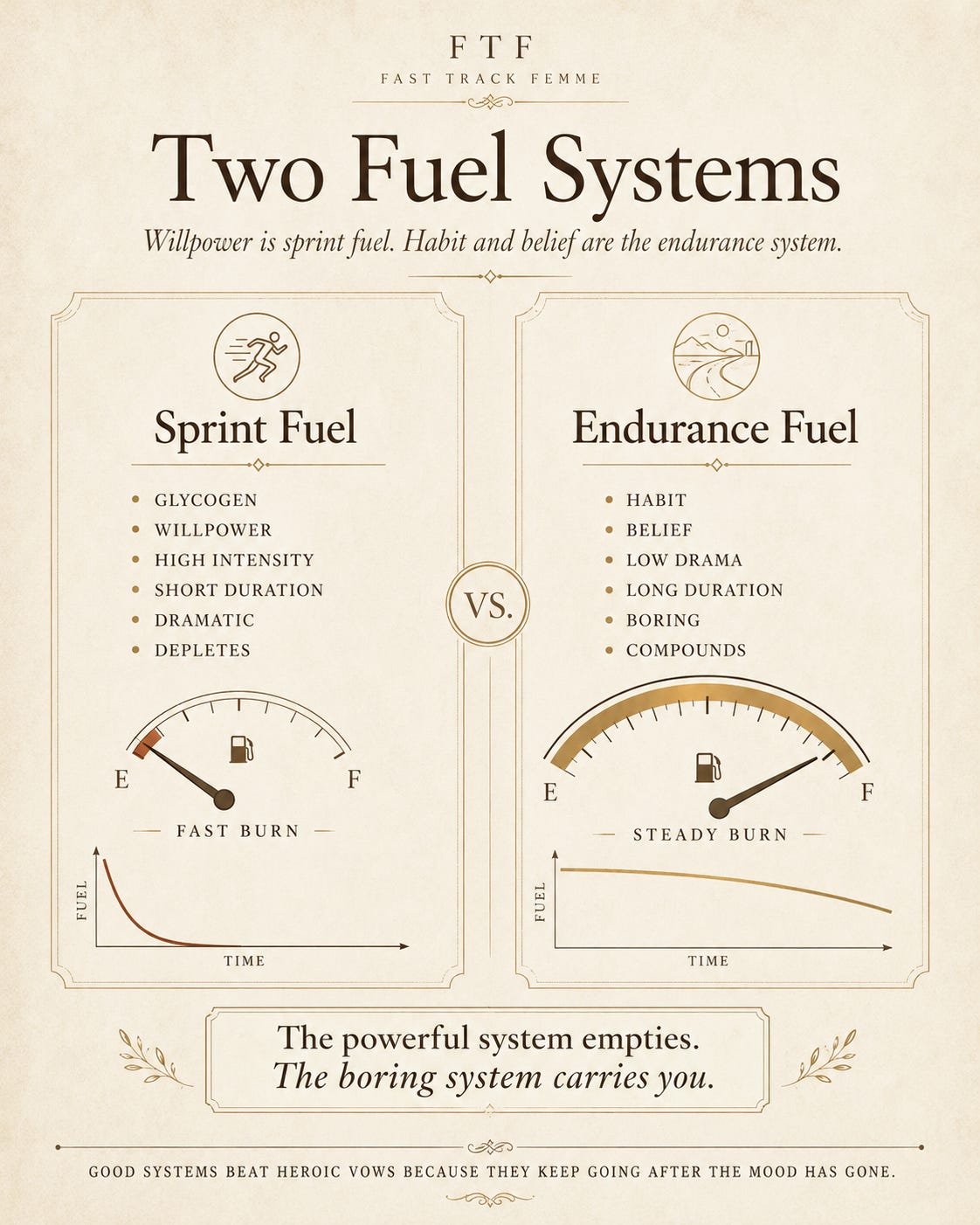
If that were willpower it would have collapsed by now. Willpower can get you through the first evening, maybe a week if you’re especially furious with yourself. It does not hum along quietly in the background for three weeks while you wonder whether the documentary about ancient trade routes is as good as the reviews said. So whatever is holding this, it isn’t willpower, which is what sent me down the rabbit hole of working out what self-control actually is.
The opposite of willpower is not weakness. It’s habit. Or more precisely, habit plus belief.
Habit and belief are the other fuel system. They’re fat oxidation: enormous tank, low effort, sustainable for years, but slow to build and frustratingly invisible while you’re building. It’s zone two training. It feels too easy to be doing anything. Nobody is filming a montage. You’re just there, repeating the thing, almost embarrassingly. And then weeks or months later you realise you can hold aerobically what used to take everything you had.
This is the bit I missed for years: I confused effort with effectiveness. I thought the thing that felt hardest must be the thing that was working, the burn, the strain, the enormous emotional charge of *never again*. It felt virtuous because it felt difficult. But most of what actually changes you doesn’t feel serious while it’s happening. It feels boring. Repetitive. Almost too small to matter. Which is exactly why people abandon it. The walk that isn’t very hard, the slightly better breakfast, the tonic in the same glass, the small act of not negotiating with yourself at six in the evening, none of it feels like transformation.
That’s because it isn’t transformation yet. It’s installation. And installation is boring.
One of the most useful things I’ve learned is that you often have to saturate yourself in the thing you’re trying to become. You cannot hear the truth once and expect it to rewire you. You have to drown in it, repeat it, bore yourself half to death with it, until the message stops being a message and becomes part of the weather.
That’s how I stopped smoking. I read Allen Carr’s book, which at the time I thought might be the worst-written book in human history, the same points over and over until I wanted to climb out of my own skull. *Yes, mate, you’ve mentioned this. The point has been made. The point has bought a holiday cottage and is now living in the village.* And then I stopped smoking. Years later I realised the repetition wasn’t a flaw. It was the mechanism. The book wasn’t trying to impress me. It was trying to seep into me.
Alastair Campbell said something similar about politics. You repeat the line until you’re sick of hearing yourself. New Labour, new Britain. By the time everyone inside the campaign is bored rigid of it, the public are only just beginning to hear it. Behaviour change works the same way, except the electorate is your own nervous system. You have to campaign at yourself, not once, not with one grand manifesto launch in the bathroom mirror, but again and again until the new message becomes more available than the old one. Familiar, then available, then plausible, then normal, then obvious. That’s the order. Most people want to jump straight to obvious.
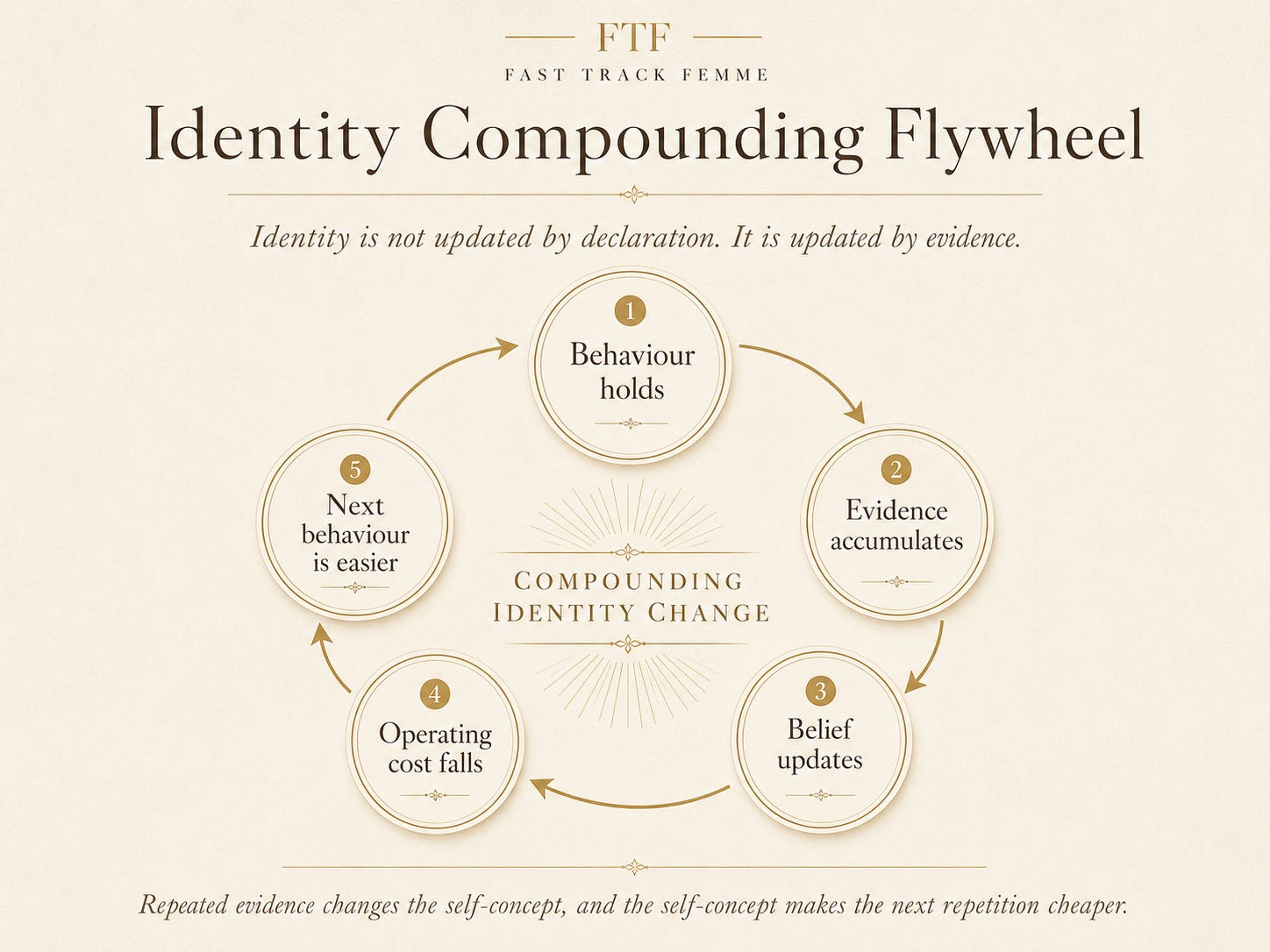
They want to *become* the person who doesn’t drink, doesn’t binge, doesn’t spiral. But identity isn’t updated by declaration. It’s updated by evidence. Every day the habit holds, it produces evidence; the evidence updates who you think you are; the updated self-concept makes the next day cheaper, because you’re no longer overriding an impulse with the same force, you’re acting like the person you’ve begun to believe you are. Day one, you’re a person trying not to drink. Day twenty-one, you’re a person who doesn’t. Completely different operating cost. The first is expensive. The second is nearly free.
This is where belief compounds. Every small repetition pays a tiny dividend, one walk, one decent meal, one early night, one bottle not opened. Nothing with cinematic value. But the dividend reinvests. The behaviour creates evidence, the evidence changes belief, the belief makes the behaviour easier, the easier behaviour creates more evidence. Slowly at first. Then suddenly load-bearing.
I know compounding. from trading and investing. The money I made, I made from boring positions held for years, compounding quietly while I got on with my life. The money I lost, I lost from high-intensity, high-leverage strategies that produced spectacular numbers right up until they tried to remove my face.
Leverage is glycogen. Compounding is fat oxidation. And it’s the same story in three costumes. In fitness, the mistake is training everything anaerobically because suffering feels like work, you batter yourself, plateau, and decide you’re not fit enough, when really you never built the aerobic base. In behaviour, the mistake is changing everything through willpower because effort feels like virtue, you vow, strain, deplete, relapse, and decide you’re weak, when really you never built the habit base. In investing, the mistake is chasing intensity because movement feels like intelligence, you lever up, trade too much, and discover that spectacular numbers go in both directions, the little bastards, when really you never respected compounding. Different fields, same lesson: the thing that feels powerful often can’t last, and the thing that lasts often feels embarrassingly underpowered at the start.
So I’ve stopped asking “how do I become stronger in the moment?” Sometimes that matters; sometimes you genuinely need the sprint fuel to get through the next ten minutes without doing the stupid thing. But the deeper question is different. How do I make the moment less expensive? How do I design the evening so the decision isn’t heroic? How do I preserve the ritual while changing the payload?
That’s why the glass matters. It sounds ridiculous but it doesn’t. The cranberry and ginger in the wine glass preserves the shape of the old ritual while removing the part that was harming me. Same chair, same evening, same tiny ceremony, different chemical payload. That’s a system. And systems beat vows, because a vow says *I will be different* and a system says *I have made different easier*. That’s the whole game.
Which is why I’ve become wary of the word discipline, not because it’s bad, but because people use it as though it were a moral substance some people are issued more of. I don’t think that’s how it works. What looks like discipline is usually architecture. The disciplined person isn’t standing there in permanent heroic restraint. She has simply built better defaults and exposed fewer stupid decisions to the weather. That’s not moral superiority. It’s infrastructure. And the good news about infrastructure is that it can be built, slowly, repetitively, without brass sections.
If I were trying to change something now, I wouldn’t start by asking how much willpower I have. I’d assume the answer is: about the same as everyone else, which is not much, and nowhere near enough to run a life. Then I’d ask better questions. What’s the smallest version of this I can repeat? What ritual am I preserving, and what payload needs to change? What do I need to saturate myself in until the new idea becomes boringly available? And above all: how do I stop confusing strain with progress?
Because the first weeks of change are deceptive. The system adapts before you can see the adaptation. You don’t expect one zone two session to turn you into a diesel engine, you do the boring work and trust that something is happening beneath the level of drama. Behaviour is the same. The first repetitions don’t feel like identity change. They feel like faffing about with tonic water and pretending it’s a personality. Too small, too domestic, too easy.
Good. Easy isn’t cheating. Easy is the point. The goal was never to prove I could suffer. It was to build something that doesn’t need suffering as its fuel.
That may be the most important thing I’ve learned. Willpower can start change. It cannot carry it. Habit carries it, belief carries it, saturation installs it, compounding strengthens it. And after a while the thing you used to fight becomes the thing you barely think about, which is the closest thing to freedom most of us are going to get.
I spent my reckless years thinking I lacked discipline. Then I spent years, without quite realising it, building better systems, fitness, food, work, health, thinking. I read, watched, repeated, failed, adjusted, repeated again. I bored myself into becoming someone else. So now, when something changes easily, I don’t mistake it for magic. I assume the groundwork was already there, and the visible decision was only the moment the system surfaced.
That’s what happened with the drinking. I didn’t discover a heroic reservoir of willpower. I’d spent years changing the machinery underneath. The old evening arrived and simply didn’t find the old infrastructure waiting for it.
For years I thought self-control meant gripping the wheel harder. Now I think it means building a better road.
Willpower is useful. But it’s glycogen. It gets you over the hill. It doesn’t take you across the country.