


In this update, I fly to London to see ABBA Voyage, lose my tickets to a CAPTCHA, defeat myself with Citymapper, get trapped in a Tube station in three-inch platform boots, nearly go over backwards fifteen times during Dancing Queen, reverse-engineer the projection stack mid-epiphany, and board a train to the wrong airport. Also: a forty-year-old promise to a little boy in the back of a Ford Cortina finally gets kept.

Several weeks ago I went to see ABBA Voyage in London.
I have a strange, deep relationship with ABBA.
If I had to name the external things that most instantly return me to childhood, ABBA would be right up there with Starsky & Hutch, Star Wars, and Christopher Reeve as Superman. That is the little cultural shrine of my early boyhood, really. Cars, capes, spaceships, disco, blonde women, impossible longing.
But ABBA sits differently from the rest of them.
Some of my earliest memories are of sitting in the back of our mid-70s Ford Cortina Mark III with the four-track player in the front, listening to the same cartridges over and over again. If memory serves, we had ABBA and The Mamas & the Papas, and those songs somehow embedded themselves into me before I had language for half of what I was feeling.
We had the albums at home but it is the Cortina I remember most. Me as a little boy, my mum and dad in the front, the world before my younger siblings were fully in it, and Skelmersdale New Town was still gleaming white and futuristic.
When I first started transitioning, my therapist was very keen that I learn to look after the little boy inside me. He asked me once whether I experienced that child as a little boy or a little girl.
I said, “A little boy. I was a little boy.”
And he said I needed to tell him I loved him. I needed to anchor back to that little fella, not erase him. He said I needed to look after that little boy, and that I’d abandoned him, not lived out his dreams, crushed him.
ABBA does that for me like almost nothing else.
Partly because I hadn’t really listened to those songs properly for years. Unlike Star Wars or Superman, ABBA had not been constantly refreshed in my adult life. My ex-wife couldn’t stand them, so they were never played in our house. They just sat there, undisturbed, in some sealed room of memory.
Then, when I finally heard them again recently, the force of it was astonishing.
It wasn’t nostalgia in the soft-focus, “wasn’t everything lovely back then?” sense.
It was more like opening a door and finding the little boy still sitting there.
And then, of course, there was Agnetha.
She was one of a small holy trinity of women I remember staring at as a child and thinking, with a pain I could not explain:
Why can’t I look like you?
Agnetha from ABBA.
Lindsay Wagner as the Bionic Woman.
Later, Debbie Harry.
I did not want to fancy them, though I’m sure I did that too in some confused little-boy way. I wanted to be adjacent to whatever they were. I wanted the hair, the face, the movement, the lightness, the possibility.
Why do I have to look like this stupid boy? I’d go to bed at night and wish that some magic would transform me, but it never does. So many of us tell this story. It’s almost universal.
But this was Liverpool and Skelmersdale in the 1970s. If thoughts like that had ever escaped into the public domain, you would have been pulverised. So I buried them deep.
Very deep.
And perhaps that is why re-listening to ABBA again now has mattered so much. The songs reach straight past the adult explanations, past the transition discourse, past the arguments and politics and family wreckage, and they find that little boy directly.
So, in order to reconnect with him properly, I decided to make the pilgrimage to London and see ABBA Voyage.
I was also fascinated by the technology, obviously, because I am constitutionally incapable of sitting in a room full of theatrical illusion without mentally disassembling the rendering pipeline.
But that came second.
First, I wanted to stand in the room with those songs.
I had waited forty years to be the Dancing Queen.
And I was going.
Now naturally, because I am me, this entire operation had been planned with military precision.
The house was spotless.
Colonel Chesterton had been prepared for my absence like a tiny aristocrat awaiting room service. I had set up a sequence of timed little food compartments for him, each one popping open every few hours with more kibble, and the occasional treat, like a little Chihuahua advent calendar.
I even left BBC Radio 6 Music on for him.
He quite likes Stuart Maconie.
His water situation had been analysed.
His entertainment requirements had been considered.
His snack-release infrastructure had been tested these last few days.
I had effectively built him a miniature hospitality platform in the kitchen.
And honestly?
The beginning of the day went beautifully.
Cork Airport.
Bang on time.
Security.
Bang on time.
Coffee acquired.
Those little ninety-calorie crisps acquired, the ones that psychologically convince you you’ve eaten crisps without actually consuming the calorific equivalent of a full bag of Maris Piper. Why do they only seem to sell enormous bags of crisps these days? It really annoys me.
Anyway, everything under control.
Then I sat down and thought:
“Oh, I should probably download the ABBA tickets now.”
Two second job.
Not a two second job.
Computer says no.
Try again.
Computer says no.
Reset password.
Now I’m fighting one of those fiddly little CAPTCHA bollocks on a tiny phone screen with long acrylic nails, which I can now confirm is one of the worst combinations known to humanity.
I am muttering under my breath in what I suddenly realise is an increasingly audible man voice.
“Stupid fucking phone.”
“Stupid fucking CAPTCHA.”
“Stupid fucking website.”
At one point I become intensely aware that the people around me can probably hear a transgender woman in a microdress angrily reverting to Northern Dad Voice at her phone before nine o’clock in the morning.
Not ideal.
Recently I listened to a podcast where marketing expert Rory Sutherland was talking about phone keyboards, and he said something I now think about constantly:
“The worst thing Steve Jobs ever did was remove the keyboard from phones.”
And honestly, I agree.
Billions of productive human hours have now been wasted poking uselessly at little glass rectangles with our thumbs like technologically advanced pigeons.
Round and round the merry-go-round went.
Can’t log in.
Reset password.
Now it says I’m a bot.
Can’t contact support because it’s Sunday.
Fantastic.
So now we are flying to London to attend ABBA Voyage without actual tickets.
Excellent start.
Still, onwards.
I arrived at Stansted and immediately decided, despite living in London for years, that I somehow knew better than Citymapper.
I do not know better than Citymapper.
I had formed a beautiful theory that the clever route was definitely, definitely via Tottenham Hale. So I bought a ticket to Tottenham Hale.
Small problem.
Tottenham Hale was closed.
A sensible person, at this point, would have stayed on the train to Liverpool Street and dealt with it there. But I had bought a ticket to Tottenham Hale, and now my brain had produced an entire imaginary confrontation with a large railway man in which I had to explain, in my still-not-quite-where-I-want-it voice, that I was terribly sorry, but I was a transgender woman in three-inch platform boots, a tiny dress and tights, on my way to see ABBA, and I appeared to have bought the wrong ticket.
No.
Absolutely not.
So I got off at Seven Sisters instead.
Now let the carnage begin.
Seven Sisters to somewhere.
Somewhere to somewhere else.


Possibly Liverpool Street.
Possibly not.
And the more agitated I got, the more I kept bollocksing up Citymapper. I kept pressing the backspace and cancelling the journey. Then I’d try and restart the journey, but it wouldn’t work out that I was already on the train. How the fuck do you tell it you’re already on the train?
This was the point at which the entire perfect ADHD itinerary began collapsing into little smoking pieces.
And, somewhere in the middle of the chaos, I realised I had failed to tap in or tap out properly. Oh, fuck. Even if I get there, I’m still going to be trapped in the tube station.
By now, time was getting unpleasantly tight. The show was about twenty minutes away, and I had calculated that if absolutely nothing else went wrong, I might arrive five minutes before it started.
A nice relaxing cultural outing, then.
On the final Tube leg, I sat there thinking:
“This barrier is not going to let me out.”
It was not a theory.
It was a prophecy.
I reached the exit.
Tap.
Computer says no.
Oh, fuck.
I looked around. No staff. Barely anyone about. Sunday afternoon. A nearly empty station.
If I had been wearing jeans and trainers, I would honestly have considered jumping the barrier. But I was not wearing jeans and trainers. I was wearing a tiny mini dress, black tights and three-inch platform boots.
That is not a barrier-jumping outfit.
That is an outfit in which you become an incident report.
Out of desperation, I tapped again.
And for some completely inexplicable reason, it opened.
The gods of London Transport had decided I was worthy.
I trotted out, half relieved and half furious with myself, and hurried towards the arena, suddenly aware of another new life experience I had never expected to have: jogging in public while feeling self-conscious about my boobs bouncing.
There are milestones in transition nobody warns you about.
Luckily, when I reached the venue, it turned out I was not the only person whose digital existence had been rejected by the ticketing gods. A little cluster of us had all been defeated by AXS in one way or another, so the box office staff handled it with the weary calm of people who had already seen this nonsense several times that day.
They found my ticket.
I was in.


And immediately realised I had underdressed.
Oh no.
Some people had gone FULL ABBA.
Sequins.
Sparkles.
Silver boots.
Little Agnetha hats.
Full on Waterloo 1974 energy.
To be fair, sitting on one of Michael O’Leary’s Ryanair flights dressed like I was moments away from bursting into Voulez-Vous might have looked even stranger than my normal level of strange.
Then I bought myself an alcohol-free mojito and stood there quietly taking it all in.
I should say something important here.
I have been really good lately.
Really good.
I have accepted something that hurt me enormously: that almost nobody from my old life wants to know me anymore.
And strangely, once I stopped fighting that reality, life became easier.
So I was more than happy to stand there sipping my alcohol-free mojito.
No drama.
No spiral.
Just me, sober and present, waiting for ABBA.
And then the curtain went up.
At first there was a tiny bit of weirdness with a couple of songs I didn’t know as well.
My brain trying to understand what I was even looking at.
Part theatre.
Part technology demonstration.
I mean, they kind of looked real, but not quite. A little bit like when Yoda turns up after he’s dead in Star Wars, and there’s a slight ethereal glow around him.
And then they started SOS.
Oh my God.
My entire chest went.
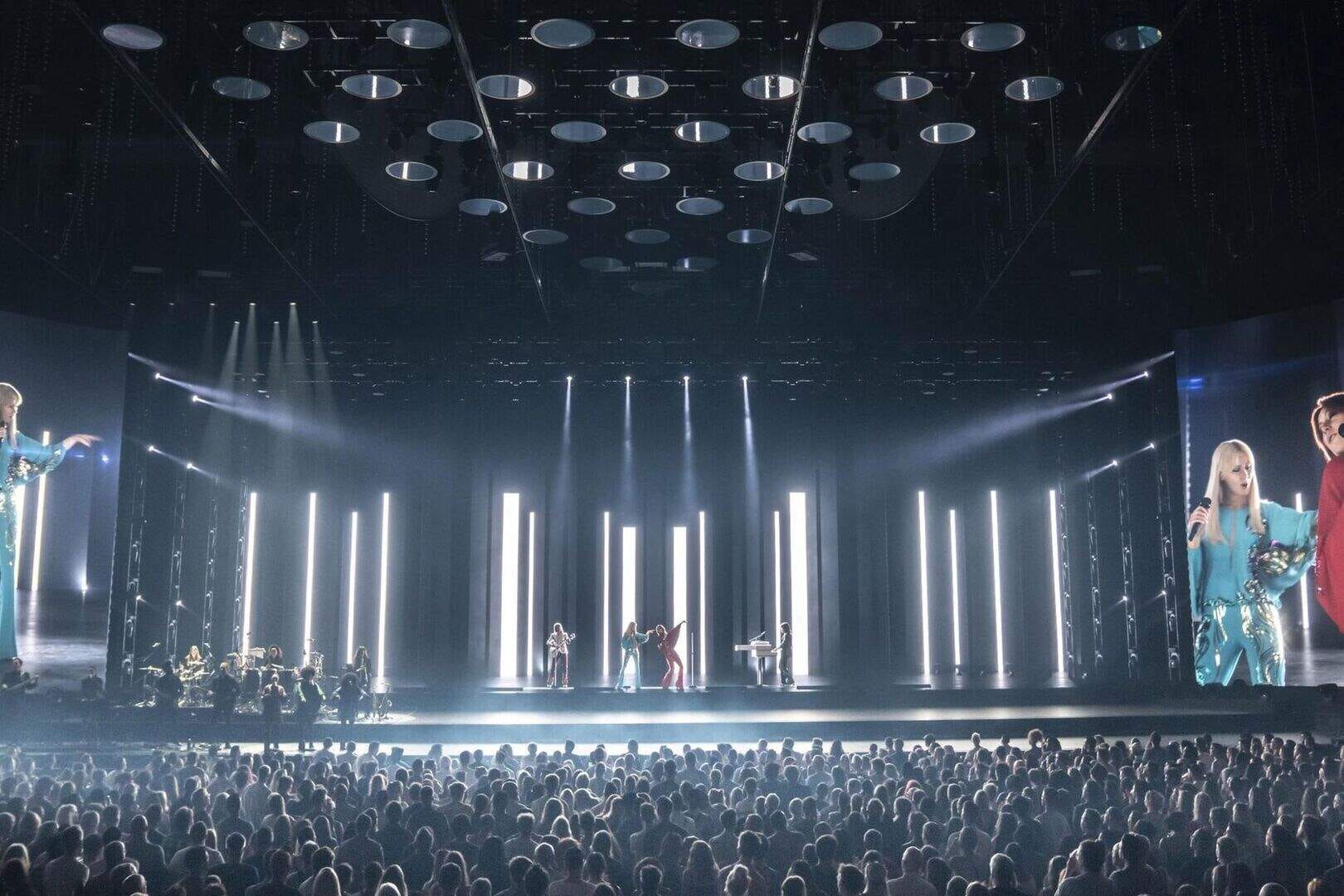
I suddenly wasn’t fifty-seven anymore.
I was back in that Cortina.
Back queuing up to see Grease and Star Wars.
Back with Bazooka Joe bubble gum and sherbet dib-dabs.
Back carrying that impossible little secret around inside me before I even properly understood what it was.
The emotional tug was enormous.
And then, as the hits started landing properly, one after another, I realised something else.
My God, ABBA had some corkingly good songs.
You know this, obviously. Everybody knows it. But there is a difference between knowing it intellectually and standing in a dark arena with thousands of people as those songs come roaring back into the room like somebody has opened a locked cupboard in the 1970s and all the light has fallen out.
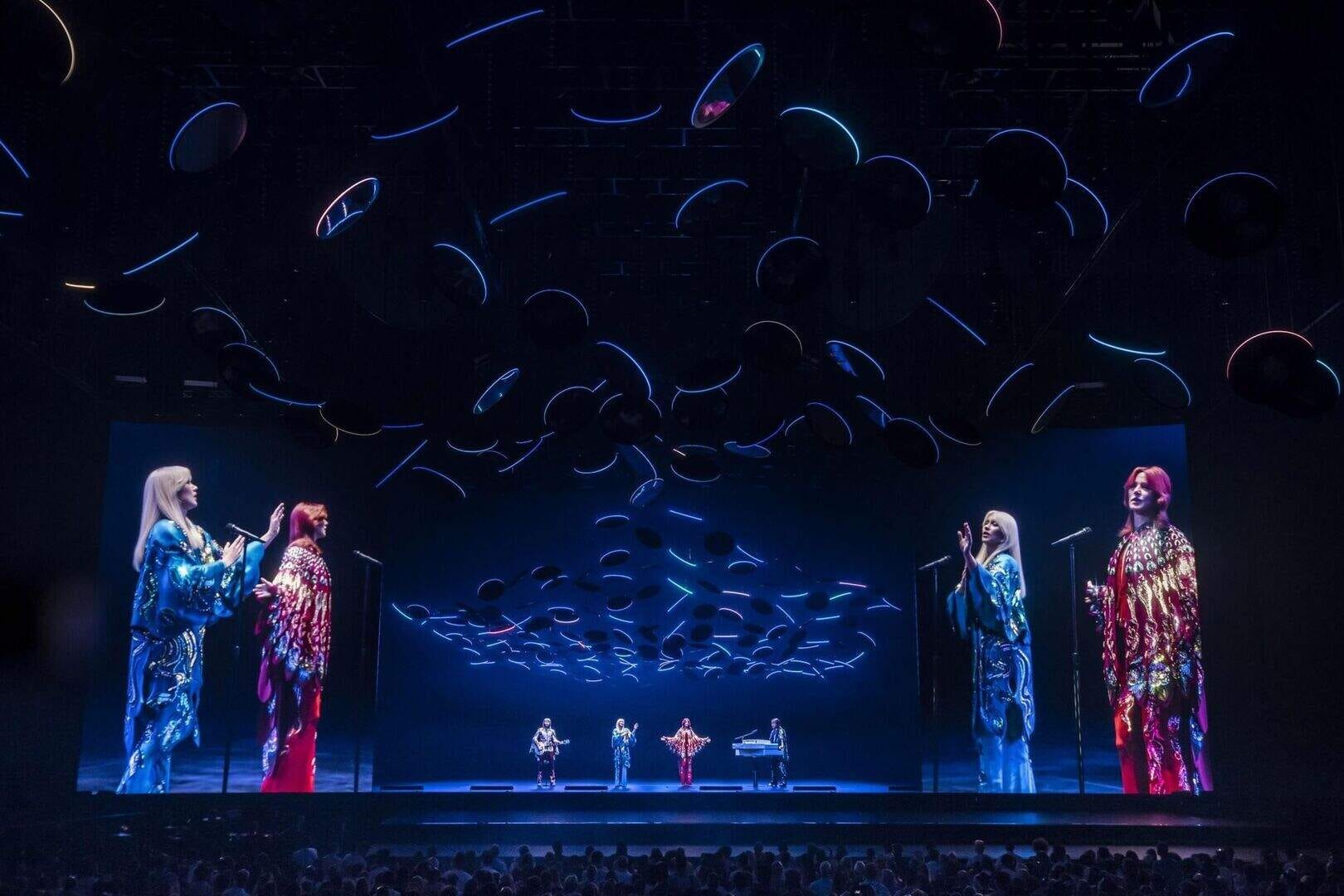
Looking around the arena was fascinating.
There were seventy-year-old women who knew every word.
Gay lads in sequins.
Younger people discovering ABBA properly for the first time.
Couples.
Nostalgic dads.
Women reliving entire summers.
People like me quietly having emotional breakdowns in platform boots.
And I kept thinking about all those women.
The ones who were now about 70 but where young when these songs were out.
I imagined them lying in back gardens in the 1970s, covered in whatever terrifying cooking oil people used before sunscreen became a moral obligation, listening to Voulez-Vous while waiting for the ice cream van to come down the road.
Probably the same way my mum did.
The same way half the country did.
And somehow, standing there, I knew every word.
Not nearly every word.
Every word.
They were all still in there.
The songs had just been sitting patiently in the sealed room of memory, waiting for somebody to turn the light back on.
Meanwhile, I was also discovering that dancing to ABBA in three-inch platform boots is significantly easier in your kitchen than in a dark arena.
Especially when your kitchen contains a permanently installed disco light.
Yes, I have one.
No, I regret nothing.
It’s my house.
I’ll do what I like.
At least fifteen times I nearly went over backwards.
There were moments during Dancing Queen where I resembled a newborn giraffe attempting nightclub choreography.
But I didn’t care.
Because somewhere in the middle of all of it, I had the strangest, loveliest realisation.
Once upon a time, I had watched those women and thought:
That will never be me.
And now, somehow, absurdly, ridiculously, late and patched together and technologically assisted and biologically improbable and wearing boots I could barely dance in, there I was.
Not seventeen.
Fifty-seven.
But still.
I was on the ABBA side of the room.
And that mattered.
Most people, I think, would leave ABBA Voyage saying:
“That was lovely.”
But not me.
Because after about an hour, once I had finished emotionally reuniting with my inner child and almost snapping both ankles during Dancing Queen, the other part of my brain began to wake up.
The annoying part.
The systems part.
The bit that cannot simply sit in a room full of theatrical wonder without trying to reverse-engineer the bloody thing.
So while one half of me was thinking, “This is beautiful,” the other half was thinking:
Where are the projectors?
Why can’t I see the beams?
Is this projection?
Is it some kind of gauze?
Is there an ultra-short-throw arrangement underneath?
How much of this is screen geometry?
How much is lighting?
How much is rendering?
How locked-in is the theatre architecture?
What can they upgrade?
What can’t they upgrade?
Which parts of the stack are easy to evolve, and which parts are buried so deep in the physical venue that changing them would be like doing open-heart surgery on a spaceship?
This is my curse.
Other people experience magic.
I immediately start modelling upgrade paths.
But that is when another thought occurred to me.
This is an early version of this technology.
Not emotionally, because emotionally it already works.
Technologically.
And if this is what an early version looks like, what on earth will this become in twenty or thirty years?
Because right now, ABBA Voyage still partly relies on us emotionally completing the illusion ourselves.
The heart comes from the audience.
The little boy inside me supplied half the electricity in that room.
But what happens when these systems become truly responsive?
What happens when digital performers are no longer replaying archived emotional states, but generating new ones?
What happens when a synthetic Thom Yorke can produce genuinely new Thom Yorke sadness?
What happens when a twenty-five-year-old Elvis can front a live band and emotionally devastate an arena in real time?
A lot of people will recoil from this idea.
They’ll call it grotesque.
Artificial.
A Frankenstein freak show.
But humans always react like that to new mediums.
And personally?
I lean in.
My life is already saturated with systems, AI, digital workflows and synthetic collaboration.
I probably don’t go twenty minutes without interacting with an AI now.
So I sat there after ABBA Voyage thinking not:
“Technology is replacing humanity.”
But:
“Humanity is inventing a new form of performance.”
Getting out of the arena was its own little cultural event.
I was desperate to get to Stratford for a very late lunch, but there was a huge queue for the DLR, with staff letting us through in batches, then holding everyone back in that very London way where public transport briefly becomes crowd choreography.
Then the train pulled in.
Down the steps came a river of West Ham fans.
Big men.
Loud men.
Drunk men.
Men in replica shirts stretched to the absolute limits of modern fabric technology.
I have always found replica football shirts faintly funny on men of a certain build. There is something wonderfully optimistic about dressing like you might be called onto the pitch at any moment when the only sprinting likely to happen is towards the burger van.

And moving in the opposite direction were all the ABBA people.
Sequins.
Feathers.
Silver boots.
Glittery faces.
Women of every age still glowing from the show.
Two tribes passing on the stairs.
And I realised, with genuine amusement, that twenty-five years ago I would probably have been on the West Ham side of that divide.
Now I was very firmly on the ABBA side.
That felt oddly important.
Anyway.
Having solved all future questions of synthetic artistic continuity, I then managed to nearly miss my flight home because I forgot I was flying from Gatwick rather than Stansted.
I had already boarded the Stansted Express before the horrifying realisation arrived.
Wrong airport.
Wrong side of London.
Completely wrong direction.
At this point I genuinely began laughing.
The entire day had become a farce written by a systems engineer with ADHD and emotional issues.
Thankfully London transport is held together by dark magic and approximately nine thousand railway lines.
So somehow, through a combination of panic, Citymapper and pure luck, I made it to Gatwick with enough time to spare.
And so the day ended exactly as it began:
with me slightly overwhelmed, mildly overdressed, technologically fascinated, emotionally compromised and somehow still standing.
Forty years late.
But we got there in the end.