



If you’ve read more than five of my Substacks, you will have seen Ferris Bueller’s Day Off mentioned at least once. I endlessly quote it.
I didn’t treat it like a film.
I treated it like Nietzsche.
Almost every scene felt like instruction in how to move through the world without being naïve.
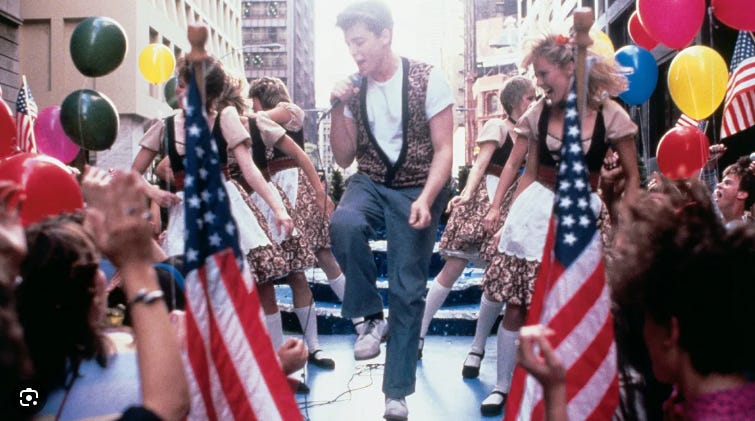
Ferris jumps on stage and sings Twist and Shout in front of a parade. He doesn’t wait to be invited. He takes the moment. If you hesitate, you lose.
The art gallery scene. Slow down. Know when to observe. Know when to appreciate. Not everything is a sprint.
Cameron falling for the first girl who pays him attention. Ferris telling him she won’t love him because you can’t love someone who kisses your arse. Self-respect is leverage.
And the Ferrari through the window. Most people see teenage recklessness. I saw something else.
It was Cameron realising his father’s approval wasn’t worth having. Be incredibly critical of whose approval you seek in life.
The man who keeps a beautiful sports car hidden in a garage and never drives it is not a man to worship.
Once that penny drops, the consequences don’t matter.
Let it fall.
It wasn’t rebellion for the sake of it.
It was understanding the game.
I force-fed that film to my children.
I would stand there with the remote in my hand, pausing scene after scene like I was delivering a TED Talk on Applied Ferris Bueller Studies.
“Now watch this bit. This is important.”
The poor souls just wanted to watch the bloody film.
I wanted them savvy. Not just book-smart. Street-smart.
I wanted them to understand game theory before they even knew what game theory was. To recognise power. To recognise bluff. To recognise when authority is hollow.
And I would say to them:
“Do you honestly think Ferris Bueller is going to do worse in life than Ed Rooney? Do you really think the bureaucrat wins?”
Ferris understands the board.
Rooney thinks the board is the rules.
Ferris plays.
Rooney enforces.
Ferris moves.
Rooney complains.
Ferris wins.
I believed that.
I believed that savvy wins.
Author’s note: I meant to mention Ferris Bueller briefly. Instead I appear to be writing a doctoral thesis on it. Stay with me. Sorry :)
There is one scene that has lived in my head for decades.
Ferris, Cameron and Sloane walk into a high-end Chicago restaurant with the calm, effortless cheek of teenagers who refuse to accept their assigned place in the world. Ferris scans the reservation list and selects a name: “Abe Froman.”
The maître d’ looks at him, sceptical, and says, “Abe Froman… the Sausage King of Chicago?”

Ferris does not blink. He does not retreat. He nods.
His friends whisper that he’s going to get busted.
Ferris turns to camera, breaks the fourth wall, and says:
“You can never go too far.”
Every time I watch that film and hear that line, I shout, “Yes, yes, yes, yes” and my eyes glaze over slightly.
That line has been my life
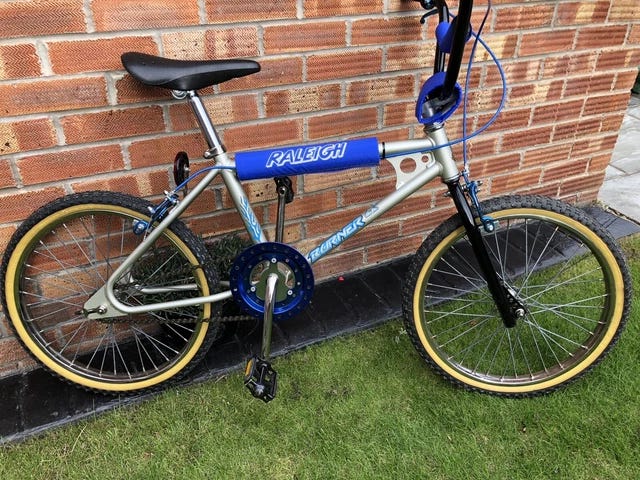
1983. A Silver Raleigh Burner GS.
My bike wasn’t some lightweight Mongoose with a chrome-moly frame. A few fancy bastards had those, the cream of the BMX crop in the 1980s.
Mine was a silver Raleigh Burner GS, heavy steel, which meant I had to pull so much harder to jump on it.
We built a low ramp outside. The aim wasn’t height. It was length. A pallet sat beyond the ramp, dragged further and further away with every successful jump.
I dragged it a metre further than anyone else.
Full run-up. Full send.
I went straight over the handlebars.
My shoulder dislocated.
My mum helped me get it back in. I sat in front of one of those three-bar electric fires with the fake coal glowing red from a bulb at the top. You were never allowed to put all three bars on. Two at most. One if “she” walked in the room. Today she let me have two! This was serious.
An hour passed.
Outside I could still hear the crate being jumped.
I went back out. Pulled the pallet back to where I’d set it. This bloody thing was not going to beat me. I told myself it had been a technical error on the landing. The handlebars were too low. That mattered.
Second attempt.
Full dislocation.
Hospital.
Fourteen shoulder dislocations followed over the next couple of years. Mostly from jumps just slightly too ambitious.
Eventually, at the very tender age of sixteen, I had to have a shoulder reconstruction.
July 13th, 1985.
“It’s twelve noon in London, seven a.m. in Philadelphia, and around the world, it’s time for Live Aid.” the BBC announce.
Around the world, it was Live Aid.
I remember July 13th, 1985 differently.
Just as Status Quo started hammering the opening riff, a nurse walked in and yanked the drain out of my shoulder.
It was excruciating.
Sixteen years old and a right shoulder full of metalwork for life.
All because I wouldn’t moderate.
“You can never go too far.”
1992. When I finally gave in.
By 1992, dance music was peaking and I had been resisting for years. I was already a rampant little crossdresser in private, containing something I could not name.
Then I gave in.
And when I gave in, I gave in properly.

Three days high on ecstasy, desperately turning myself into a girl in my Nottingham flat. Spinning it out as long as I could. Speed to keep it going. Cannabis at the end to cushion the crash.
I was as chemically fearless as Keith Richards, in a dress, trying to convince myself I was a woman.
And then the quiet horror of coming down and realising I was still a man when the chemicals drained away.
“You can never go too far.”
2010. One hundred pounds.
By then, I had crushed Stevie. Stone dead. My will, when I decide, is iron.
The price was awful.
I went from 150 pounds to 280.
I didn’t care about the male body. I hated it. I didn’t want to be it. So I let it rot.
That was my rebellion then.
If I had to be him, I wasn’t going to polish him.
You can go too far in self-destruction.
And then, just as ruthlessly, I went the other way.
Once I decided to lose it, I lost it.
One hundred pounds in eight months.
Not moderation. Not balance.
No carbs. No compromise.
“Go on, have a day off.”
Absolutely not.
“You can never go too far.”
2015. Forty five kilometres an hour.
One morning I was riding at around 45 kilometres an hour on a bike path, treating it like a velodrome.
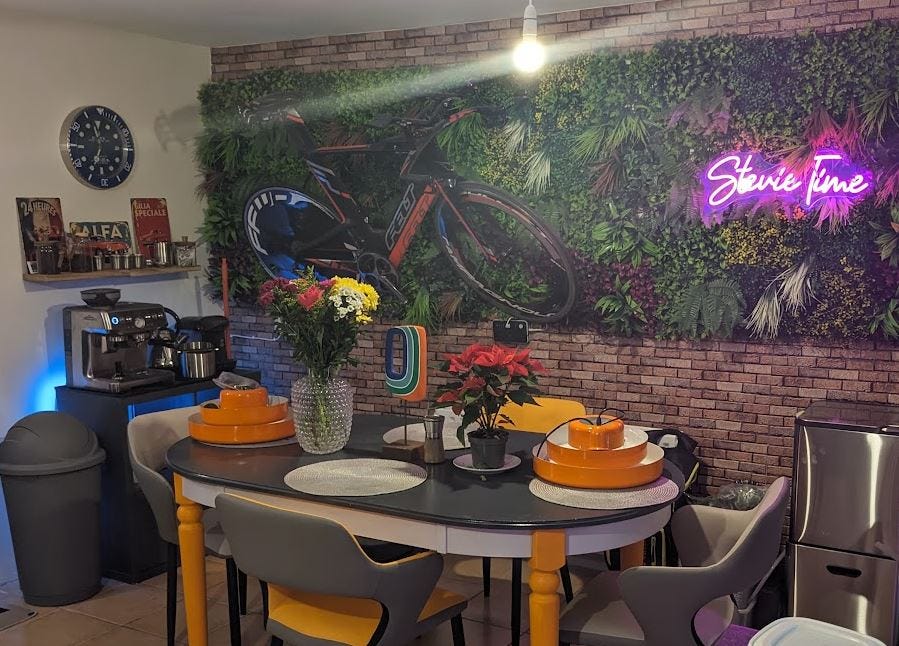
Full aero kit. Pointed helmet. Time trial bike. The kind with the extended bars sticking out the front, elbows locked in, body folded low and tight.
I wasn’t riding. I was racing.
Clipped in. Tucked deep. Eyes locked on the numbers on the bikes dashboard computer.
Numbers. Data. Power. Wattage. Time.
Nothing else existed. I had ridden this route every day for almost two years, so I knew it well, and I knew the light sequences.
Then a car jumped the red light at the crossing and ploughed straight into the side of me.
My wrist was smashed to pieces. There was a hole in my leg that needed a skin graft. Two surgeries, nine days in hospital. I could have been killed.
Doctors said I’d be off a bike for months.
Twenty-three days later I was back on it. Wrist in a lightweight carbon style brace I had managed to secure online, and my leg kind of strapped up.
Still on Tramadol, which I accidentally discovered is a performance-enhancing drug. I took the fourth fastest time of the year over Tower Bridge on Strava.
When I got to work, pus was leaking through my cycling shorts.
“You can never go too far.”
2017. Richmond Park, London.
I was chasing something called an FTP over 300 watts. To non-cyclists, that’s a benchmark. A line in the sand.
I’d never gone over it.
Today was the day.
Halfway up that deceptive rise in Richmond Park, one or two beats off maximum heart rate, something in me said:
Go harder. What happens if you do? Go much harder. Launch.
I ignored the pain.
Under that cardiac load, my blood pressure dropped. Cerebral perfusion fell.
The world narrowed.
Then it went black.
As my consciousness faded, I remember the handlebars starting to wobble involuntarily, twitching left and right as my body shut down. No control. No correction.
I veered off the side of the road and crashed.
My little finger dislocated so badly it took twelve hours before someone competent reduced it. Even now, no amount of elegant nail polish disguises the fact that it looks like it should be stirring a cauldron. It is so bent and deformed.
“You can never go too far.”
And then one day I did…
Years of relentless training. Twelve to twenty hours a week. 150 kilometre Sunday rides. Half marathon home from work. 40 kilometre bike every day. 3 kilometre swims.
Obsessed.
And then, one day, something changed.
I jogged a kilometre down to my local gym, jumped on a static bike, ready for action.
Within seconds my heart rate was at 150 beats per minute.
That wasn’t right.
At that rate I was hovering near my lactate threshold. That’s where you can survive for an hour. Maybe two. Not indefinitely.
I assumed the chest strap was wrong.
I jumped off the bike and onto a treadmill, put my hands on the metal sensors.
One hundred and sixty.
I wasn’t sprinting.
I was barely moving.
Something was very wrong.
The gym was about two hundred metres from King’s College Hospital. I shuffled there like an old man.
They wired me up to monitors that beeped endlessly.
Persistent atrial fibrillation, they said.
My heart wasn’t beating in rhythm. It was quivering. Firing chaotically. Efficient output gone.
They tried to shock it back into rhythm.
It didn’t work.
I went from the fittest man in the room to barely being able to cross a road.
I remember having to meet a former Goldman Sachs banker in a café in Notting Hill about a week later about developing his start-up a wealth management platform.
I arrived fifteen minutes early and shuffled in, breathless. When he walked through the door, I stood up and became Ironman again for 20 seconds.
He may even have mentioned it. I probably had an Ironman finisher’s bag with me. I smiled.
He left first. I waited five minutes before shuffling out so he wouldn’t see that I could only walk at about one mile an hour and had to stop every twenty seconds.
I looked like an old man.
It was awful.
Mind you I still got the project. I still built the system.
But I was very ill.
The hill beside the hospital treating me was one I used to race on Strava. I held the third fastest time ever recorded up it.
One Sunday morning I got up at 4 a.m. so I could be on that hill at 5, when there would be no traffic. I knew the light sequence. I knew I would get clean greens all the way through.
I launched up it like an absolute psychopath and took third.
Now I could barely walk forty metres of it, from the cardiology department to the bus stop.
They tried to shock my heart back into rhythm. It failed.
I needed a catheter ablation.
An operation where they thread wires up through a vein into your heart and burn or freeze the misfiring cells, scarring them so the electrical chaos stops and the rhythm can reset.
Surgeons now talk about “Ironman heart.” Middle-aged men who thought you could never go too far.
Well, I did.
And it frightened me.
After that, I was never the same cyclist again. Like a footballer after a cruciate injury, I never quite went to the line the same way. I knew the line could bite back.
That lesson stayed with me.
Seven months. Twenty-two procedures.

When I transitioned, I applied the same intensity.
Seven months. Twenty-two surgical procedures.
My sister messaged me when I told her the stats:
“That’s very on brand for you.”
She’s right.
I wanted the in-between phase as short as possible. I was fifty-something. If I was doing this, I was doing it properly.
Push. Push. Push.
But this time there was a difference.
I had already learned what going too far feels like.
So when the surgeries were done, I stopped.
I plan no procedures for at least a year. Just healing.
Because years of training had taught me something I once ignored:
Training doesn’t make you stronger.
Recovery does.
The stimulus creates the change. The rest allows it to become you.
It’s the same with surgery.
The operating theatre alters the structure. Kindness, patience and rest allow the result to settle into its best form.
Hormones did not turn me to jelly.
Wisdom did.
I still have that Ferris Bueller engine in me. The poster sits framed on my office wall, next to my other favourite rogues: Jordan Belfort and Frank Abagnale.
The part that wants to test the edges never disappeared.
It just knows now that edges are real.
I used to believe you could never go too far.
Now I believe you can.
And if you’re lucky, you survive it long enough to learn where to stop.
Stevie’s little outro.
I began with a clean title: You Can Never Go Too Far.
However, reading it back now, I appear to have delivered a theological critique of Ferris Bueller, interspersed with repeated attempts to maim myself on bicycles.
Maybe I should have called it “Ferris Bueller and assorted bike crashes”.
Well, you aren’t the only one!
I’m also a Ferris fan, have been absolutely driven, and have managed to workout my way to an atrial fibrillation diagnosis. It’s under control so far. Oh, and I did my transition marathon as well, many years ago.
I suspect there is an unusually high proportion of rather driven overachievers within our small slice of the population.