


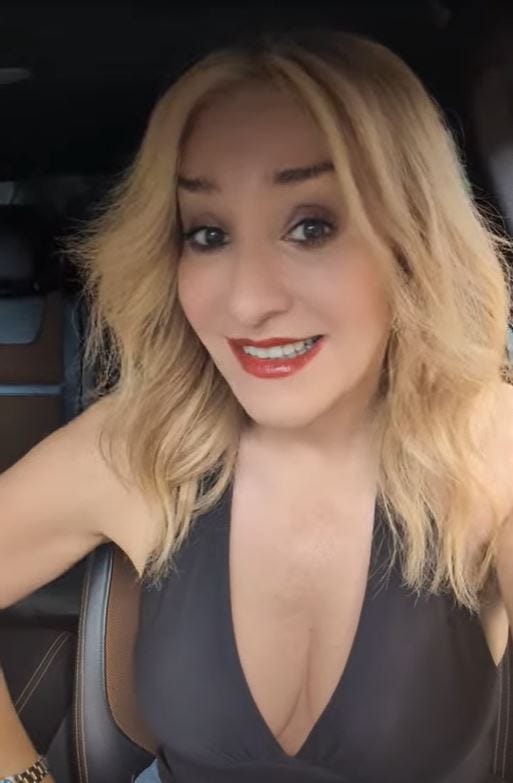
Most people who encounter me now probably think I am a fairly confident, capable and presumably quite popular human being.
Professionally, online, through Fast Track Fem, and through the various strange corners of my life I seem to have accumulated, that is probably the version of me people see.
Hell, last weekend I ended up on stage in Wild nightclub doing a Katy Perry impersonation with the drag queens.
They did ask who wanted to do it.
“Me,” I said, obviously.
But I have also made no secret whatsoever of the fact that after I transitioned, almost everybody from my previous life wanted absolutely nothing to do with me.
And I mean almost everybody.
My marriage ended. My children wanted little or nothing to do with me. Friends disappeared. Family disappeared. At one point I was left with about two people, and one of them was my mother.
That is quite an extraordinary thing to happen to a human being.
And I have spent an enormous amount of time trying to understand why.
There is, of course, an obvious explanation available: transphobia.
And with some people, I am sure that is part of it. There are people who have a visceral dislike of the whole idea of somebody being transgender.
Oddly, I am not particularly exercised by that.
I don’t think everybody has to agree with the concept. I don’t think everybody has to believe that I am a woman. They can think whatever they like. I have said that many times before.
But I don’t think transphobia explains most of what happened to me.
Because I suspect many of the same people who wanted nothing to do with me would be perfectly pleasant to a transgender colleague. They might work with her. Befriend her. Go for a drink with her. They might even consider themselves completely accepting.
With me, it was different.
And I have thought about that difference over and over again.
Why?
Why did so many people who had loved me, liked me, lived with me, grown up with me or known me for decades turn away so completely?
I think, eventually, I arrived at the answer.
One word.
Choice.
They believe I made one.
And the uncomfortable thing is this:
I think they’re right.
That is the case against me.
I had a wife. I had children. I had a family. I had friends. I had a house, a career and a life which, from the outside, looked not merely functional but pretty successful.
Then I transitioned.
And the consequences were catastrophic.
I wasn’t an idiot. I understood perfectly well that I was pulling a pin from something extraordinarily complicated.
I knew my marriage might not survive. I knew my children might struggle with it. I knew my family might react badly. I knew friendships could disappear.
I didn’t wake up one Tuesday morning, put on some lipstick and think, Christ, I wonder what will happen now.
I knew there was risk.
And there is therefore a version of events which is simple, coherent and, on the face of it, pretty damning.
Stevie chose herself.
She had responsibilities to other people, particularly her children, and she chose what she wanted instead.
I know that argument very well because I have made it against myself approximately four million times.
I also know that quite a few people from my old life read what I write.
They would never dream of telling me, obviously.
They would apparently rather gnaw through their own forearm.
But they do.
I’m not stupid.
So I don’t particularly want to construct a comforting little courtroom in which I appoint myself judge, jury and glamorous middle-aged defendant, dismiss all charges, congratulate myself on my bravery and then go for lunch.
I think the prosecution has a case.
I made a choice.
And that is precisely why I have such difficulty with one of the standard stories we tell about transition.
“I had no choice.”
We have all heard versions of it.
I was a woman trapped in a man’s body.
I had gender dysphoria.
I had to transition.
There was no alternative.
And I understand why that story exists. It does a tremendous amount of moral heavy lifting.
If I genuinely had no choice, then there isn’t really much left to discuss.
Nobody has to ask what I owed my wife.
Nobody has to ask what I owed my children.
Nobody has to ask whether I was entitled to cause enormous pain to other people in order to stop living in a way that caused enormous pain to me.
If there was no choice, there was no decision.
Something happened to me.
I responded.
End of story.
But I don’t think that is true of me.
I did have another choice.
I could have carried on.
In fact, I have unusually good evidence that this was possible because I had already done it for decades.
I had wanted to be female for as long as I can remember.
I had spent an enormous part of my life negotiating with that fact, suppressing it, indulging it privately, becoming frightened by it, putting it back in its box and then discovering several years later that the bloody thing had escaped again.
But I functioned.
More than functioned, really.
I made money. I built a career. I got married. I became a father. I wrote software. I paid bills. I went to school events. I did children’s birthdays and family holidays and all the other things society generally uses as evidence that somebody is getting on perfectly well with being alive.
I wasn’t going to drop dead if I didn’t transition.
That matters to me because I don’t want to retrospectively turn my life into a medical emergency simply because doing so would make the story morally cleaner.
And I have never been particularly fond of the way the phrase “gender dysphoria” is sometimes used as though it explains everything.
It is a useful clinical term. I understand what it means.
But sometimes it feels less like an explanation and more like a full stop.
Why did you transition?
Gender dysphoria.
Ah. Very good. Case closed.
Except what did that actually mean?
For me, it meant that I wanted, with extraordinary persistence, to be a woman.
I wanted my body to be female.
I wanted to move through the world as a woman.
I wanted other people to see me that way.
And I wanted it badly enough that the desire survived decades of negotiation, denial, distraction, work, marriage, children, money and every other thing I threw at it.
You can call that dysphoria if you like.
But giving something a clinical name doesn’t magically remove the question of choice.
Which brings me, somewhat unexpectedly, to Torremolinos.
Buying a flat in Torremolinos is a choice.
Walking out of a burning building is also a choice.
Technically, you can remain in the burning building.
Nobody has removed your free will. You can sit on the sofa while the curtains catch fire and maintain a principled commitment to staying exactly where you are.
But nobody would describe those two decisions as belonging to the same category.
Nobody says, “Well, she chose to leave the burning building, didn’t she? She could have stayed.”
The interesting choices in life are usually somewhere between Torremolinos and the burning building.
Most of life happens there.
Someone leaves a miserable marriage. They could have stayed.
Someone walks away from a career that is destroying them. They could have carried on.
Someone comes out.
Someone leaves the religion they were raised in.
Someone emigrates.
Someone decides not to spend another twenty years living according to expectations which make everybody around them comfortable.
There is nearly always another available option.
The important question is what that option costs.
And I think this is where the word “choice” becomes dangerously slippery.
Because we often judge somebody’s decision by looking only at the thing they chose.
We don’t look closely enough at the thing they rejected.
I could have remained Stephen.
That sentence is true.
I had the necessary clothes.
I had the passport.
I had an established social identity and decades of experience performing the role.
I was actually rather good at it.
What I don’t know is what another twenty or thirty years of doing it would have cost me.
And that is where the neat moral arithmetic starts to fall apart.
Because now there are two sets of suffering.
Mine and theirs.
If transition made my life more bearable but made the lives of people I loved less bearable, how exactly are we supposed to calculate that?
Do I get priority because it is my life?
Do my children get priority because I brought them into the world and therefore accepted obligations which should outrank my desire for personal fulfilment?
Does my wife get priority because she married one person and was entitled to expect some basic continuity in the bargain?
How unhappy was I required to become before I had permission to change things?
How much of yourself are you morally required to sacrifice for the people you love?
There is an extremely seductive answer to that last question.
Everything.
Parents sacrifice for children.
Partners sacrifice for one another.
Families work because people constantly suppress what they would individually prefer for the benefit of the whole.
Civilisation would collapse fairly rapidly if everybody woke up tomorrow morning and announced that they were going to live their authentic truth regardless of who had to pick up the pieces.
I believe in responsibility.
Which is inconvenient, because responsibility is a much easier principle to hold when it is somebody else who has to make the sacrifice.
But there has to be a limit.
There has to be some point at which a life belongs, at least partly, to the person living it.
Otherwise we arrive at a fairly grotesque principle.
Once enough people depend upon a particular version of you, you acquire a moral duty to remain that person indefinitely.
Even if maintaining it requires you constantly to suppress something fundamental about yourself.
Even if the person everyone wants you to remain is becoming increasingly difficult for you to inhabit.
Even if everybody else gets the version of your life they want because you have agreed not to have yours.
That doesn’t make leaving painless.
It doesn’t make the damage unreal.
And it certainly doesn’t mean the people who were hurt are required to applaud.
This is perhaps what frustrates me about both of the simple stories we tell about transition.
One removes choice altogether.
No choice. No responsibility. Nothing to discuss.
The other treats it as completely ordinary choice.
You wanted something. You chose it. Your family paid the price.
I don’t believe either describes what happened.
I chose.
But a choice can be real without the alternatives being equal.
A choice can be technically available while carrying a cost that nobody else can see.
And acknowledging that I made a decision doesn’t require me to pretend that remaining exactly as I was would have been a neutral option with no consequences of its own.
Perhaps that is the thing I wish some people from my old life understood.
Not that they were wrong to be hurt.
Not even necessarily that they were wrong to be angry.
Just that the choice they think I made may not be the choice I experienced.
From their side, there were two doors.
Behind one was the existing family, the existing marriage, the existing person.
Behind the other was transition.
And I walked through the second one.
From their side, I can understand how brutal that looks.
What they could not see was what was written on the first door.
And perhaps neither could I, fully.
I once came across an idea that has stayed with me ever since.
At the end of your life, there are only two people you really need to please.
You at eight.
And you at eighty.
It sounds like the sort of sentence somebody sticks over a photograph of a mountain on Instagram, which should immediately make me hate it.
Unfortunately, I don’t.
I think about it all the time.
The eight-year-old version of you, before the compromises, the bills, the sensible decisions and the careful construction of an adult life.
And the eighty-year-old version, looking backwards, when there is very little time left for bullshit.
I think I can face those two people.
The little boy I was would be astonished by me.
Not just because I eventually became the woman he so desperately wanted to be.
He would recognise everything else too.
The endless love of cycling. The obsession with computers. The need to build things, fiddle with things and make things work. He built dens, go-karts and ridiculous contraptions with CB radios attached to them. Then computers arrived, I started coding, and in many ways I never really stopped doing the same thing.
I did not destroy the person I was.
I became even more the person I was.
I think he would recognise that immediately.
The wanting. The making. The tinkering. The curiosity. The refusal to leave things alone when they could be rebuilt into something better.
I carried all of it with me.
I saw it through.
And the eighty-year-old woman?
I hope I get to meet her.
I don’t think she will let me pretend nobody was hurt.
I don’t think she will let me rewrite the past into a comforting story in which I had no agency and therefore no responsibility.
I think she will see the wreckage as well as the victories.
But I hope she will think I was brave.
I hope she will think that eventually, after an absurd amount of hesitation, I accepted that this was also my life.
Maybe that is selfish.
Maybe, at some level, every serious act of self-preservation is.
But I no longer think the opposite of selfishness is necessarily goodness.
Sometimes it is simply disappearance.
So yes.
I had a choice.
I think that is what makes the decision morally interesting.
And I think I made the right one.
And as I have already said, there will be people from my old life who read this.
I would bet my bottom dollar that at least one of them will get to the end and say:
“Yes, but you still had a bloody choice.”
To which I would answer:
You didn’t read the bloody essay.
Wow, this was an incredible..and tortuous read. I’m right where you were. At the threshold in front of the 2 doors. Preparing to make a choice. Trying to determine if I can live with the consequences of either. In my case, there’s a 3rd door. I’ve had my hand on the doorknob several times, and managed to avoid opening it. Ugg. Thanks for the wonderfully accurate description of my situation. Best of luck to you too.
Stevie, what you captured here is important for the people who think it is a black and white decision. As the wife of a transitioning partner, I did feel an initial sense of “I did not sign up for this, you are abandoning the social contract we had as a husband and wife.” But the more I understand what she had to suppress in order to play a role that she was not comfortable with, the more I realize that the choice was the less painful one. It initially did seem selfish, but now I understand the pain she endured in trying to be someone she was not. She never intended to deceive me, and she did not want to hurt me, but she did need to please 8 and 80 year old versions of herself. It took the untimely death of a close friend of hers to make her realize that if she did not transition, she would essentially die unhappy, having never lived the life she wanted. As I get more familiar with her past, this is easier for me to accept. That does not mean I still do not grieve the husband that I lost, the male body that I found attractive. But I recognize that she could not longer live in that body. We are trying to stay together, we are best friends, and we will endure. it is not easy, and sure, she did make a choice, but she also made a choice to ignore it when she met me, to marry me knowing who she was, to hide it for 18 years. And that must not have been an easy choice either.