



Today was the day of my colonoscopy.
There is nothing glamorous about a colonoscopy. It involves a three-day diet of beige and, on the final day, nothing but water and a pharmaceutical declaration of war on your intestines. Think Renton in the toilet scene in Trainspotting. By the time I arrived at the Bons Hospital in Cork I was tired, dehydrated, and dealing with a trapped nerve in my back that was so painful, I was so close to calling this whole thing off. This was not a good day.
The first thing they handed me was a form.
Name. Date of birth. Emergency contact.
And then, at the bottom, a question I hadn’t anticipated.
Who will be responsible for you for the next 24 hours?
I looked at it, then looked up at the nurse and said, “Nobody.”
She paused. “You’ll need to name someone.”
“I can’t,” I said. “I don’t have anyone here.”
There was another pause. Then she explained, gently but firmly, that without someone to take responsibility for me, they wouldn’t be able to sedate me. Hospital policy. Safety rules. Non-negotiable.
I thought about this for a moment and said, quite calmly, “That’s fine. I’ll do it fully conscious, no sedation.”
She looked startled. “Are you sure?”
“Yes,” I said. “I’m fine with that.”
I’ve endured countless medical procedures over the years, including seventeen hours of facial surgery. I know what pain feels like, and I know how to sit with it. I said I’d manage perfectly well, so long as they could give me some IV paracetamol for the trapped nerve in my back.
The nurse said she’d need to run it past the consultant. She left, then came back a few minutes later.
“He’s looked at your notes,” she said. “He said this poor lady’s been through enough surgery lately. We’ll sedate you and keep you in overnight.”
And so the colonoscopy went ahead, in the usual way these things do: lie on your side, try not to think too much, and surrender what little dignity you have left.
Later, as I was being settled into a room for the night, the nurse asked me again, carefully, why I hadn’t been able to name anyone in the first place.
She tried, kindly, to problem-solve it with me. Employers. Neighbours. Anyone at all.
I explained that I work remotely for a UK company, that I’d only recently moved, that I didn’t really know anyone yet.
There was a pause.
And then I answered without rehearsing it. The words surprised me as they came out.
“Because everybody hates me.”
She looked at me properly then. Not clinically, not professionally, but as a person. There was a brief pause, and I could see that she wasn’t the only one taken aback. Another nurse had drifted over by now, and both of them seemed momentarily stunned by the mismatch between what I’d just said and the person they’d spent the day chatting with.
“Why?” she said quietly. “You seem lovely.”
There was real emotion in her eyes. Not politeness. Not protocol. Something closer to sorrow. As if the statement simply didn’t make sense of the person standing in front of her.
I explained, briefly. I transitioned. That was it. No speech. No defence.
She said nothing for a moment, and in that silence it was obvious that whatever picture she had in her head of someone who would be universally hated, it didn’t look anything like me.
After that, something shifted.
People were kind to me. Not ostentatiously. Not performatively. Just kind. Nurses lingered a second longer. Conversations softened. There was a sense of quiet confusion, of people trying to reconcile what they were seeing with what they had been told must be true.
I noticed it without making anything of it. I’m careful not to frame myself as a victim here. I made choices. Choices have consequences. That part is not in dispute.
But that brief human collision stayed with me. Because for a moment, outside whatever story had formed elsewhere, someone met me where I actually am. And from her face alone, it was clear that the idea of universal hatred did not arrive as something obvious or deserved, but as something profoundly sad.
Sitting there afterwards, with nothing but time, I found myself doing what I always do. I started to build a framework in my head. Not a feeling, not a mood, but a whole psychological and architectural explanation for why something like this happens. Why “everybody hates Stevie”. How reactions propagate, harden, and then start reinforcing themselves. How individual responses stop being individual at all, and instead become part of a system that seems to move on its own.
I should probably admit something here. This is how my brain works. I reduce things to systems, boundaries, feedback loops. I usually keep that to myself, because saying it out loud makes me sound like I’m trying to turn human pain into a flowchart, which isn’t what this is. It’s just the way I make sense of things.
My “Grand” Hypothesis
The thing that matters most is not the act itself, but how it is framed by the person whose reaction carries the greatest emotional and social weight.
Very often that is a partner. Sometimes it’s a parent, a sibling, a family elder, or another figure whose opinion anchors the group. Whoever it is, their response does something crucial. It doesn’t just express pain or anger. It sets the range of acceptable interpretations for everyone else.
If that person says, “This is shocking and painful, but it is a human thing, and I will try to find a way to live with it,” then that message propagates. Not universal acceptance, necessarily, but a bounded, survivable moral space.
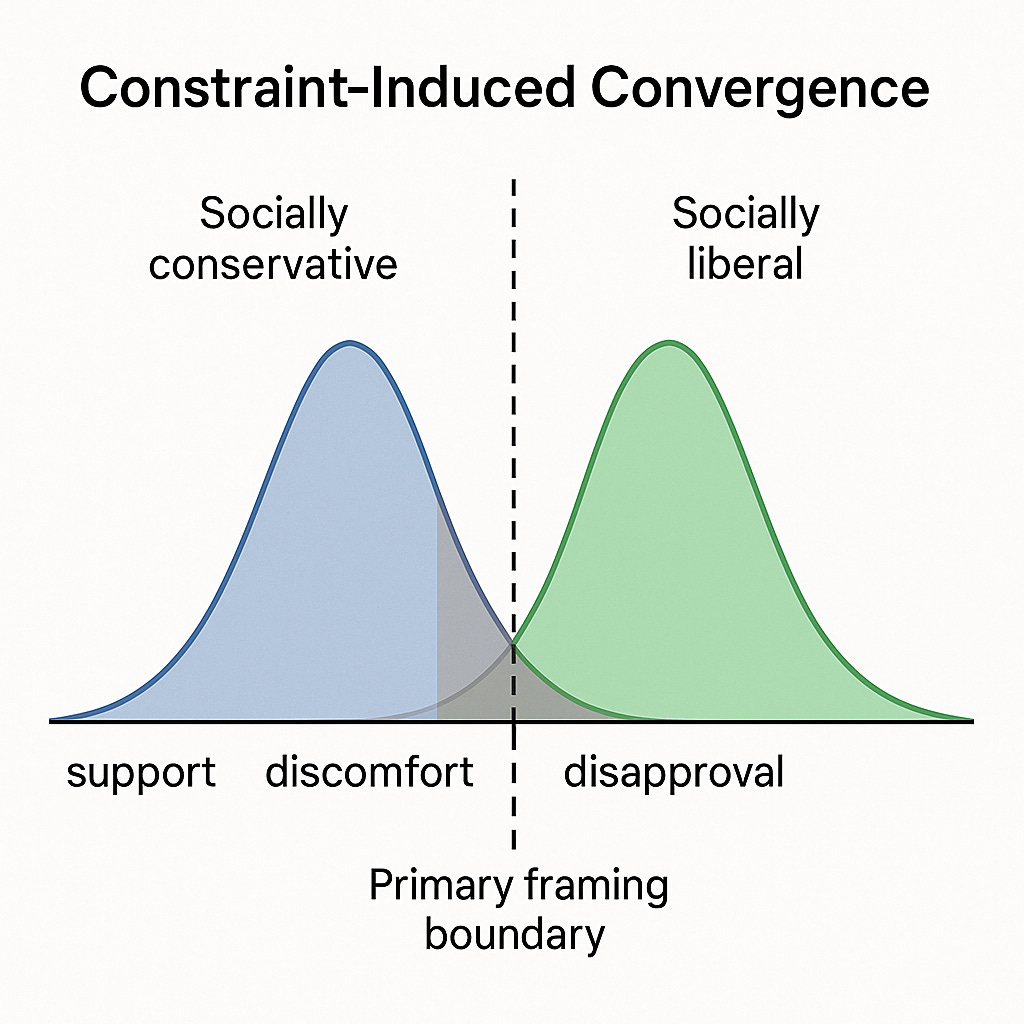
But if the framing is, “This is monstrous, unforgivable, and has destroyed everything,” then that becomes the ceiling. No one else is permitted to be more understanding than the person most visibly hurt. Anything softer would imply that their suffering is exaggerated, or illegitimate.
What spreads is not hatred itself, but permission.
People downstream do not ask, “What do I think about this?” They ask, often without realising it, “What am I allowed to think without invalidating the person who matters most?”
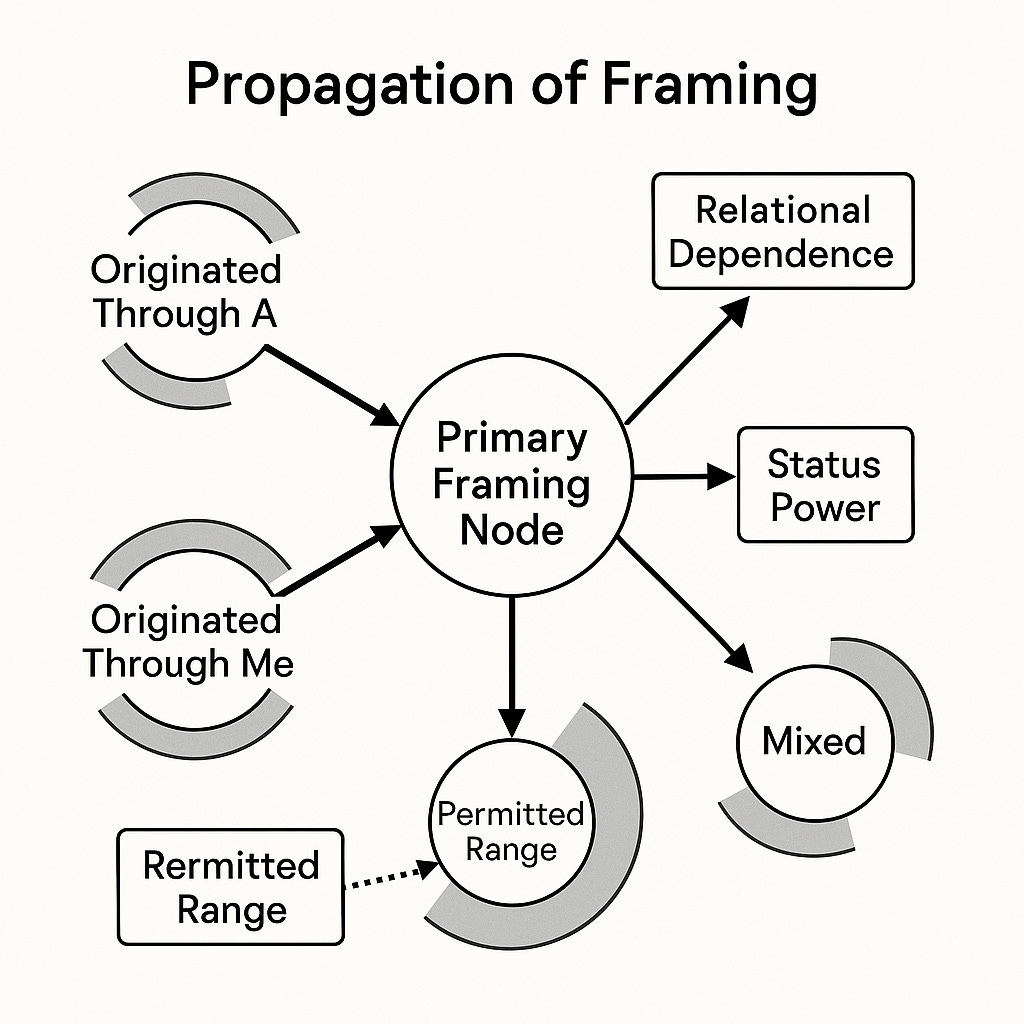
Relationship proximity matters. If your connection to the situation comes primarily through the injured party, your latitude shrinks. If it comes through their family, it shrinks further. If powerful or high-status figures in that circle express revulsion more strongly still, others escalate to match them, not out of cruelty, but out of self-preservation.
None of this requires calculation. From the inside, it feels like sincerity. Like obviousness. Like moral clarity.
Once that framing is in place, it becomes self-reinforcing. Each additional expression of certainty becomes evidence that the original act must be as bad as claimed.
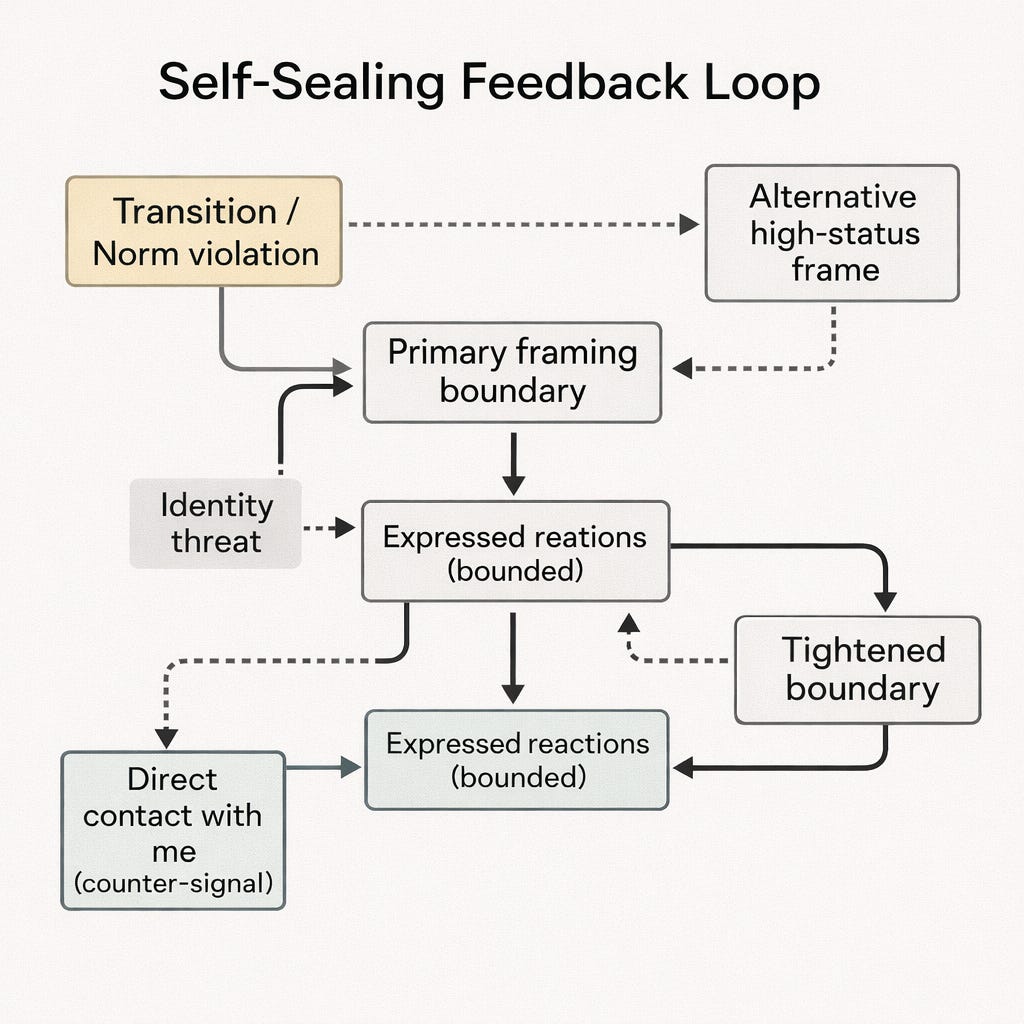
“It must be terrible,” the group tells itself, “because look how strongly everyone feels.”
At that point the loop closes.
Nuance becomes betrayal. Silence becomes suspicious. Calm becomes smug. Any attempt to explain oneself is taken as further proof. The reaction no longer depends on the act itself. It sustains itself through alignment.
Once you see this, a simple rule emerges.
If the people closest to you do not respond with revulsion, the wider circle usually doesn’t either.
If the inner circle hardens, the outer circle follows.
Almost always.
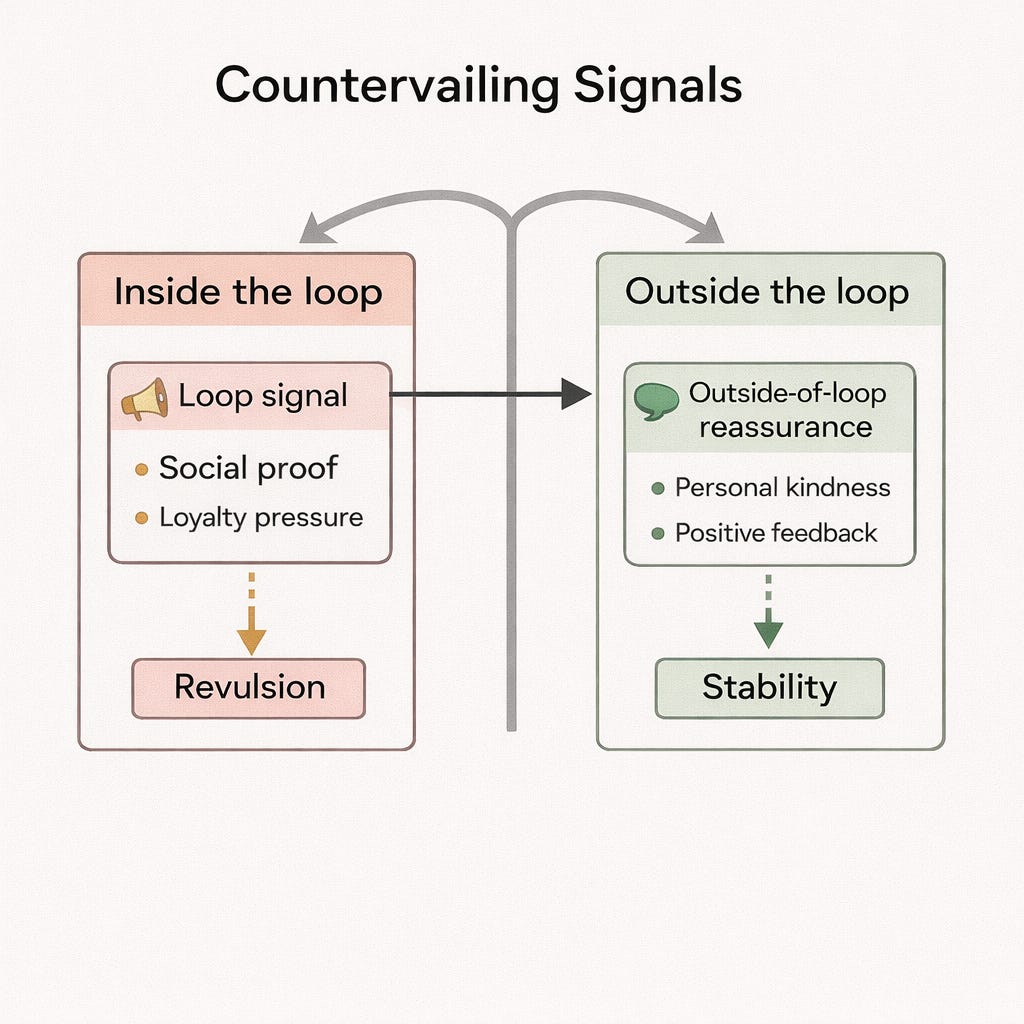
The nurse could see the mismatch instantly because she was outside the loop. She had no stake in it. No loyalty she needed to signal. No status to preserve. All she could see was the gap between the story and the person standing in front of her.
That gap doesn’t break the spell in some dramatic, once-and-for-all way. But it does something quieter, and more important.
That gap is what keeps me going.
Because again and again, from people who are not inside the loop, I hear the same things. That I’m nice. That I’m kind. That I’m good at my job. That I’m funny. That I’m decent company. Those small, uncoordinated reassurances loosen the grip of the feedback loop. They remind me that it isn’t total, and it isn’t universal.
I don’t need everyone to believe those things. I just need enough evidence that the loop is not reality itself.
Finally…
Right, I think they’re finally about to let me out of here. If I’m honest, I suspect they may be quietly relieved to see the back of the mad trans woman who’s been pacing up and down the hospital corridor, talking into her phone like a dictaphone and writing long essays instead of resting.
Several people stopped to ask if I was OK.
“Yes,” I kept saying. “Yes, honestly. I’m absolutely fine.”
Before I go, I should probably add one final thing. I do this kind of modelling a lot. Not just about this, but about people, reactions, systems, power, and behaviour more generally. I don’t often talk about it because it can sound, at first glance, like a slightly unhinged way to think about human pain. As if I’m trying to turn lived experience into diagrams.
But this is just how my brain works. It’s kind of autopilot mode for me to think like this.
Finally… Finally…
I’ve also noticed that my hair has started to turn yellow and I’ve only very recently discovered something called toner, who new. So my immediate mission now is to get to Boots before I start looking like someone who’s been stored too close to a nicotine patch.
Hopefully this tramadol inspired waffle makes some sense to somebody.
Very relatable article Stevie - i often think about this - i believe everyone connected to my ex hates me. Its certainly not my family friends or colleagues although we can never be sure what anyone really believes or thinks. Although Hate is a loaded word and is probably heightened by our own insecurity and anxiety. In reality ´ghosting’ or middle class syndrome of´ignore reject deny’ is more common which in my case causes me to think this is hateful. Its possible these people don’t hate - they prefer avoidance and what you don’t see you can forget about. Its unpleasant but then having lived a life of relative privilege its not the worst thing in life to suffer.
Thank you for your thoughtful reply. I agree with you that “hate” is a strong word. When I used it, I was aware it was a journalistic term, but I also used it because I had said that word to the nurse at the time and wanted to remain faithful to that moment. Still, I recognise that the reality is more nuanced.
What I experience feels less like simple hatred and more like an amplification of whatever the underlying driver already is. For some family members, that driver seems to be a pre-existing dislike of trans people. For others, it appears rooted in concern, whether genuine or projected, about the future wellbeing of my wife and children, financially or otherwise.
So yes, it’s more complex than a single word can capture in a short article. That said, in terms of both velocity and intensity, the reaction does seem to correlate strongly, in my case, with the position taken by my almost ex-wife.
Oh, and on a lighter note, I had a look at your profile. You look great. Genuinely.