

Shame.
It's a big, big word in our world. It's the backdrop that most of us live with, at least if you're my age. If you're 22 and started hormones at fifteen, this may not land the same way. For most of us my age, it does. I didn't start young. Nor did most of us.
I grew up in a tough, northern, working-class town in Britain. I was brought up in a one-parent family on benefits, and at one point the town had the highest unemployment rate in the UK. This was not the kind of place where you came skipping up the road in your mum's tights and stilettos.
Oh dear God, no, no, no.
You learned fairly quickly what you were allowed to be. And what you absolutely were not.
And so there was shame.
I want to be honest with you as I start writing this. I've had it in my head for a long time that I wanted to write an article called Shame, but I've never been entirely sure what the article actually was. Normally when I write something, I have at least a vague idea where I'm going. With this one, there isn't. So I'm going to try to work it out while I write it.
When I started my transition, I had three rules.
Actually, that isn't quite true. This was before I knew I was starting a transition. It was when I knew something had broken. The dam had gone. I could sense it falling away after twenty years, and I wrote down three rules.
The first was no shame.
That one mattered enormously, because shame had done some hideous things to me before. Hideous things.
There was so much self-hatred in my twenties.
Between about twenty and twenty-seven, I wanted desperately to be a girl. I don't say that lightly. I wanted it so badly that I tried to mutilate myself, to remove the thing I thought was standing in the way.
I couldn't bear the pain of it, so I went looking for ways to hide from it. Three-day benders on ecstasy and speed. The idea was simple: get high enough and, for a while, I might forget I was a man.
Then I would come round, and the shame was enormous.
This was never fetishistic for me. I wanted to be girly. That was it. And the pattern went on for years.
Eventually I quit Stevie. But I quit her out of shame. I was so ashamed of what I'd been, and so upset with the whole thing, that I piled on weight. I went from about 150 pounds to 300.
I've never written that number down before. I always say 280. That's a lie. It was 300.
Then, slowly, somewhere between thirty-four and thirty-six, I started to come out of it. It was endurance sport that really saved me. I'm not going to rewrite my own history to make this article work, but by about 2006 or 2007 I don't think I felt very much shame about it anymore. That roughly coincided with meeting someone and getting married. And, to be honest, I think I made a good enough job of being a husband that in some strange way I forgave myself for what had happened before.
By thirty-five or thirty-six, I was pretty much convinced I was cured. That was genuinely how I thought about it.
Cured.
There were leakages. Not just the sort where I could excuse myself for looking at transgender Reddit groups late at night. There were stranger ones. I would occasionally wake up in the middle of the night having dreamed that I was a woman. Sometimes I would be making love to some nebulous creature in the dream, but I was a woman while I was doing it. And I would wake up and the inevitable physical thing would have happened.
That did bring shame. It was a warning light.
Oh fuck. Be careful. You're not 100 per cent cured.
Don't prod it. Don't wake the thing up again.
And for years, largely, I didn't.
Then it woke up.
When that happened, my three rules were simple. No shame. No subterfuge. And do one thing. If that feels right, do another thing. That was it. No grand transition plan. No five-year strategy. Do one thing. See how it feels. Then do another.
That system lasted approximately two months, after which I looked at the accumulating evidence and thought:
Fucking Christ. I'm all in, aren't I?
Apparently I was.
The no-subterfuge rule lasted slightly longer. About four months. Eventually I burst. I have to tell her. I have to tell her everything.
But the first rule never changed.
No shame.
And this is where I have always got stuck when I've tried to write this article. I knew exactly why I had made that rule. I knew what shame had done to me before. What I couldn't understand was why it worked. Why wasn't I ashamed this time? Why didn't I feel the same terror? There must have been a point. There must have been a moment.
One day, after twenty years of supposedly being cured, I went onto the Next website and ordered a dress. I guessed I was a size 16. Turns out I was a 14.
Damn.
Can't wear the bloody dress now anyway. Don't like it.
But forget the dress. What did I feel while I was ordering it? That is the question I cannot seem to answer, because something else came roaring back almost immediately, and that I remember extremely well.
Secrecy.
Oh fuck. I'm going to have to intercept every parcel before it gets into this house.
There were only two or three parcels at the beginning, but instantly I knew the routine. Where am I going to hide this? Where can things go that nobody else will look? It was horribly familiar. It was the rhythm I had lived with for years in the 1990s.
I remember sitting in my office and looking around the room for hiding places. There was a little separate kitchen attached to my office, apart from the main kitchen in the house, and I actually started looking at the baseboards. Could I take those off? Could I get half-inch-thick things underneath there? And I remember thinking:
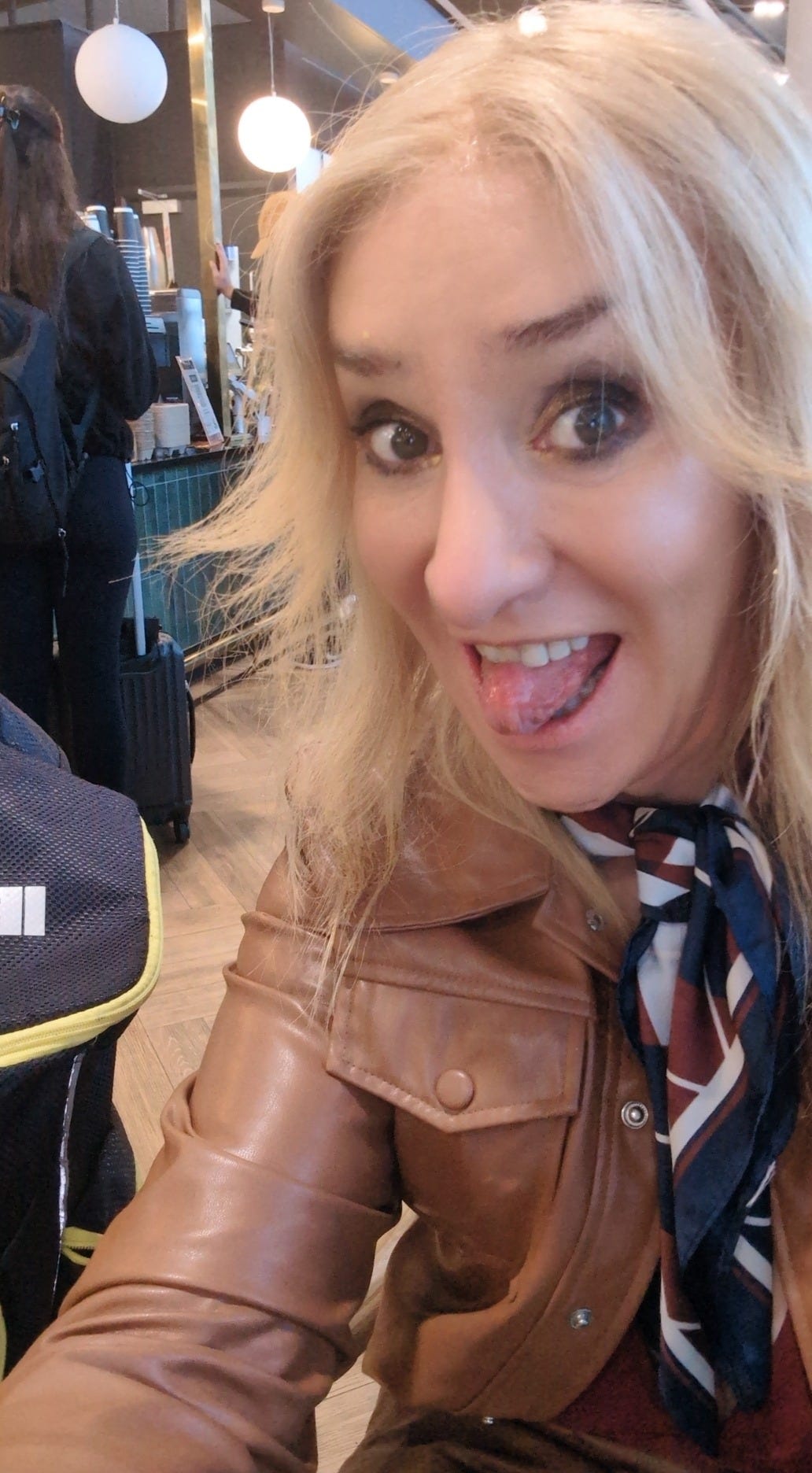
Oh dear God. Here we go again.
What disturbed me was how easy it was, how naturally I slipped back into deceit. Twenty years had passed and apparently my brain still had the entire operating manual.
But thinking about it now, I'm not sure what I felt was shame. I think it was guilt. There is a difference.
I felt horribly guilty about deceiving my wife. I didn't want to intercept parcels or hide things. I didn't want to become that person again, moving objects around the house and maintaining a secret parallel existence. And for those months when she didn't know, the guilt was enormous.
But was I ashamed of wanting the dress? Was I ashamed of Stevie? I don't think I was.
Guilt says: I've done something wrong.
Shame says: There is something wrong with me.
Those are not the same thing.
I remember some of those very early days. I remember sitting watching Taskmaster with my children in the evening, knowing perfectly well what I had been doing that afternoon. I had scrubbed the makeup off so hard that my bloody eyeballs hurt, and now I was sitting there as Dad as though nothing had happened. There was definitely an uncomfortable feeling attached to that. But again, when I examine it properly, I think it was guilt. I was hiding something my wife didn't know about, moving between two worlds and pretending one of them didn't exist. That felt wrong. But was I ashamed that I had spent the afternoon as Stevie? I honestly don't know that I was.
And perhaps somewhere along the line I had managed to pull guilt and shame apart.
But that still leaves the question. Why? Why had the shame gone?
The world had changed. There were about six trans women around my own age whose profiles I saved. I would literally have their pictures open on my monitors and look at them. Not because I fancied them. I was studying the evidence. Could this work? Could I do this? One worked in what looked like high-end finance. Another had been a Marine. They had jobs and lives. They seemed to function perfectly well. They had transitioned, and then gone to work.
That sounds hilariously mundane. Maybe that was precisely why it mattered.
But even that doesn't entirely explain it.
So I'm stuck. And I'm going to do something slightly unconventional.
When I'm trying to understand something about myself and I keep circling the same memories, I sometimes get a frontier language model to interview me. I give it the problem and ask it to interrogate me one question at a time. Sometimes it has been surprisingly useful. Sometimes it produces complete bollocks.
But I genuinely don't know why the shame disappeared. So rather than invent an answer because this is an essay and essays are apparently supposed to have answers, I decided to try the interview.
This is what happened.
Interview
Take yourself back to just before you ordered that first dress. What did you believe was going to happen? Were you thinking about transition, or was there almost no internal negotiation at all?
I think I remember. I really just wanted the dress.
There was something quite specific in the background, though. Throughout my marriage, I had almost never tried on any of Liz's clothes. There was one exception, a beautiful Ted Baker dress sometime around 2016. I tried it on once, realised there was absolutely no chance it was going to fit me, and that was that. I never really did it again.
I think that mattered to me. There was something about buying my own dress that felt more honourable. I wasn't stealing my wife's things or sneaking around in her wardrobe. It was mine. I had chosen it and paid for it. I could tell myself: it's just one dress. How much harm can one dress possibly do?
I certainly wasn't thinking that I was transitioning. It was much simpler than that. I just thought: I really think I'll feel nice if I do this. I think it will feel right. Maybe underneath that I simply wanted to explore the feeling a little bit and see what happened.
When you thought, "I think it will feel right," what did right actually mean? What were you hoping to see or feel when you first looked at yourself wearing it?
That is actually the part I still don't understand. What did "right" mean? I don't know.
I was curious. I wanted to see what I would look like and know how I would feel. And if I'm completely honest, I didn't know whether I would like it or whether some part of me would be repelled by it. That sounds strange now, but it's true. I think I was testing something. Would I look in the mirror and think, oh God, no? Would I find the whole thing ridiculous or somehow repulsive? Or would I like what I saw? I didn't know.
What I did know was that I wanted to see myself looking feminine. I liked the idea of that. Somewhere in there was probably the thought that perhaps eventually I could even look hot. That appealed to me. But I can't give you some profound explanation for why it appealed to me. I just wanted it. I wanted to see what happened when I looked in the mirror and saw something feminine looking back.
When you did look in the mirror, what happened?
I was disappointed.
There was something terribly sad about it because I recognised the person looking back at me. I knew her. Except it was almost as though I had put her into a time machine and she had come out the other end a quarter of a century older.
There were inevitably some what-ifs. What if I had done this then? What if all those years hadn't passed? But strangely, even those thoughts were quite fleeting. I still hadn't really bought into the idea that I was going to do anything about this. I wasn't standing there thinking, right, I'm going to transition. I think I was simply responding to an urge. I wanted to see her again. And when I did, I recognised her.
But time had happened to both of us.
Did you feel ashamed of the person you saw? Or merely disappointed by what time had done?
No. I don't think I felt shame. I felt disappointment, certainly. But more than anything else, I felt sorry for her.
That sounds strange even saying it now, but it's true. I looked in the mirror and thought:
Oh dear God. You've been in here all along, you poor thing.
And I'm not imposing some neat narrative on it afterwards. I genuinely think that was the feeling.
Fuck. Jesus. You never went away, did you? You're still here.
And then another thought followed almost immediately. How did I not see you for all those years? How had I managed to go for so long believing this part of me had disappeared when apparently she had simply been there all along?
This is going to sound horribly poetic, but I think I felt protective of her. I looked at that person in the mirror and felt sorrow for her, not disgust. Maybe that mattered. Instead of looking at this part of myself and thinking, you need to be hidden again, something in me was saying:
This person needs looking after.
When you felt protective of her, who were you protecting her from? Other people? Society? Or were you protecting her from Steve, from the part of you that had shut her away before?
Oh my God. Before I even got to the end of that question, my head was shouting:
Steve.

Steve.
Steve.
That was who I wanted to protect her from. Not the world, not other people. Steve. I didn't want Steve to fucking destroy this person again.
And that feels enormously important now that I say it out loud. For most of my life, whenever Stevie appeared, I had effectively stood on the other side of the room from her. I was the one judging her, frightened of her, trying to control her, contain her, drug her away, sober her away, marry her away, work her away, cure her and eventually convince myself that she had disappeared altogether.
Then I looked in the mirror all those years later and somehow I wasn't standing over there anymore. I was standing beside her. I felt sorry for her. I wanted to protect her.
Maybe for the first time the person I regarded as the threat wasn't Stevie. It was the part of me that might shut her away again.
If Steve was the danger, what did you think he had actually taken from Stevie? What were you mourning for her?
I think there was a dual feeling.
It was time. God, so much time had gone. There was inevitably grief in that. And there was guilt too, because by then I had raised a family. I loved them. I really did love them. Nothing about discovering this other part of myself suddenly made that life false. Those two things can be true at the same time.
But there was something else. I felt sorry for Steve too. I almost wanted to say to him:
Fucking hell, Steve. What did you carry?
Because he carried an enormous amount and never let the world know. He got on with things, built a life, raised a family. And all the while he was carrying something that nobody looking at him could possibly have understood. It wasn't easy for him.
So I don't think I looked backwards and saw a villain who had imprisoned Stevie for twenty years. I saw two people who were actually the same person. I felt sorrow for Stevie because of all the time she had lost, and sorrow for Steve because of what he had needed to do to survive those years.
Bit of everything, really.
You'd spent twenty years being normal, and it had worked. What happened to that?
Not at the exact moment I ordered the first dress. I don't think I had some grand philosophical revelation while clicking "buy". But it didn't take long.
I remember lying in bed and thinking about all the people this could hurt. And then I had this very stark thought.
You are going to be dead for a million years. Nobody is going to care who Stephen David Bennett was. Then you'll be dead for another million years. And another million after that. For the rest of eternity you will simply be gone. With a good wind, maybe you've got thirty years left. Forty if you do spectacularly well.
You have to stop running. You just have to stop running.
That became enormously important to me. And alongside it, another realisation started forming. I had spent years making deals with myself. If I just do this, I'll be happy. If I try this version of life, perhaps I'll finally be happy. And none of the deals ever quite worked.
I had done normal. I had done it extremely convincingly. People thought I was being myself. I absolutely was not. And by this point I had begun to feel like the person in the background of my own life.
So I think releasing Stevie became entangled with something larger. It wasn't simply, I want to wear a dress. It became, I have had enough of disappearing inside my own life. I wanted to cut loose. I wanted to know what being myself actually felt like. And once that feeling started, it became overwhelming.
Did Stevie become possible because you stopped being ashamed of being trans, or because you had finally become more frightened of wasting your life than of being abnormal?
That's difficult to separate because I think the two things blossomed at exactly the same time. I don't think one clearly caused the other. The feeling that I had to stop running, stop living in the background of my own life, that was growing. And at the same time, Stevie was coming back. They seem almost fused in my memory. The more strongly I felt that I couldn't keep living as I had been, the more impossible it became to keep her buried. And the more she came back, the more obvious it became that I had been living a version of my life that was no longer enough.
But none of that meant I instantly accepted what it meant. It took an enormous amount for me simply to say the words to myself: I am transgender. That was a massive threshold.
And bizarrely, there was another one which may have been even harder.
Holy fuck. I'm LGBT.
I really struggled with that. In some ways, I still do. I had spent my whole life regarding that as a world somewhere over there. Then suddenly I had to confront the fact that, whether or not I identified with every part of its culture, I belonged somewhere underneath that enormous umbrella. I'm not sure I have ever completely reconciled myself to that.
So this wasn't a simple story in which I suddenly became liberated and thought, wonderful, I'm trans, everything makes sense. Some parts of accepting myself came remarkably easily. Other words remained incredibly difficult to say. And somehow both things were happening at once.
Why was saying "I am transgender" so difficult?
I knew that once I said it, I would probably act on it. That is my nature. I don't tend to say something important, acknowledge it, and then sit passively beside it for five years. So saying "I am transgender" wasn't simply attaching a label to myself. It meant something was going to happen. Once the words were out, I knew I would probably start moving.
But the extraordinary thing is that once I finally said them, I felt an enormous sense of relief.
Holy fuck. I've given myself permission.
That was what it felt like. Permission. And it felt good.
In fact, once I had said it once, I couldn't seem to stop saying it. There were plenty of days when everyone was out of the house and I would spend the day in my office as Stevie. And I remember going back to the mirror constantly, genuinely perhaps once an hour, looking at myself in whatever I happened to be wearing and saying it again.
I'm transgender. Holy fuck. I'm transgender.
Over and over. It was as though I was testing the words to see whether they still worked. And every time, they did.
Once I crossed that line, it wasn't shameful. It was fucking liberating.
What exactly had you given yourself permission to do?
I think it was permission to embrace it. And perhaps that is much closer to the shame question than I realised.
Because once I said the words "I am transgender", I wasn't merely describing myself. I was giving myself permission to stop fighting it, to stop treating it as something that had to be contained, explained away, postponed or cured. Maybe simply saying it was part of what got rid of the shame.
It felt like a weight lifting. A really big one. Even thinking about that moment now makes me slightly tearful.
Because perhaps I had spent so many years refusing to say the thing plainly that the shame survived inside the refusal. Then I finally said it. I am transgender. And nothing terrible happened inside me. Quite the opposite.

When you remember saying "I am transgender" now, who are the tears for? Stevie? Steve? The years that had gone? Or are they tears of relief?
Relief.
That was the word that came into my head before I even got to the end of the question. Not grief, not pity. Just enormous relief. And with it, calmness. Happiness. It felt as though something inside me had finally stopped fighting.
That is what I remember most clearly now.
Was the shame tied to the constant effort of containing Stevie? Did saying the words finally mean, "I am done containing this. I am going to let it exist"?
I think when you deny something, you deny facing it. You never quite confess it, even to yourself. As long as you don't say it out loud, you can keep circling around it. You can treat it as an urge, a phase, something you once had and might somehow get rid of again.
But once you actually say "I am transgender", there is something almost like lancing a boil. The pressure goes. It deflates.
Because at that point, you would have to be some kind of bloody fool to stand in front of a mirror, say "I am transgender", accept that this is true, and then immediately say, and I fucking loathe transgender people. Or, and I feel deep shame because I am one. Those two positions suddenly became much harder to hold at the same time.
I think that may genuinely be what happened. The shame had survived partly because I had never fully admitted the truth to myself. Once I did, there was nowhere for quite so much of it to hide.
Imagine you could sit beside the Stevie who had just put that first dress on. She is disappointed by the mirror. She is older than she remembers. She has no idea what happens next. What does she need to hear?
You're still a good person.
This is going to be tough, but you're a good person.
Don't forget that.
That's it. I don't think she needed to be told that she was definitely going to transition, or that everything would work out. She needed to know that whatever this was, it didn't make her a bad person. That she hadn't suddenly become something lesser. That she was still good.
And perhaps more than anything else, that was the thing I had finally begun to believe myself.
So, what did we find?
At that point I asked the model to stop interviewing me and tell me what it thought had actually happened. This was its conclusion.
The deepest thing came almost accidentally. When asked what the woman in the first dress needed to hear, you didn't say "you're beautiful" or "it'll all work out". You said: you're still a good person.
That may be the heart of the whole thing. Shame had spent years telling you that Stevie's existence said something about your character. And somewhere along the way, perhaps before you even understood that it had happened, you stopped believing it. You didn't yet know what you were going to do. You didn't know whether you would transition. You weren't even sure you liked what you saw in the mirror. But you had stopped believing that wanting to see her made you bad.
That may be what "no shame" actually meant.
Well.
Fuck.
I genuinely did not think this was going to work. I really didn't. When I started the interview, I thought we would probably uncover a few interesting things. We would wander around some old memories, find a couple of connections I hadn't spotted before, and there would probably be enough mileage in it to justify putting the experiment into the article. I did not think I was actually going to get an answer.
But I think I did.
And irritatingly, having spent all this time trying to find some complicated psychological explanation, the answer sounds almost embarrassingly simple.
I accepted what I was.
That's it. I accepted what I was. I know how bloody obvious that sounds when you read it written down. Of course shame disappears when you accept yourself.
Thank you, Stevie. Groundbreaking work.
But it didn't feel obvious to me. Not at all. I had spent years assuming that something must have happened to the shame. Maybe society had changed enough, or I had seen enough trans women online getting on with their lives. Maybe I had simply got older and stopped caring what other people thought. And I am sure all of those things helped.
But I think the important thing happened inside. I stopped arguing with the fact.
So I said the words again. I'm transgender. Holy fuck. I'm transgender. And it felt good.
Because once I accepted that this was simply true about me, there was another thing I apparently accepted at the same time without ever putting it into words.
It didn't make me a bad person.
That was the bit I couldn't see when I started writing this. And strangely, that is the bit that has made me emotional while writing it now. Because when I was asked what I would say to that frightened, disappointed woman looking at herself in the mirror in her first dress, the answer came instantly.
You're still a good person.
Maybe that is all shame ever really needed from me. Not a political argument or a theory of gender, and not somebody telling me I was stunning and brave. Just permission to stop treating myself as if I had committed some terrible offence by existing.
And I genuinely feel relieved to understand that.
I started writing this essay because there was something about myself that I could not explain. I think I can explain it now.
And if you are reading this with some version of the same thing sitting inside you, something you have spent years hiding, negotiating with, suppressing or feeling ashamed of, I'm not going to pretend that my answer automatically becomes yours. It might not.
But perhaps there is one question worth asking yourself. Not whether everyone else will accept you. Not even, yet, what you are going to do about it.
Just this.
If this thing about me is true, does it actually make me a bad person?
Because perhaps shame starts to lose its grip when the answer is finally:
No.
Jesus Stevie- Tears are flowing this end-Self acceptance for transgender individuals of our generation is one of the g hardest bridges to cross- I am largely across that bridge but its a hard crossing!